Ancient Burial Mound Found at Receding Reservoir
Archaeologists in Nakhon Ratchasima uncovered a Late Prehistoric burial mound at Mun Bon Dam containing human remains, a rare intact 2,500-year-old Phimai Black pottery vessel, and other artifacts exposed by the receding reservoir.
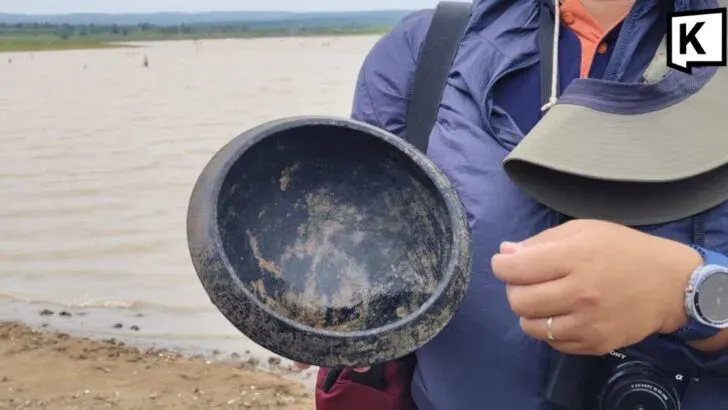
NAKHON RATCHASIMA — On July 9, 2026, the 10th Regional Office of Fine Arts uncovered what is believed to be an ancient burial mound dating to the Late Prehistoric period at Mun Bon Dam, where archaeologists discovered human skeletal remains and a large number of artifacts, including a rare intact Phimai Black pottery vessel estimated to be about 2,500 years old.
On Wednesday, officials from the 10th Regional Office of Fine Arts in Nakhon Ratchasima, led by the head of the Maha Wirawong National Museum and a senior archaeologist, inspected the site after villagers reported finding human skeletal remains and archaeological evidence, particularly pottery fragments, in the middle of Mun Bon Dam at Taling Chan Village (Moo 9), Chorakhe Hin subdistrict, Khon Buri district. They were joined by district officials, staff from the Mun Bon Water Transmission and Maintenance Project, and local community leaders. The inspection followed a continued decline in the reservoir's water level, which exposed the site.
Officials initially discovered an intact Phimai Black ceramic vessel resembling a bowl or alms bowl, measuring about 15 centimetres in diameter and estimated to date from approximately 2,500 to 1,500 years ago. Numerous human skeletal remains were also found nearby.
Additional archaeological evidence from the same period included orange glass beads, iron tools, earthenware pottery, and polished stone axes. Several buried earthenware vessels believed to have been placed as grave goods were also uncovered. The discovery area has been designated "Mun Bon Dam Archaeological Site 1."
Based on preliminary assessments, officials believe the site was an ancient burial mound from Thailand's Late Prehistoric Iron Age because of its elevated position beside an ancient waterway. It may represent the closest prehistoric burial site ever discovered near the headwaters of the Mun River.
Wannapong Palakawong Na Ayutthaya, an archaeologist with the 10th Regional Office of Fine Arts, said the site contains clear evidence of a burial mound used by Late Prehistoric people.
"The most remarkable discovery at Mun Bon Dam Archaeological Site 1 is the intact Phimai Black vessel because archaeologists usually recover only broken fragments of this type of pottery," he said. "The complete vessel allows us to make a relatively reliable preliminary estimate, placing the site in the Iron Age of the Late Prehistoric period, approximately 2,500 to 1,500 years ago."
He added that Phimai Black pottery is typically found throughout the upper Mun River basin but has not previously been documented this close to the river's headwaters. Wannapong said the site appears to be a significant burial mound. Further archaeological research could provide valuable new insights into the prehistoric communities that once inhabited Khon Buri district.