Anutin Orders Faster Cross-Border Pollution Fix, Myanmar Talks Set
Deputy Prime Minister Anutin Charnvirakul has ordered the Ministry of Natural Resources and Environment to speed up solutions for cross-border water pollution from Myanmar. A joint Thailand-Myanmar working group will meet in Bangkok on November 25-26 to address contamination in the Kok and Sai Rivers, with Thailand pushing for more monitoring stations and joint action plans. Recent tests show arsenic levels in the Sai River have dropped significantly, but continuous monitoring continues.
Deputy Prime Minister Anutin Charnvirakul has instructed the Ministry of Natural Resources and Environment to accelerate efforts to resolve cross-border pollution, coordinating with Myanmar for a meeting on November 25-26 to inspect water quality and address problems at their source, enhancing public safety.
On November 18, 2026, Dr. Rawiwan Phuridech, Permanent Secretary of the Ministry of Natural Resources and Environment, disclosed that the government under Prime Minister and Interior Minister Anutin Charnvirakul places importance on public health and quality of life, particularly water quality in the northern region. He assigned Minister of Natural Resources and Environment Surachat Chomklin to urgently drive solutions for cross-border pollution together with the Myanmar government, aiming to manage problems at their source alongside close environmental monitoring and public safety protection.
This cooperation progressed after Deputy Prime Minister and Foreign Minister Sihasak Phuangketkeow visited Naypyidaw, Myanmar on November 12, meeting with Senior General Min Aung Hlaing, Chairman of the State Administration Council of Myanmar, to push for resolution of pollution in the Kok and Sai Rivers. The schedule for the 1st Thailand-Myanmar Joint Working Group on Water Quality Management was accelerated from early December to November 25-26, 2026 in Bangkok to reach conclusions and establish joint operational guidelines.
The meeting will be co-chaired by Dr. Rawiwan Phuridech of Thailand and Mr. HLA MAUNG THEIN, Permanent Secretary of Myanmar's Ministry of Natural Resources and Environmental Conservation, with representatives from relevant agencies of both countries. Discussions will cover water quality monitoring, academic data exchange, surveillance enhancement, and driving pollution solutions from the source.
Thailand's key proposals include requesting additional water quality monitoring stations and related parameters in the Sai and Kok Rivers on the Myanmar side for more comprehensive and accurate situation assessment. Additionally, an operational workshop will be held to draft joint action plans for both short-term (1 year) and long-term (3 years), while pushing for early joint field visits. Meanwhile, Myanmar will visit the Pollution Control Department's environmental laboratories to exchange knowledge on water, air, and waste analysis and management.
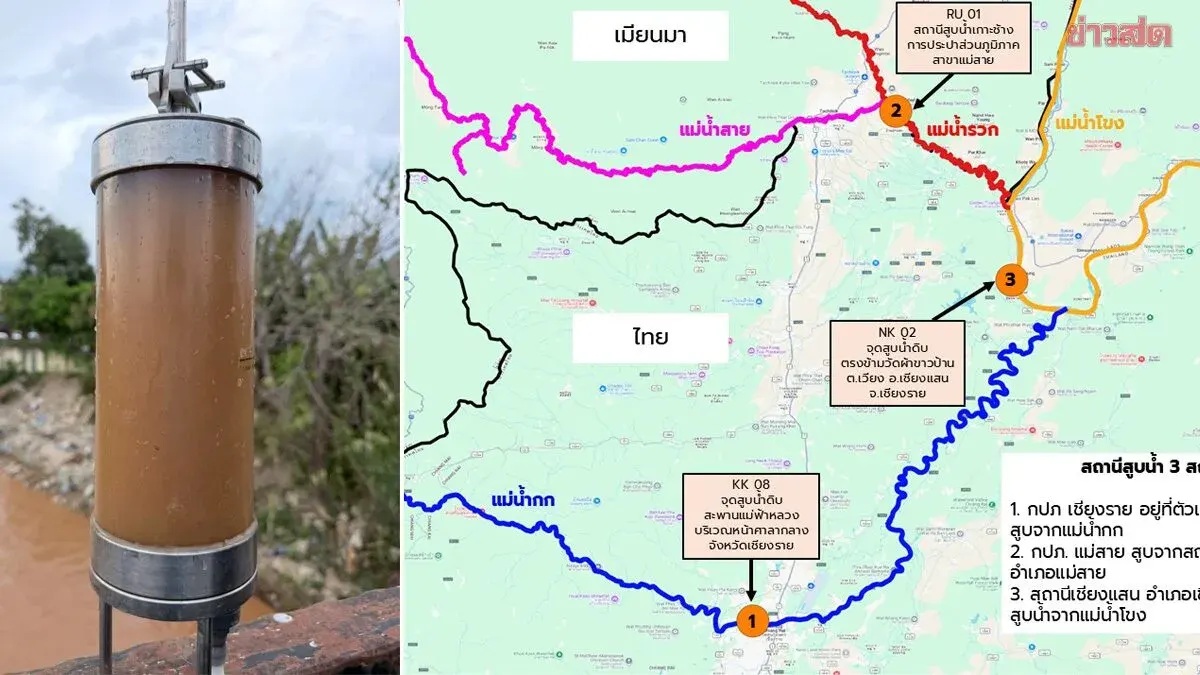
Dr. Surinth Warakijthamrong, Director-General of the Pollution Control Department, stated that the department has continuously monitored water and sediment quality in the Kok, Sai, and Ruak Rivers in Chiang Mai and Chiang Rai since 2025, with 22 automatic water quality monitoring stations covering 9 parameters.
In November 2026, field inspections at Ban Hua Fai on the Sai River using field test kits found arsenic at approximately 0.017 mg/L, down from a previous reading of 0.284 mg/L. The department will continue collecting water and sediment samples for laboratory analysis to assess the situation and communicate accurate, science-based information to the public.
Meanwhile, the Ministry is preparing water supply readiness to alleviate concerns and care for affected communities, integrating backup water sources and mobile Reverse Osmosis (RO) water production trucks for areas in need.