Editorial – The Land Bridge Project
Thailand's government is moving forward with the Land Bridge Project to establish itself as a regional logistics hub, but faces scrutiny over environmental impacts, local community effects, and decision-making transparency from opposition M
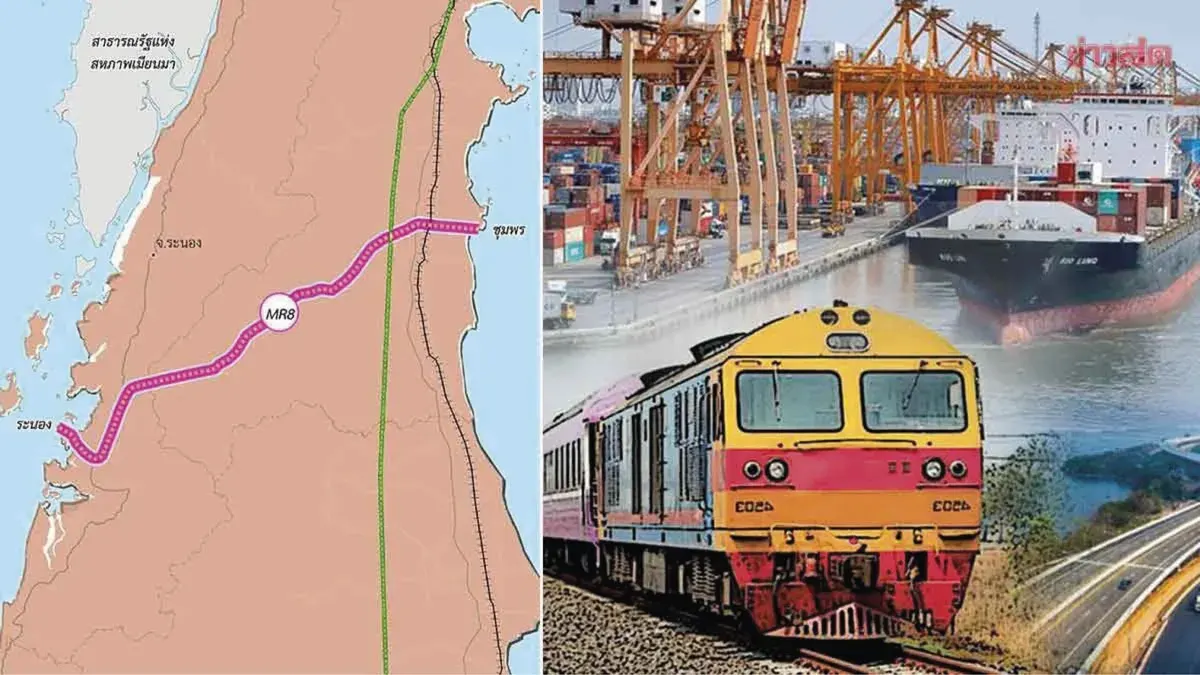
The government's announcement to move forward with the Land Bridge Project under Prime Minister Anuthín Charnvirakul, promoted as a flagship policy to elevate Thailand as a regional "logistics hub" and strengthen its negotiating power in global trade amid geopolitical tensions and maritime shipping constraints that are critical bottlenecks in the world economy.
The government emphasizes this is not a new concept but has undergone continuous study for six years since the Prayut Chan-o-cha administration, through the Srettha Thavisin government, to the current administration. Policy and planning agencies have reached a consistent conclusion that it has economic merit.
The government has also established a public-private partnership investment model to avoid burdening the national budget and points to foreign investor interest as important momentum.
Nevertheless, opposition voices from opposition MPs, some senators, and local residents cannot be ignored. Questions range from long-term value and environmental risks to impacts on local communities and decision-making transparency.
While the government asserts every step must undergo thorough analysis before cabinet consideration, public confidence cannot rest on assurances alone. It must be built on evidence and genuine participation.
Moreover, while the Southern Economic Corridor concept, modeled after the Eastern Economic Corridor, has potential to spread prosperity, the government must answer whether development will avoid repeating problems of inequality, benefit concentration, and natural resource impacts.
The government's challenge is not merely to push the project forward but to build trust across all sectors, fully disclose information, address concerns with verifiable reasoning, and genuinely involve the public.
Lessons from past large projects show that even if financially sound, without public acceptance, projects struggle to proceed smoothly. Resulting conflicts and social costs may exceed anticipated benefits.
Not only the Land Bridge Project, but all large projects require the government to understand and listen to public concerns. The government must communicate continuously at every stage for transparency and to confirm that all its policies truly serve the country and people's interests.