PM Anutin, Xi Agree on Rice Trade, Cross-Border Water Pollution
Prime Minister Anutin Charnvirakul met with Chinese President Xi Jinping in Xiamen to strengthen bilateral ties, securing agreements on a 500,000-ton rice purchase, joint action on cross-border water pollution, and high-quality Chinese investment in advanced industries. The leaders also pledged deeper cooperation against online scams, accelerated railway connectivity, and coordinated efforts on regional peace in Myanmar and Cambodia.
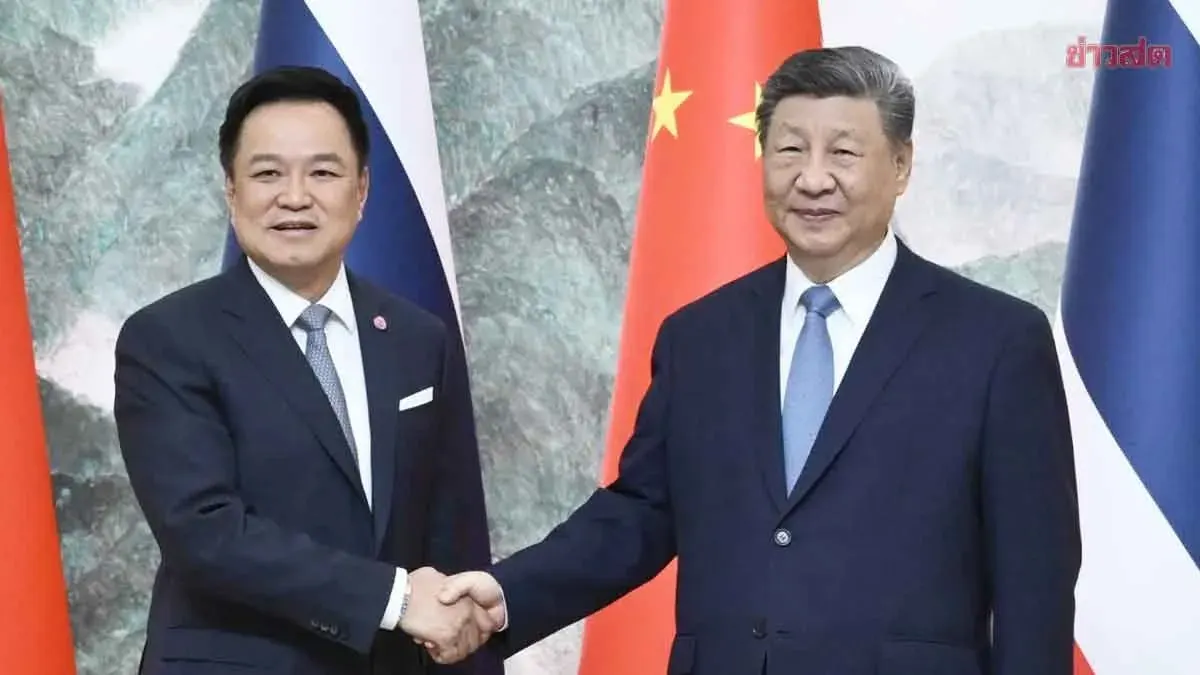
Prime Minister Anutin Charnvirakul led a full delegation for bilateral talks with Chinese President Xi Jinping in Xiamen, People's Republic of China, on November 20, 2026, following the 33rd APEC Economic Leaders' Meeting. The meeting aimed to strengthen the comprehensive strategic partnership and follow up on the outcomes of Chinese Premier Li Qiang's official visit to Thailand the previous week, reflecting the close ties between the two nations and the Prime Minister's determination to translate cooperation into concrete results — particularly resolving water pollution affecting the public, alongside creating economic opportunities, enhancing security, and promoting regional peace for the mutual benefit of both peoples.
The Prime Minister emphasized the importance of addressing cross-border water pollution that impacts the environment and quality of life, proposing that the issue be included in the upcoming Mekong-Lancang Cooperation (MLC) Leaders' Meeting in Kunming this December.
President Xi affirmed that China does not support any activities that damage the environment and pledged to cooperate with Thailand in addressing toxic substances in rivers, supporting technical operations to systematically increase monitoring, tracking, and remediation of water quality.
On economic and investment cooperation, both sides agreed to promote high-quality Chinese investment in Thailand through a "co-create" value-sharing model in advanced industries such as digital technology, clean energy, space technology, and electric vehicles. They also committed to balanced trade, expanding markets for Thai products via Geographical Indication (GI) registration and online platforms, and pushing for the purchase of 500,000 tons of Thai rice. Additionally, they agreed to accelerate development of the China-Laos-Thailand railway connectivity toward Malaysia and Singapore, including the second Nong Khai-Vientiane railway bridge and the Chiang Khong-Nateuy-Mohan route.
On security, the leaders agreed to elevate cooperation in combating transnational crime, particularly online scam networks. The Thai government places the highest importance on the safety of tourists of all nationalities and is ready to cooperate with China in disseminating accurate information to build confidence among Chinese visitors.
Regarding regional and international cooperation, the Prime Minister supported China's constructive role in promoting regional peace and stability based on international law and ASEAN centrality, as well as cooperation on safe and accessible AI. Both sides also coordinated on supporting peace in Myanmar and reaffirmed Thailand's commitment to resolving issues with Cambodia through peaceful negotiation under international law, while supporting China's role in biodiversity conservation.
Thailand will also advance domestic processes to join the BBNJ Agreement and expressed readiness to consider joining the International Organization for Mediation (IOMed), while seeking China's support for nominating the Thai costume as a UNESCO Intangible Cultural Heritage of Humanity.