During King Rama V's reign, bicycles symbolized wealth and status among Thai royalty before becoming fashionable among the upper class, a trend captured in the novel "Four Reigns" by Sansanee Veerasil Chai.
E-books have become essential for book lovers and readers today, offering convenience, simple navigation, and the ability to read anywhere with internet access without taking up physical shelf space.
This week's bookstore feature highlights these interesting e-books:
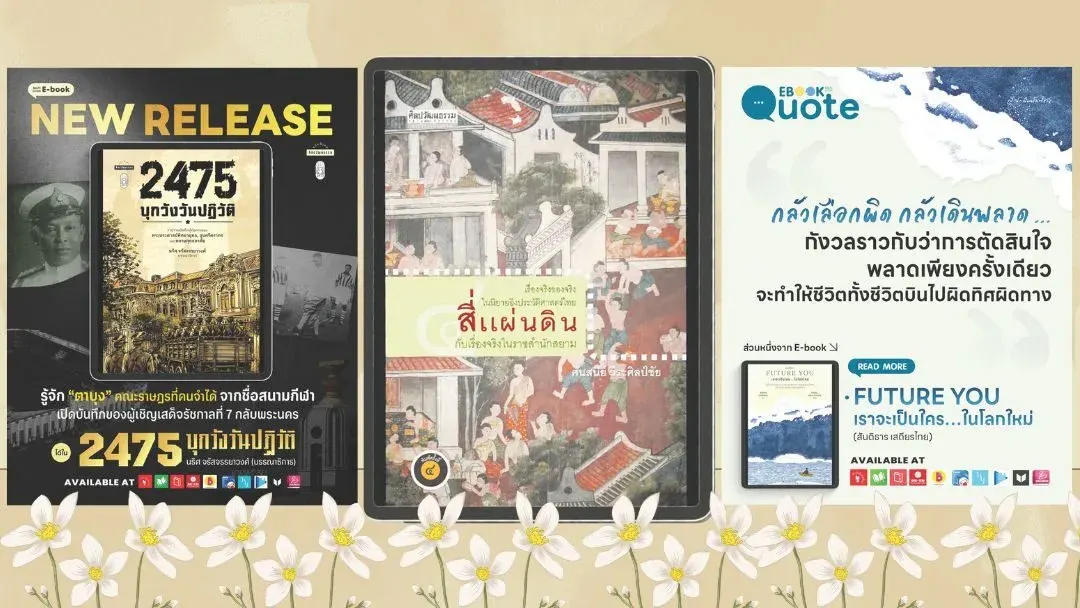
"Four Reigns" and True Stories from the Siamese Royal Court by Sansanee Veerasil Chai
Bicycles have recently become increasingly visible as public bike-sharing systems expand and health and wellness trends surge, making them both a quick mode of transport and an effective exercise tool. However, in the past—particularly during King Rama V's reign—bicycles held a different status as a symbol of social standing and wealth. Bicycles were among the fashionable items that palace residents enjoyed, originating in the Western world around 1837. When they spread to Thailand during King Rama IV's era via Christian missionaries, palace staff during King Rama V's time had the opportunity to ride them, creating a fashion that soon spread among upper-class society. Not owning one's own bicycle even became a matter of embarrassment.
This craze for bicycles is reflected in the literary work "Four Reigns," which describes competitions over vehicles—whose was better than whose—and aligns with historical evidence. Letters from Queen Sukhumala Marasri instructed Prince Boriphat Sukhumphon, who was studying in Germany, to purchase bicycles, specifically requesting: "Mother is asking her son to find a bicycle for her—one that is of good quality and as light as possible."
This fashion for bicycles during King Rama V's limited circle eventually evolved and spread beyond palace walls to ordinary people, eventually becoming the beloved vehicle and exercise tool many enjoy today. Read about the origins of the bicycle and the enduring "craze" in "Four Reigns" and True Stories from the Siamese Royal Court by Sansanee Veerasil Chai.
2475: The Palace During the Revolution by Narit Charusjranyavong, Editor
When people hear the name "Suphachalai," many think of the national stadium that has hosted major sports and entertainment events. Yet few know that "Suphachalai" is also connected to one of the 2475 Revolution's key figures, who played an important role at the Klaikangwon Palace by meeting with King Prajadhipok (Rama VII). This is evident in the records of Mom Chao Poon Pismai Diskul: "There was a discussion with Luang Suphachalai (Uncle Suphachalai), a naval officer who commanded the warship to escort the King back from Hua Hin. He said Luang Supha drank and went aboard the warship with a flushed face, yet when he saw the King, his hands trembled and his speech was halted."
Beyond his role in Thai political history, "Uncle Bunga" was also instrumental as a People's Party member in modernizing Thai sports, serving as the first Director of the Physical Education Department. The stadium's name thus commemorates not just a sports pioneer, but also reflects the People's Party era's policy of using sports to promote public health and national strength through the power of the people.