Sin Tax Health Funding Delivers 118-Fold Return, Academics Confirm
ThaiHealth's sin tax funding yields 118-fold social return, with academics citing 8.6 million quit drinking and 1
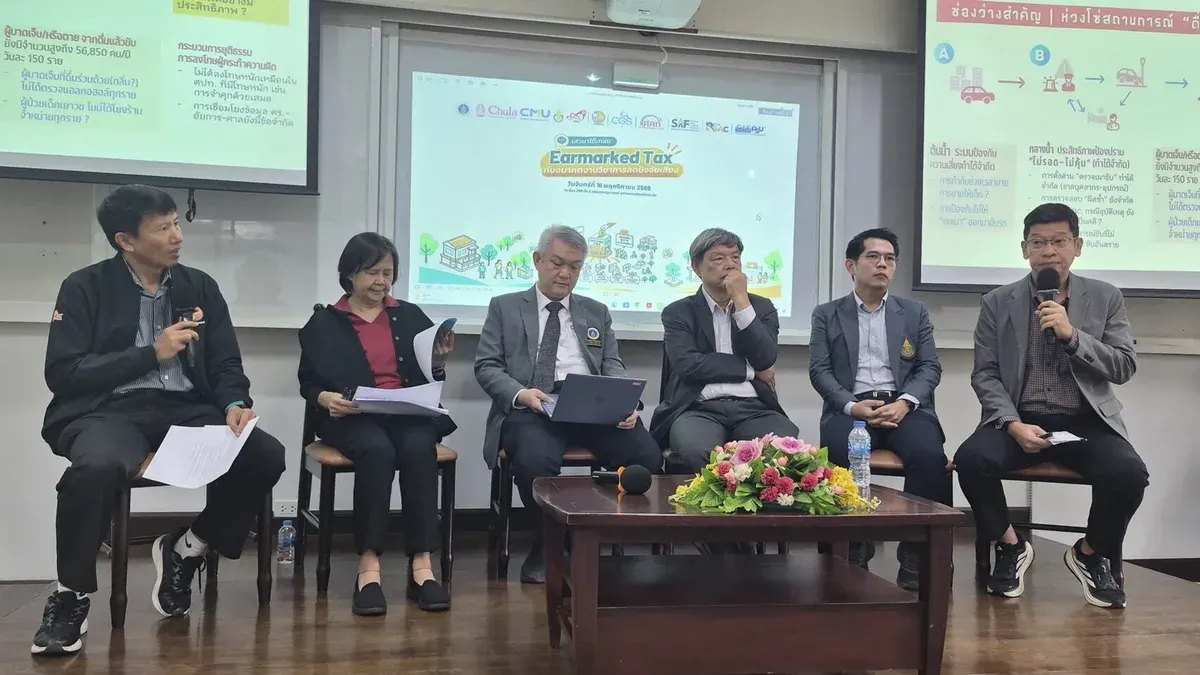
Academics voiced support for using "sin tax" revenue to protect public wellbeing through research grants from the Thai Health Promotion Foundation (ThaiHealth). They cited evidence from 20 years of anti-alcohol campaigns showing 8.6 million people quit drinking, household savings of 150 billion baht, nearly 140,000 fewer smokers in three years, and total benefits exceeding 130 billion baht. Every baht invested by ThaiHealth yields 118 baht in social value.
November 16, 2026 – Assoc. Prof. Dr. Witya Kulsomboon, a ThaiHealth board member, spoke at a roundtable titled "Earmarked Tax and the Future of Academic Work on Risk Reduction." She stated that "health taxes" or "earmarked taxes" are critical to public policy, fiscal economics, and the direction of Thai societal wellbeing.
"In economics and public finance, we usually talk about tax as revenue for the treasury. But the earmarked tax mechanism — specific taxes on health-harming products, or sin taxes, that ThaiHealth has driven for two decades — has a deeper definition."
Following World Health Organization and World Bank principles, using earmarked taxes from alcohol and tobacco is considered a "policy innovation" designed to correct market failure from negative externalities. Money from consuming health-damaging products is recycled into "intellectual capital and social capital" to protect public health — a closed loop that turns harm into a social shield.
The key question: how do we know taxpayer money is used cost-effectively and on target? The answer lies in "evidence-based policy." Financial support cannot create sustainable change without rigorous academic work guiding it. Major academic centers — the Gambling Studies Center, the Road Safety Academic Center (RSAC), the Tobacco Control Research and Knowledge Management Center (TRC), the Alcohol Research Center (ARC), and the Substance Abuse Academic Foundation (SAAFTH) — produce not just reports gathering dust, but living academic work that saves lives, reduces hospital bed occupancy, and generates massive economic value for the nation.
"Thai society faces new, complex, fast-moving, borderless risk factors: online gambling, new-form nicotine e-cigarettes, speeding, drunk driving, and alcohol and drugs repackaged as lifestyle products. Meanwhile, the earmarked tax mechanism itself faces questions of efficiency, transparency, and governance. Today's forum aims to jointly sketch a 'future vision' for how Thailand's academic work on risk reduction can stand firm, adapt, and create powerful policy innovations."
Asst. Prof. Dr. Phalet Wijitkunakorn, Director of the Alcohol Research Center (ARC) at Songkhla University, noted that the 2% surcharge from alcohol and tobacco excise taxes allocated to ThaiHealth supports not only campaigns but also data systems and comprehensive risk-factor research to underpin evidence-based public policy.
Preliminary study findings evaluating the cost-effectiveness of alcohol control investment through ThaiHealth from 2002 to 2021 found that every 1 baht invested...