Thailand Imposes Strict Diving Rules to Protect Coral Reefs
Thailand has enacted strict new diving regulations to protect coral reefs from tourism damage, effective April 22, 2025. The 11 rules require certified dive controllers to accompany all tourist dives, mandate life jackets for shallow dives, and set supervision ratios based on dive type. With the dive tourism market growing 12% annually and valued at 8.5 billion baht, officials warn that uncontrolled tourist behavior — trampling, standing on coral, and fin kicks — could destroy the reefs that sustain the industry.
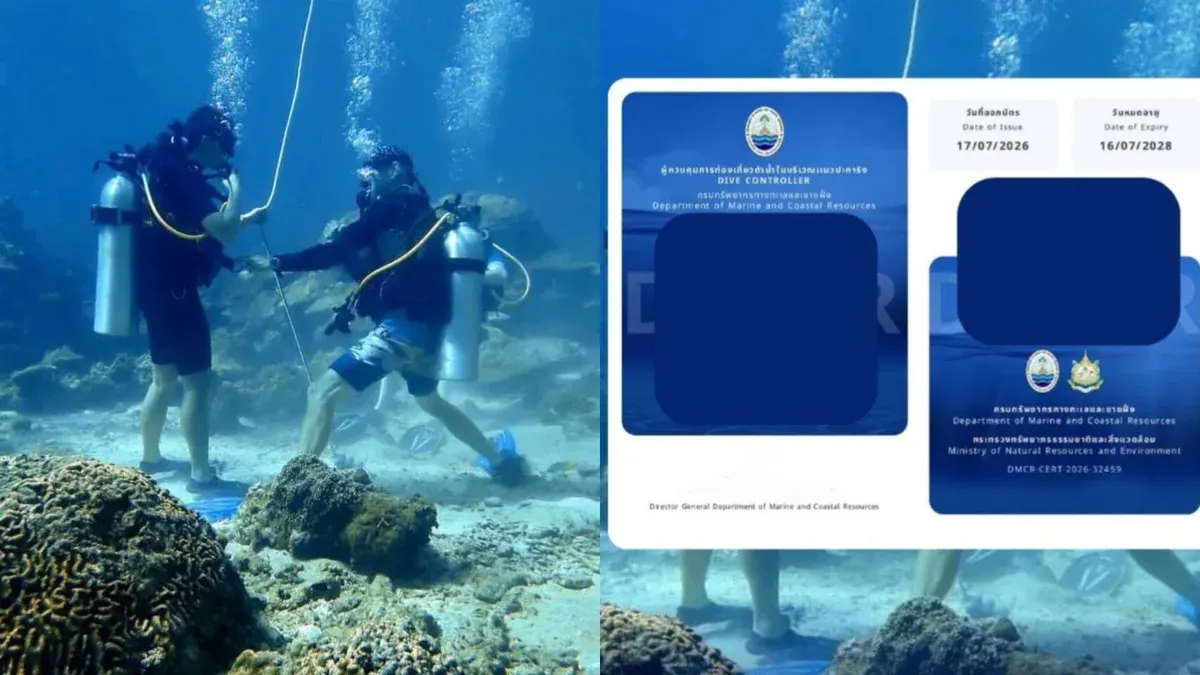
The Department of Marine and Coastal Resources is enforcing new "iron rules for diving" to shield coral reefs from tourism damage, underscoring the critical importance of protecting reefs in the Andaman Sea and Gulf of Thailand that draw millions of visitors enchanted by their beauty — reefs now crying out for help from the scars of trampling, fin kicks, touching, broken branches, and tourists standing on fragile coral for photos.
"Let's do a rough calculation for a single day at Racha Island, Phuket, during the absolute peak of high season: there will be 50 to 70 boats, each carrying an average of 20 tourists to dive and view coral. If just 1 to 10 percent of them accidentally break coral branches or stand on the reef for pictures, how much damage will that cause?" said Pariyaphorn Wai-prip, nicknamed "Pum," a senior fisheries specialist with the Marine Resource Conservation Division of the Department of Marine and Coastal Resources. She and Rawiporn Bunman, a fisheries professional, have played key roles in advancing coral protection from law into practice.
Pariyaphorn explained that DMCR data shows the main problem with dive tourism in the past was tourists' lack of basic knowledge. When tour boats or dive instructors brought tourists to coral viewing sites, they entered the water without close supervision. Many did not realize coral is not rock but a living "marine animal" that forms a fragile home, a source of marine life, and a nursery for juvenile aquatic species.
"If dive activities are allowed to proceed without direction, they will impact the ecosystem. Marine life loses habitat. Reefs break from trampling, photo-standing, or fin strikes from novice divers, plus sediment stirred up spreads and smothers coral until, ultimately, it may kill the tourism golden goose. When coral dies and turns into rubble, tourists stop coming, directly affecting the economy and the country's revenue generation."
The Tourism Authority of Thailand projects Thailand's dive business market value will grow continuously at about 12 percent per year, surpassing 8.5 billion baht. Hotspot dive-training coordinates include Koh Tao, Koh Phangan, and Koh Samui in Surat Thani; Racha Island in Phuket; and the Chonburi coastal stretch.
These reasons prompted the Ministry of Natural Resources and Environment to issue the Ministerial Regulation on Measures to Protect Coral Resources from Dive Tourism Activities B.E. 2568, which took official effect on April 22, 2025, to curb degradation before world-class tourist sites are permanently damaged.
The heart of this announcement, Rawiporn explained, is 11 key regulations — new for dive tourism — that strictly define the duties of operators and controllers. Especially "Clause 4," "Clause 5," and "Clause 6" are the core of reef protection.
Simply put, the first part assigns duties to the dive tourism controller or operator: the operator must have a "dive controller" accompany tourists every time, and life jackets must be worn for every shallow dive. The second part assigns duties to the controller and assistant dive controller, who must control dive tourism activities in coral reef areas and must hold a "Dive Controller Card" earned through a specialized DMCR training course.
Rawiporn said to make these measures truly actionable, DMCR also established a five-tier system for cardholders based on dive type and tourist ratios, as follows: deep diving...