Kasetsart University Unveils 4X Basil Research, 14,000 Vegetable Accessions
Kasetsart University hosted a public forum on October 29 to discuss 'Kaeo Juree 01-04,' a new tetraploid (4X) holy basil variety developed through chromosome doubling in collaboration with CPRAM for the frozen food industry. The event brought together government, industry, farmer groups, and civil society to address plant variety protection, benefit-sharing, and conservation of over 14,000 vegetable accessions. Researchers confirmed the 4X basil shows no cross-pollination with conventional diploid varieties in trials, easing genetic contamination concerns.
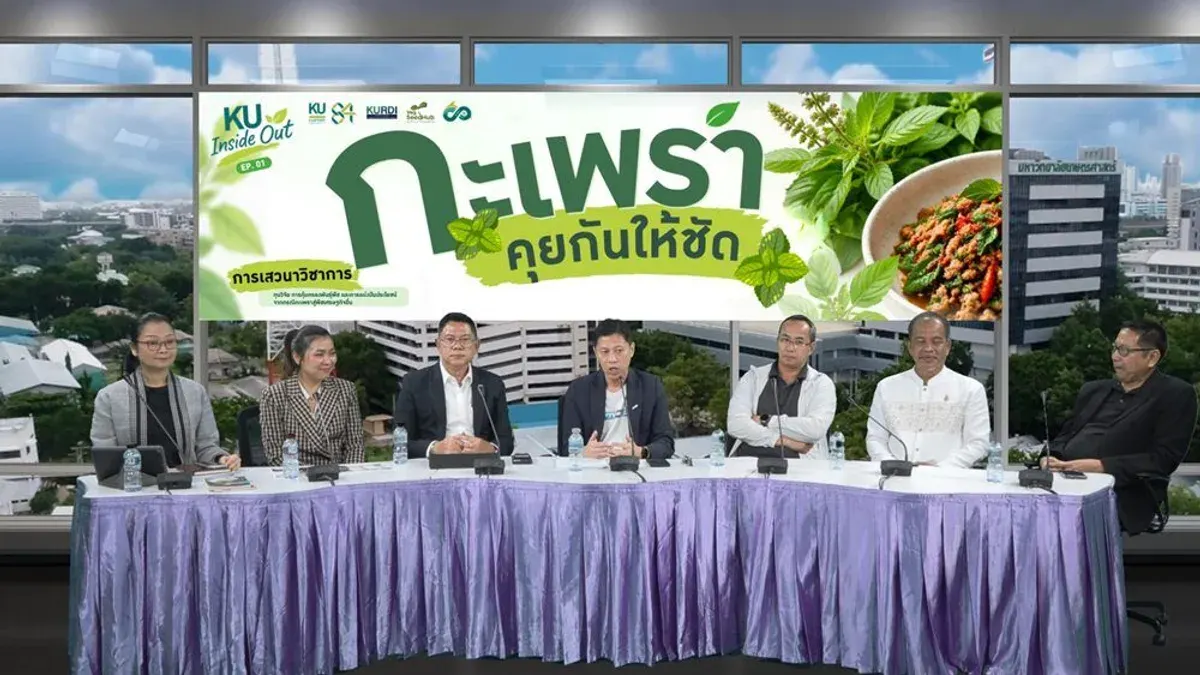
Kasetsart University opened the forum 'Ka Prao...Let's Talk Clearly,' revealing behind-the-scenes of 4X basil research and showcasing conservation of over 14,000 vegetable accessions to benefit Thai farmers.
On October 29, Kasetsart University hosted KU Inside Out EP.01 'Ka Prao...Let's Talk Clearly,' gathering researchers from government, private sector, farmer councils, and civil society to exchange information behind the development of 'Kaeo Juree 01-04' basil — from research origins and chromosome doubling techniques (4X) to plant variety protection guidelines and benefit-sharing. The forum also presented the potential of conserving over 14,000 vegetable accessions to drive research for farmer and societal benefit.
It opened space for representatives from multiple sectors to exchange data and opinions on the 'Kaeo Juree 01-04' basil case, which connects agricultural research and innovation, genetic resource utilization, plant variety protection, and farmer rights and benefits, aiming to build understanding based on scientific data and facts. This forum included Kasetsart University researchers, Department of Agriculture representatives, private sector, National Farmer Council, and BIOTHAI Foundation, exchanging views covering research origins, industry collaboration, scientific breeding processes, cross-breeding concerns, and Access and Benefit-Sharing (ABS) guidelines, aiming to promote innovation, biodiversity conservation, and protection of all stakeholders' rights.
Origin of 'Kaeo Juree 01-04': Developing 4X Basil for the Food Industry Associate Professor Dr. Sutkhet Nakasathien, Department of Field Crops, Faculty of Agriculture, Kasetsart University, and Assistant Professor Dr. Chatchamart Kanchanaupatham, Head of the Tropical Vegetable Research and Development Center, Kasetsart University Kamphaeng Saen Campus, recounted the story of 'Kaeo Juree 01-04' basil. It originated from collaboration between Kasetsart University and CPRAM Co., Ltd., where the private sector provided local basil seeds for the university to research and improve, yielding basil suited for the frozen food industry — in leaf size, leaf thickness, and aroma retention. The research used polyploidy techniques to develop basil with four chromosome sets (4X) through selection and testing of volatile aroma compounds, resulting in four genetically stable lines. Researchers clarified this work improves varieties to meet industrial demand while the university continues conserving and developing other basil genetic resources. For instance, basil accession OC034 is a genetic resource collected by Kasetsart, used as a parent line to develop KU034-C8-24, another university-bred variety, reflecting how conserved genetic resources are translated into agricultural knowledge and research outputs.
Regarding concerns about cross-breeding and genetic contamination, the research team reported that Kaeo Juree basil underwent chromosome doubling to 4X, while common basil is 2X. Experimental crosses between the two groups, both in laboratory and field trials, have not produced seed set.
These experimental results provide scientific data that...