Anutin Clarifies US Trade Statement Not Binding Agreement
Deputy Prime Minister Anutin Charnvirakul clarified that Thailand's joint statement with the US on reciprocal trade is not a binding trade agreement. He emphasized the document only outlines a framework for future negotiations and that Thailand's trade surplus and market access with the US remain protected. Anutin said the terms mirror standard reciprocal provisions in Thailand's other free trade agreements.
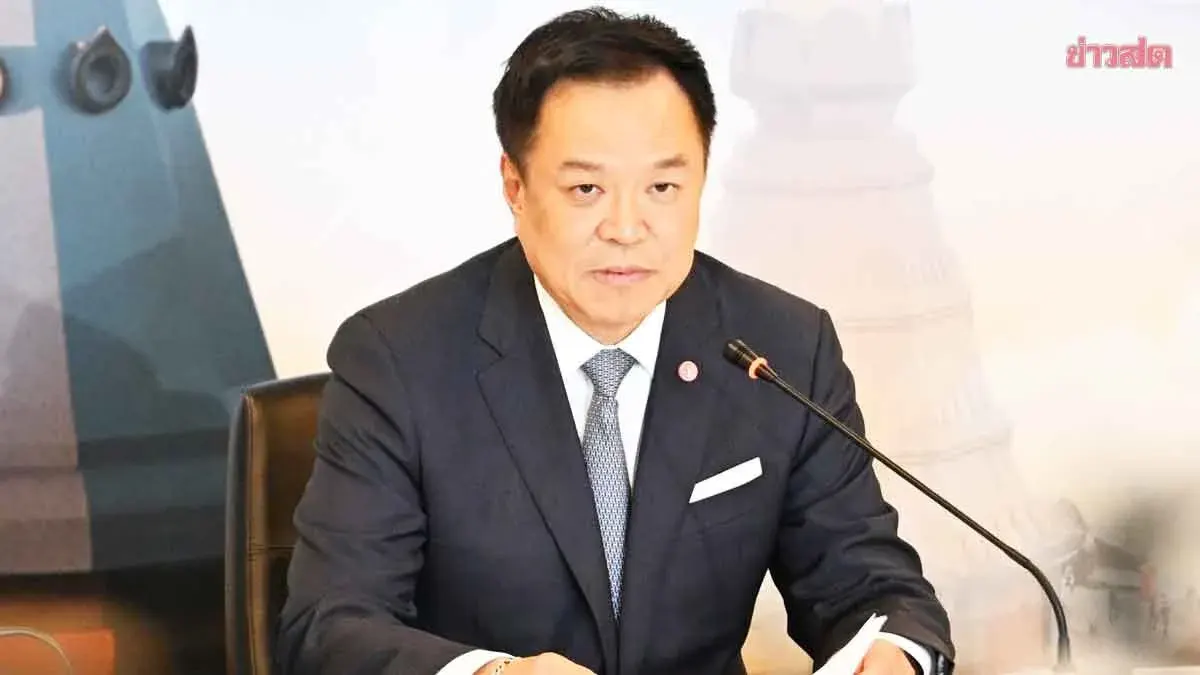
At 3:40 p.m. on November 20, 2026, at Wing 6 Don Mueang Air Force Base, Deputy Prime Minister and Interior Minister Anutin Charnvirakul addressed the signing of the Joint Statement on an Agreement Between the United States of America and the Kingdom of Thailand on Reciprocal Trade (ART) with US President Donald Trump.
Anutin said public attention has focused on the joint signing, but he stressed it remains only a joint statement, not the signing of a reciprocal trade agreement between Thailand and the US. He noted considerable confusion in news coverage and commentary from various sectors, but the reality differs. Benefits remain in Thailand, and the principle of a reciprocal trade agreement — derived from 'Agreement from Reciprocal Trade' — means mutual concessions: Thailand gives concessions, and the US gives concessions in return.
The negotiation principle is to preserve Thailand's number one export market, the United States, where Thailand enjoys a trade surplus. This generates revenue to expand and develop the country and broaden the domestic production base. Thailand must retain this customer base and not lose it to competitor nations.
The Prime Minister added that the agreement ensuring US goods are not disadvantaged relative to other countries is reciprocal: Thailand must allow US products market access. This mirrors terms in FTAs Thailand signs with other regional blocs, with no special exemptions granted to any partner, largely adhering to reciprocal trade principles.