Japan's Big Six Automakers Commit 1.34 Trillion Baht to Thailand
Deputy Prime Minister Ekniti Nitithanprapas secured investment pledges totaling over 1.34 trillion baht from six major Japanese automakers during talks in Tokyo. The five-year commitments from Toyota, Honda, Isuzu, Mitsubishi, Mazda, and Nissan aim to transform Thailand into a production hub for hybrids, electric pickups, and hydrogen vehicles. A new excise tax structure will impose a 35% rate on imported BEVs and REEVs without local production from January 2027, while offering incentives tied to domestic investment, jobs, and parts sourcing.
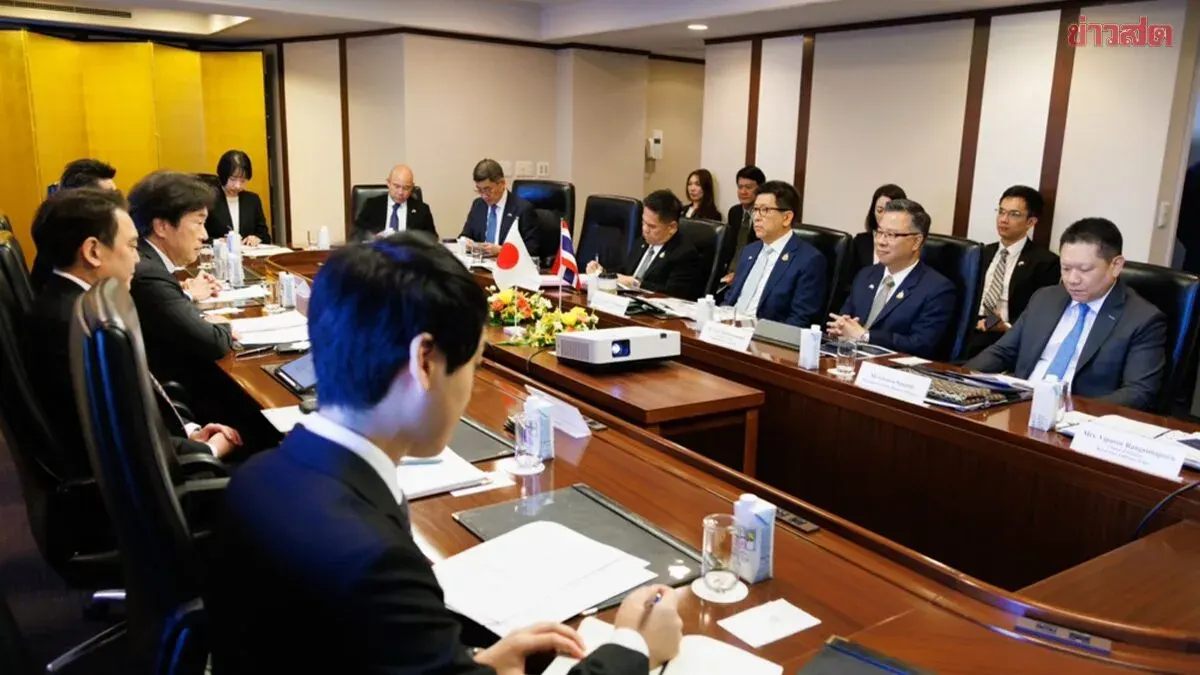
Deputy Prime Minister and Finance Minister Ekniti Nitithanprapas led a delegation in talks with six Japanese automakers — Toyota, Honda, Isuzu, Mitsubishi, Mazda, and Nissan — in Tokyo on November 20, 2026, to explain the new automotive excise tax structure and hear investment plans. The six companies jointly announced investment commitments exceeding 134,000 million baht (1.34 trillion baht) between 2026 and 2030 to upgrade Thailand's production base for next-generation vehicle technologies.
Ekniti stated the new excise tax framework will support long-term investment and local parts usage. Imported battery electric vehicles (BEVs) and range-extended electric vehicles (REEVs) without a production base in Thailand will be taxed at 35% from January 1, 2027. Meanwhile, vehicles imported by manufacturers with Thai production bases, as well as locally assembled vehicles, will follow a tax structure linked to investment levels, job creation, and domestic parts usage, with further details to be finalized after stakeholder consultation.
"The government aims to create fair and equal competition across all technologies, with incentives tied to investment and benefits to Thailand — including technology transfer, employment, skills development, local parts usage, and supply chain resilience," Ekniti said.
On specific investment plans: Toyota will expand its vehicle and pickup production in Thailand to support hybrids (HEV), battery electric vehicles (BEV), and hydrogen fuel cell vehicles (FCEV), notably developing Thailand as a global export base for new FCEV pickups. Isuzu will maintain its pickup and commercial vehicle production and export base while developing BEV pickups, FCEV trucks, promoting B20 biodiesel, and preparing to test B30. Honda will accelerate new model development, particularly Smart Hybrid technology combining hybrid systems with smart car features. Mitsubishi will invest in HEV and plug-in hybrid (PHEV) technology for pickups and PPV SUVs. Mazda will develop mild hybrid (MHEV) production lines, increase automation, and prepare for future BEV production. Nissan will expand supply chain investment and Thai workforce development to strengthen its production base competitiveness.
Japanese executives also requested flexibility on compliance timelines for critical e-Parts requirements for HEVs and component-set localization rules for BEVs, allowing manufacturers to adapt production lines and develop Thai supplier networks in step with technology changes. Ekniti tasked the BOI with coordinating relevant agencies to study the proposals.
Additionally, a trade-in scheme to revive the domestic market — especially the sluggish pickup segment — was proposed under an "old-for-new" vehicle replacement program.