Prachinburi River Turns Black, Locals Suspect Chemical Pollution
Black, foul-smelling water has contaminated the Prachinburi River after the Irrigation Department opened a drainage gate releasing water from nearby rice fields. While government officials claim the discoloration and odor come from rotting grass, local residents insist the water contains chemicals, citing an unbearable stench and drawing parallels to a previous pollution case at Sri Maha Pho where chemical contamination was confirmed. The acting governor has ordered water testing, but locals allege samples were taken only from cleared surface water after sediment settled, not from the polluted discharge itself.
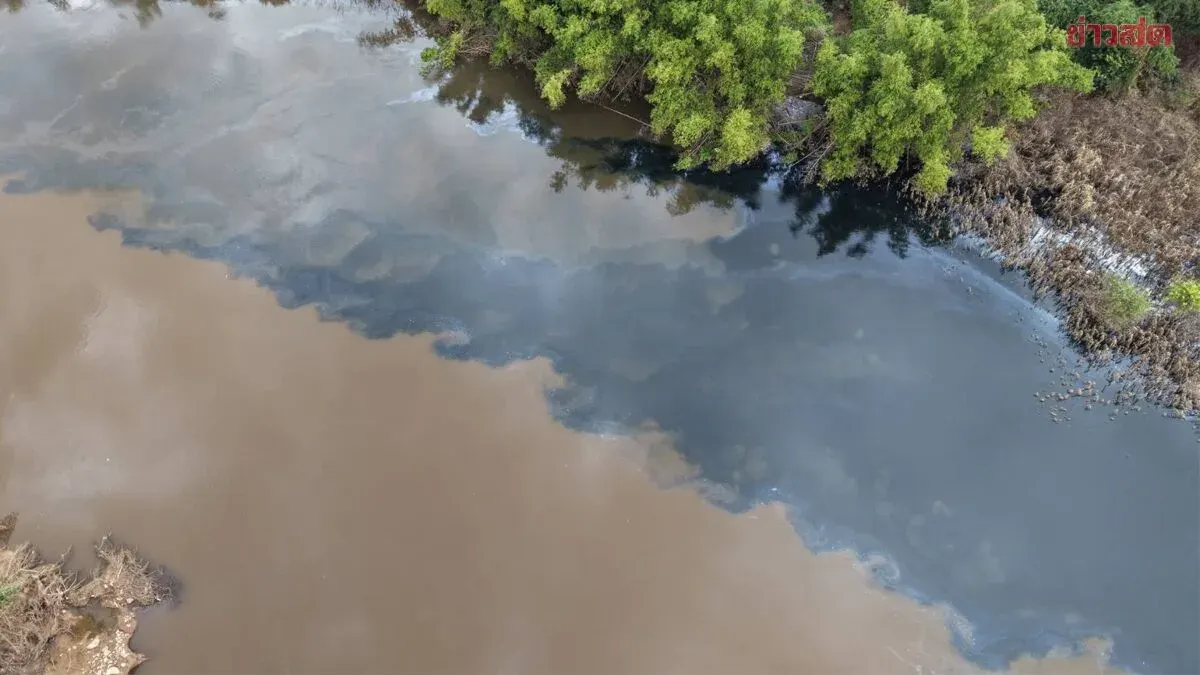
Residents of Prachinburi are outraged after water turned a pitch-black color with an unbearable stench, which they believe comes from chemical contamination. However, government agencies insist it is merely rotting grass, claiming locals know what decomposing grass smells like and that current canal and river conditions are completely different from natural grass decay.
October 20, 2026 – Following the discovery of black water at the Phet Eiam drainage gate in Kabin Buri District, Prachinburi Province, the Royal Irrigation Department opened the gate, allowing black water from rice fields in Villages 3 and 8 to flow into the Prachinburi River, turning the river water a cocoa-brown to black color, as previously reported.
Subsequently, Acting Governor Channathip Kokmanee led officials to collect samples of the black water to test for contaminants. At the same time, Irrigation Department officials closed the drainage gate to prevent further black water from entering the Prachinburi River.
Most recently, this morning journalists revisited the Prachinburi River and the Phet Eiam drainage gate and found that black water remains pooled in the long ditch between rice fields in front of the drainage gate.
Somdet Topathankun, a local resident, stated that during the recent flooding he did not open the gate until water overflowed the road. Once the road dried, water flowed rapidly. When the water began to recede, he started opening the gate to release water, and that was when the black, foul-smelling water arrived – so putrid it was unbearable.
Agencies that came out claimed the smell was from rotting grass, but it is definitely not just rotting grass because decomposing grass is a different matter entirely – this is certainly chemicals. When they came to test the water, they closed the drainage gate. Once closed, sediment settled. After the sediment settled, the water on top cleared up, so they tested the clear surface water because the sediment at the bottom did not rise up due to the closed gate.
"Let them open the gate and test again – it will be like the Sri Maha Pho case, won't it? At Sri Maha Pho they found chemicals described as rainbow-colored water; here it's similar but even blacker and foul-smelling. Whatever the case, it's not the rotting grass that government officials claim. We live in this area; we know what rotting grass is like. In the canals right now, it's a completely different story."