Trang Farmers Convert Rubber Land To Mixed Fruit Farm
Farmers in Trang’s Huai Yot district have replaced over five rai of rubber trees with a mixed farm that grows nine varieties of champedak alongside other fruit and local crops. The shift aims to provide steady year‑round income as rubber prices remain volatile and younger generations avoid rubber tapping. The farm already yields champedak selling for 30‑40 baht per kilogram and expects continuous harvests from complementary crops.
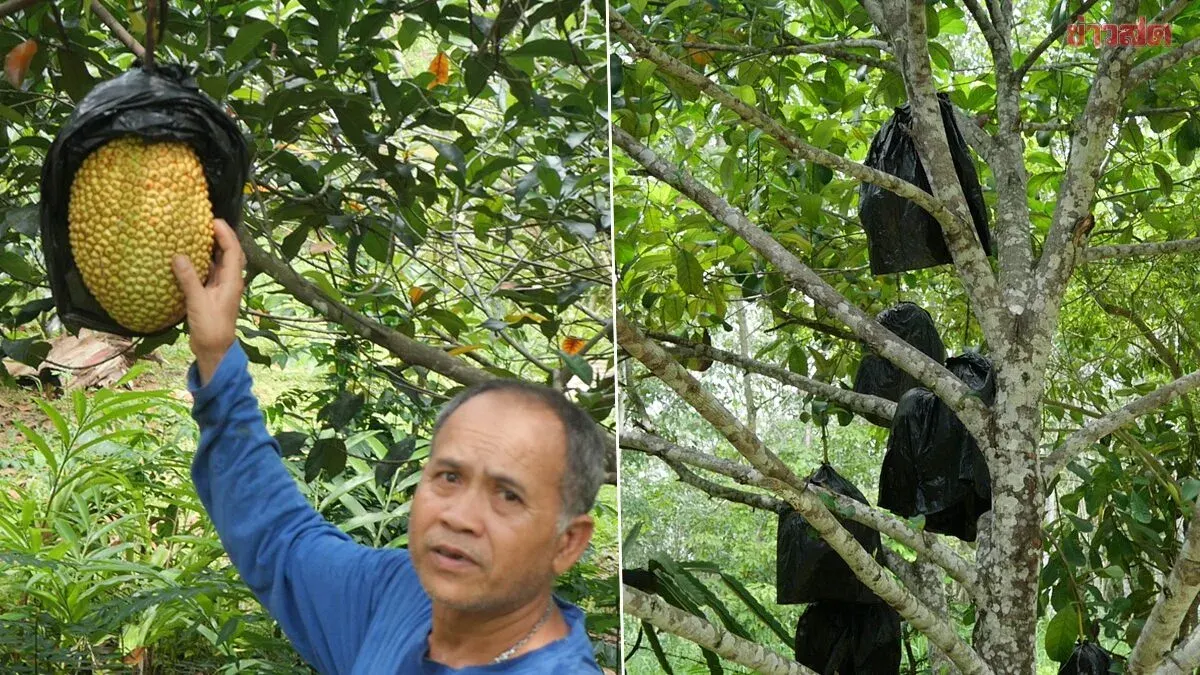
Rubber farmers in Huai Yot district, Trang province, decided to uproot their old rubber plantation on more than five rai and shift to mixed agriculture, emphasizing the planting of many champedak varieties together with fruit trees and local plants. They hope to create continuous family income throughout the seasons after rubber prices became unstable and their descendants showed no desire to work as rubber tappers.
On 20 October 2069, reporters visited the mixed farm of Jirarut Hiran, Moo 5, Tube To subdistrict, Huai Yot district, Trang province. The farm owner had converted the former rubber area into a mixed farm growing champedak, jackfruit, stink bean, pineapple and other agricultural products to diversify income and lessen dependence on a single economic crop.
Jirarut said the farm covers over five rai and currently has about 130 champedak trees representing nine varieties: Khwan Trakul, Thong Champaa, Chan Malay, Plad Thong, Thong Neua, Thong Duang, Thong Champan, Sai Nam Phuang and Ruang Thong. The most planted variety is Khwan Trakul with about 40 trees, followed by Thong Duang and Thong Champan at roughly 30 each, and Chan Malay at about 20.
Besides champedak, the farm also grows other fruit and local plants such as durian, mangosteen, Malay lychee, rambutan, santol, crystal longan, ebiu, stink bean and luk nang, so that produce can be harvested at different times and supplied to the market throughout the year.
The owner noted that champedak planting started about five years ago and the trees are now yielding more fruit than in the first years, although not all trees have borne fruit yet. Champedak sells for about 30‑40 baht per kilogram, providing a steady stream of income even though overall earnings are still in the early stages of farm development.
The advantage of mixed farming is the year‑round turnover of produce: when champedak season ends, stink bean or luk nang begin to yield, giving the family alternating income throughout the year. Additionally, the Pattaviaw‑hybrid pineapple has attracted steady customer interest and regular purchase inquiries.
Jirarut added that the main reasons for removing the old rubber were the uncertain rubber price and the labor‑intensive nature of tapping, while his children have other jobs and no wish to continue the rubber‑tapping profession. He therefore turned to fruit trees and mixed crops that can be tended and harvested seasonally.
Although the mixed farm is still in its early stage, the owner sees it as a suitable way to generate family income by planting a variety of crops to lower risk and build continuous agricultural revenue.
Those interested in the farm’s produce or who need more information can call 099‑481‑7981 or 063‑076‑1144.