Thailand Targets 47% Emissions Cut by 2035 at COP31
At COP31, Thailand pledged to cut greenhouse gas emissions by 47 percent by 2035 and achieve net zero by 2050 under its updated NDC 3.0. The government also secured roughly 800 million baht in international climate funding and is advancing a Climate Change Act targeting 2027 enforcement to strengthen domestic climate governance.
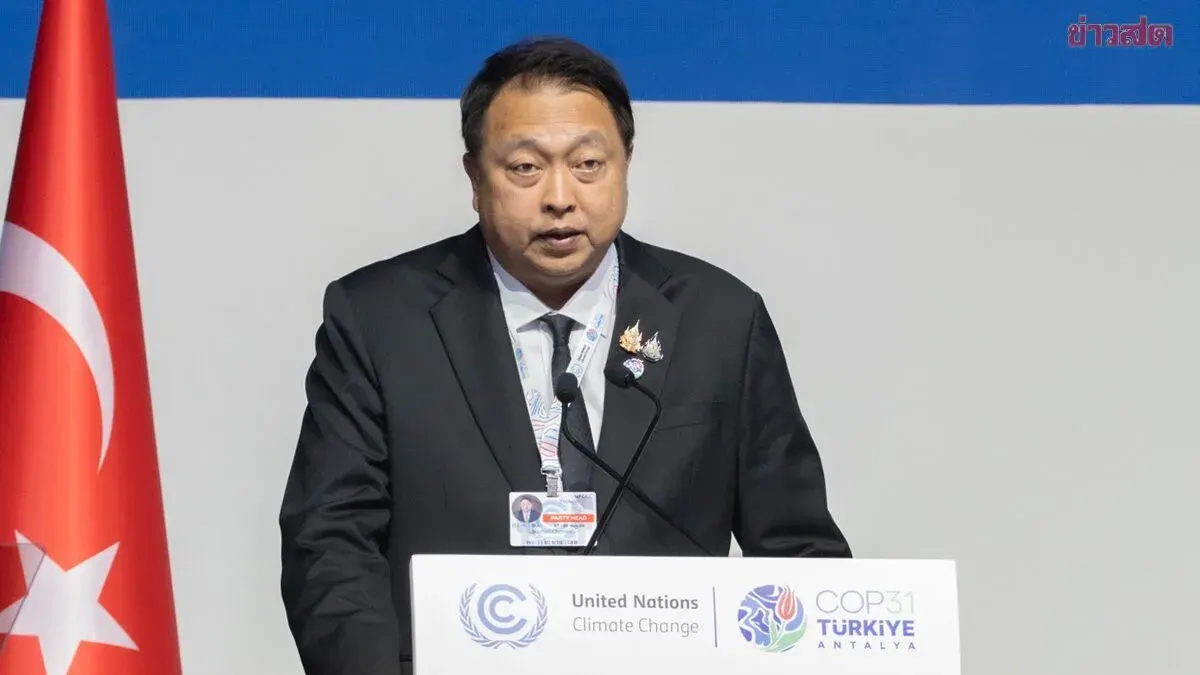
Natural Resources and Environment Minister Surachat Chanklin, heading the Thai delegation, delivered Thailand's national statement at the Resumed High-Level Segment of the 31st session of the Conference of the Parties to the UN Framework Convention on Climate Change (COP31) on November 17, 2026. He was accompanied by Thai Ambassador to Turkey Jatuporn Chaiyakam, Permanent Secretary Rawiwan Phuridech, Climate Change and Environment Department Director-General Phirun Saiyasitpanich, and senior ministry officials.
Speaking for Thailand, Surachat affirmed the country's determination to drive concrete climate action to keep the 1.5°C global temperature goal within reach. This involves intensifying emissions reductions alongside adaptation to worsening climate impacts, while calling for adequate and accessible finance and technology support for developing nations. The efforts align with government directives prioritizing climate solutions, emissions cuts, and balancing economic development with environmental protection.
Thailand announced progress on its updated Nationally Determined Contribution (NDC 3.0), targeting a 47 percent net emissions reduction by 2035 compared to a 2019 baseline, and net zero by 2050. This is coupled with the revised second Long-Term Low Greenhouse Gas Emission Development Strategy (2nd LT-LEDS) to guide sectoral transitions. Key measures include promoting solar rooftops for one million households — expected to cut 2.9 million tonnes of CO2 equivalent annually — advancing electric vehicles and low-carbon transport, shifting industry to low-carbon production, sustainable waste and agriculture management, and expanding forest conservation to boost carbon sequestration.
Thailand also emphasized a people-centered climate transition that creates economic opportunities while solving environmental problems. The government is fast-tracking the Climate Change Act, aiming for enforcement by 2027 as a key mechanism to strengthen governance and resilience. Another major outcome at COP31 was securing approximately 800 million baht in international grants from bilateral partners and multilateral financial institutions to support the Net Zero 2050 goal and enhance adaptive capacity, in line with the government's drive for sustainable economic, social, and quality-of-life improvements.