Democrats Warn Solar Rooftop Shortfall May Burden Public
Democrat Party MPs warn that the government's solar rooftop scheme has attracted only 80,000 registrations against a 1 million target, with a 400-billion-baht loan deadline looming. They allege political pressure to inflate sign-ups could shift costs onto households that must still pay 90,000 baht each, and question whether the budget might be diverted elsewhere. The party welcomes state utilities' withdrawal as installers following reports of queue-jumping fees.
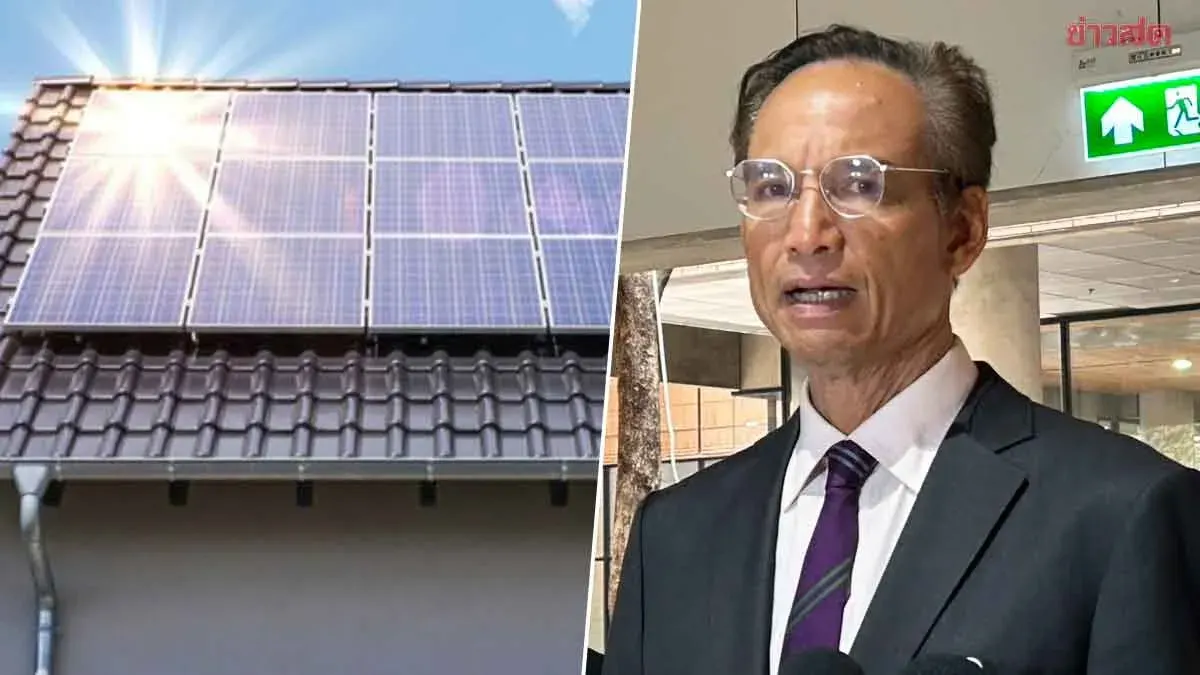
At 2:00 p.m. on November 26, 2026, at Parliament, MP Kanit Kwanich, a party-list MP and deputy leader of the Democrat Party, addressed the solar rooftop project, which currently has about 80,000 households registered against the government's announced target of 1 million. Registration remains open until the end of January 2027, with the Provincial Electricity Authority slated to complete all verification by the end of September 2027 under the terms of the 400-billion-baht loan decree — a very tight timeline. This reflects the Democrats' concern over how achievable the 1 million target really is; Kanit views it as unlikely and worries the budget might be diverted to other, non-people-related projects, leaving the public without direct benefit. He urged confirmation that the loan funds will actually serve the declared solar rooftop program, arguing it would be better for the country if the government simply refrained from borrowing rather than redirecting the money to unrelated, low-value projects that would become a long-term public burden.
Kanit also voiced concern over reports that a certain political party plans to mobilize its MPs and members to gather registrations because sign-ups are too low. If true, the Democrats fear this will pressure MPs to campaign for registrations, ultimately saddling households with the cost: even with a 50,000-baht subsidy, each household must still pay roughly 90,000 baht. "I see this as a long-term burden on the people," Kanit said. "Any promotion must clearly explain the project's value, but for households with electricity bills under 3,000 baht, the investment is hard to justify. If the push is only to hit government targets while people are financially unprepared and the installation isn't worthwhile, that's dangerous. I urge that party to reconsider; the registration map will eventually show where people are genuinely interested."
On a positive note, Kanit welcomed the Provincial Electricity Authority and Metropolitan Electricity Authority's withdrawal as installers, as well as their re-evaluation of their public-service mandate. He cited evidence that one provincial electricity office had been offered queue-jumping fees of 30,000 baht per installation by private contractors, and thanked the authorities for reviewing their policy.