ONEP, GIZ Debrief COP17 to Accelerate Thailand's Biodiversity Goals
ONEP and GIZ Thailand hosted a debriefing on the UN Biodiversity Conference COP17 to translate global decisions into domestic action for Thailand's 2030 biodiversity targets. The event reviewed the Yerevan Pathway and six priority areas for accelerated implementation, emphasizing policy integration, finance reform, and inclusive participation across all sectors.
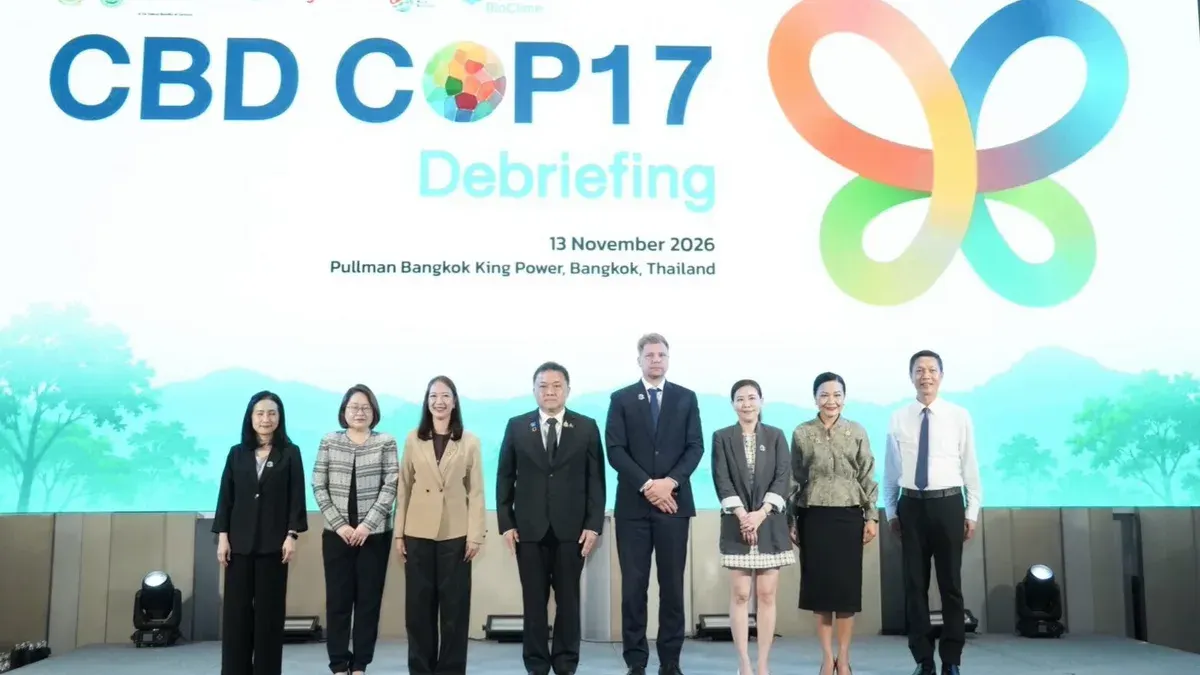
On November 13, 2026, the Office of Natural Resources and Environmental Policy and Planning (ONEP) under the Ministry of Natural Resources and Environment, together with GIZ Thailand, organized the CBD COP17 Debriefing at the Eternity Hall, Pullman King Power Hotel, Bangkok. The meeting disseminated results from the 17th Conference of the Parties to the Convention on Biological Diversity, Thailand's stance, and joint approaches for government, private sector, academia, communities, and civil society to conserve and protect biodiversity to achieve 2030 goals, with budget support from the German government's International Climate Initiative (IKI).
CBD COP17 took place in Yerevan, Armenia, from October 19–31, 2026, led by Dr. Rawiwan Phuridej, Permanent Secretary of the Ministry of Natural Resources and Environment, alongside Thai delegates. Parties adopted key decisions including the 'Yerevan Pathway,' a response to the first global stocktake under the Kunming-Montreal Global Biodiversity Framework (KM-GBF). The assessment found the world is not on track to meet 2030 targets, urging accelerated action in six priority areas: • Accelerate implementation per NBSAP and KM-GBF targets • Expand scope of action • Strengthen support mechanisms for finance, technology, and capacity • Integrate all government levels for systematic implementation • Promote whole-of-society participation in driving targets • Develop monitoring and knowledge systems to assess progress and support implementation
Beyond accelerating action, the meeting highlighted the need to close gaps in policy, finance, data, and capacity, alongside creating equitable implementation mechanisms — particularly reforming incentives and subsidies harmful to biodiversity (Target 18), promoting indigenous peoples and local community participation per the Seven Guidelines, and advancing digital sequence information (DSI) and the Cali Fund.
These outcomes prompted today's debriefing to exchange perspectives and domestic implementation strategies, analyze challenges and opportunities, and align COP17 conclusions with Thailand's context, focusing on linking policy to practice and building cross-sector cooperation. The program split into morning and afternoon sessions: the morning opened with a COP17 overview video, welcome remarks by Dr. Timo Menniken, GIZ Thailand Director, and opening remarks by Banrak Saengthong, ONEP Secretary-General. Narirat Phanmani, ONEP Deputy Secretary-General, presented "CBD COP17 Key Outcomes and Beyond: Thailand's Key Results and Next Steps," followed by a panel "Inside CBD COP17: Deep Dive into Key Global Issues." The afternoon featured "Action on Ground: Turning Commitments into Practice," gathering perspectives from government agencies, private sector...