Minister Orders Probe Into Black Water in Prachinburi Canal
Thailand's Natural Resources Minister has ordered the Pollution Control Department to investigate black, foul-smelling water in a Prachinburi canal after social media posts raised alarm. Preliminary tests show low contaminant levels with no immediate health risk, but lab analysis is underway to determine the cause. Authorities are coordinating with local agencies and community networks to monitor the situation and keep residents informed.
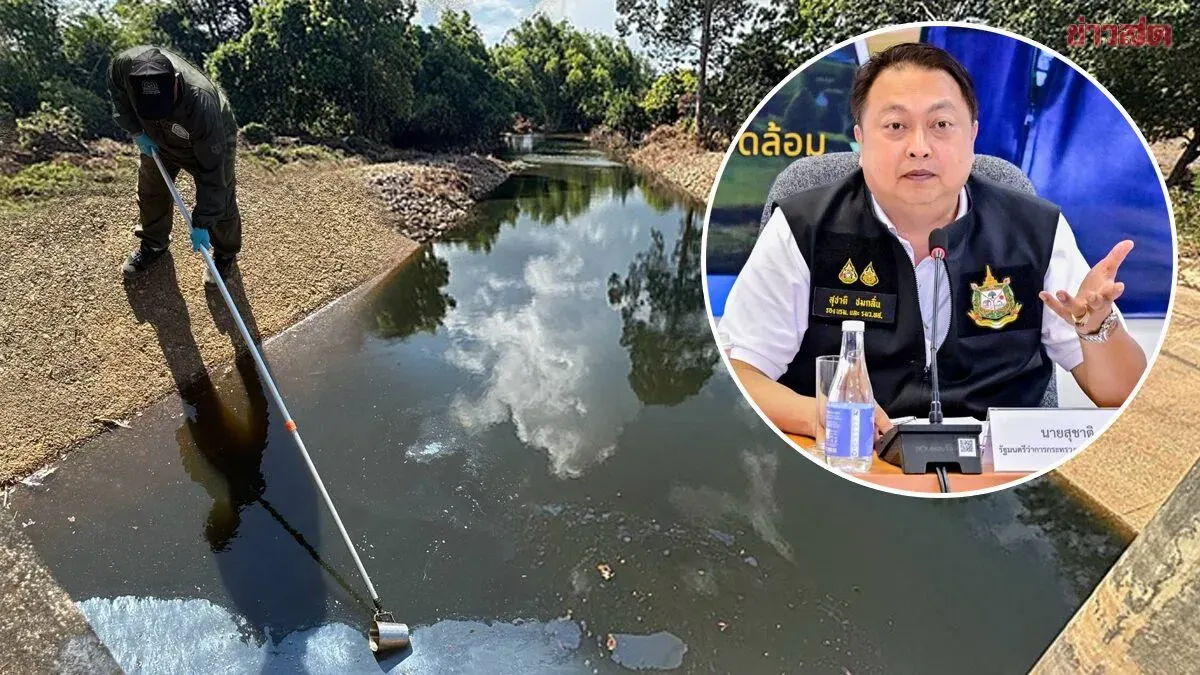
On October 21, 2026, Pollution Control Department Director-General Dr. Surint Warakijthamrong revealed that Minister Suchart Chomklin had ordered an urgent fact-finding and water-quality investigation after social media posts showed dark, murky water with a rotting smell in Khlong Phetcha Eiam, Prachinburi, alarming local residents. The minister also instructed close coordination among relevant agencies to determine the cause and remediation plan.
Dr. Surint assigned Environmental Office 7 (Saraburi) and the Prachinburi Provincial Natural Resources and Environment Office to conduct on-site inspections, coordinated by Prachinburi Deputy Governor Chinathip Kokmani. The team included community networks, Kabin Buri district officials, public health and agriculture offices, the Regional Waterworks Division, the Prachinburi Irrigation Project, and the Wang Dan Subdistrict Administrative Organization.
Preliminary findings upstream of the canal's drainage gate showed the gate was closed, preventing discharge into the Prachinburi River. Water in the canal was brownish-black with a slight odor. Volatile organic compound (VOC) measurements using headspace technique registered 0.8 parts per million at one of five sampling points near the gate — well below the 3 ppm threshold for noticeable odor and the 10 ppm level that could affect vulnerable groups. Field water-quality readings were similar to those in the main river: dissolved oxygen 3.23–3.26 mg/L, salinity 0.0–0.5, pH 6.68–6.96, and conductivity 123.5–129.8 microsiemens/cm. All five samples have been sent to the Environmental Office 7 laboratory for detailed analysis to pinpoint the cause of the discoloration and assess water quality.
Dr. Surint added that the department will expedite lab results, coordinate with agencies on a fact-based solution, and keep the public informed. Emphasis will be placed on addressing community concerns and involving local networks in environmental monitoring to build confidence and prevent impacts on nearby communities.