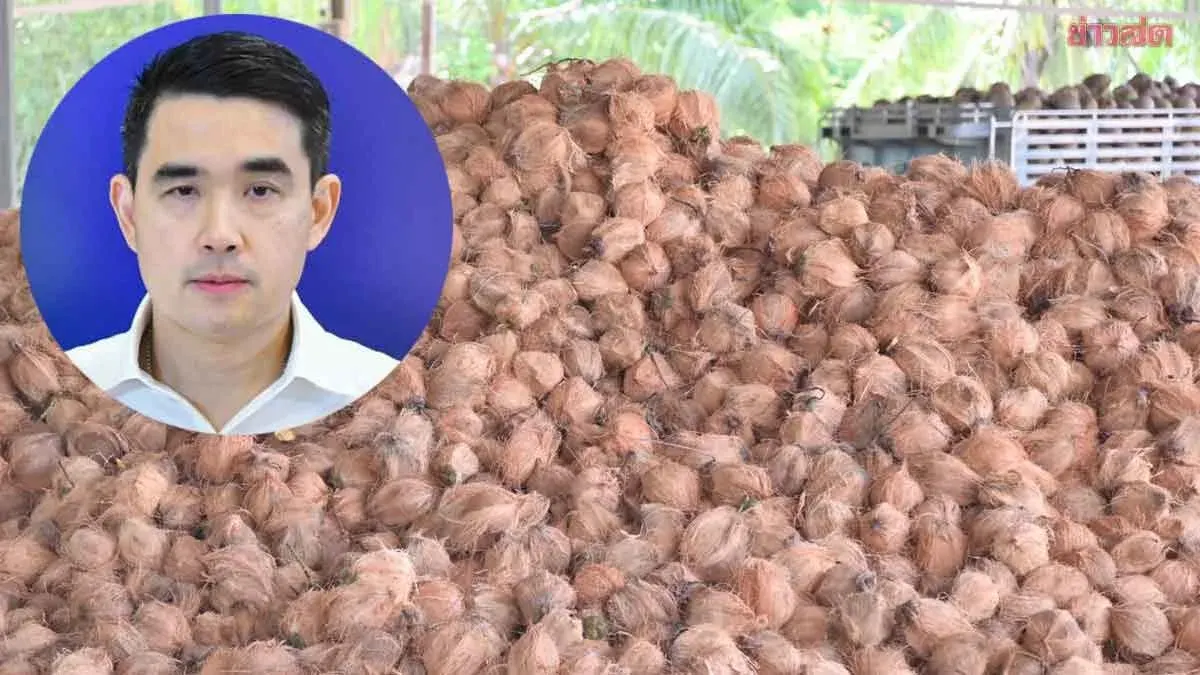
Thailand's Commerce Ministry is allocating 90 million baht to purchase 20 million coconuts directly from farmers at premium prices, addressing supply gaps in major growing regions like Nakhon Si Thammarat and Surat Thani. The government is
Commerce Ministry Spokesperson Kranij Nonzuy announced that Deputy Prime Minister and Commerce Minister Suphajee Suthammaphand has tasked the Internal Trade Department with purchasing additional copra at market-leading prices while surveying and assisting farmers still struggling to sell their crops. The department will also closely monitor coconut imports to fully support domestic production.
Previously, the Commerce Ministry worked with provincial commerce offices in major coconut-growing regions—Prachuap Khiri Khan, Nakhon Si Thammarat, Surat Thani, and Chumphon—coordinating with factories and traders to purchase copra from farmers continuously. They have already purchased over 11 million coconuts against a target of 10 million. However, field monitoring revealed that some farmer groups remain unsupported because most traders work through existing networks and established partners, and many importers impose standards such as GAP certification, monkey-free certificates, and traceability systems. The government is therefore allocating additional budget to purchase copra at market rates to reach all farmers and absorb the incoming harvest.
On imports, the Foreign Trade Department has requested cooperation from importers and coconut milk factories to halt coconut imports during Thailand's domestic harvesting season. Factories have confirmed they will use Thai coconuts as primary raw material. A survey of nine processing factories found they use domestic coconuts for 80 percent of production and import only 20 percent. Coconut imports during January to May 2025 totaled 79,388 tons, down over 60 percent from the same period last year's 190,734 tons.
The Office of Agricultural Economics forecasts 2025 copra production at 608 million coconuts, a 2.4 percent increase from 2024. Production begins in June, with an estimated 69 million coconuts entering the market between now and August. Since factories and traders may not absorb all supply, the Commerce Ministry has prepared support measures. Jirawut Suwannarat, Deputy Director-General of the Internal Trade Department, announced the department will allocate approximately 90.1 million baht to purchase copra at premium market rates. The plan targets two categories: 20 million young coconuts at an additional 4 baht per fruit, and 1,000 tons of coconut meat at an additional 5 baht per kilogram.
Foreign Trade Department Director-General Arda Fuangtong noted the department has continuously monitored and enforced strict controls on mature coconut imports through WTO quota and AFTA frameworks. Importers receiving tariff benefits must comply with stringent measures, including being processing factories using coconuts as raw material, adhering to specified import periods, and—under AFTA—being prohibited from reselling or processing coconuts outside factories. Currently, no importers are using either framework to import mature coconuts. All frameworks restrict imports to two customs checkpoints: Bangkok Port and Laem Chabang. Under the WTO non-quota framework, which importers currently use, the tariff is 54 percent.