New Phra Pathom Chedi Medal Released
A commemorative medal honoring Phra Pathom Chedi was first created in 1922 by a former Thai minister to celebrate his 70th birthday, with 10,000 pieces distributed at a Buddhist merit-making ceremony that year.
Phra Pathom Chedi is an important sacred site in Thailand located within Wat Phra Pathom Chedi Rajworamahaviharn, with a long and storied history enshrining the Buddha's hair relic. The sanctity of Phra Pathom Chedi has become renowned throughout the kingdom. During the reign of King Rama VI, when he held the title of Siam Maha Vajirunhis, he changed his royal residence to Sanam Luang Palace and witnessed the Buddha's hair relic from Phra Pathom Chedi radiating with brilliant light. He reported this to his father King Rama V, who responded that he too had witnessed similar miracles when passing through Nakhon Pathom and ordered an investigation to determine if anyone had contrived the phenomenon, but found no evidence of deception.
Wat Phra Pathom Chedi holds an annual nine-day-nine-night veneration festival from the 12th lunar waxing day through the 5th lunar waning day of the 12th month. The first edition of the Phra Pathom Chedi medal was created by Chao Phraya Thewet Wongwiwat (M.R.W. Lanan Kunchon), former Minister of Agriculture during King Rama V's reign and owner of the acclaimed Theuk Damborn Theatre. He commissioned this meritorious work to celebrate his 70th birthday on November 18, 1922, inviting 200 monks for alms-rounds, offering meals, and delivering teachings over three days.
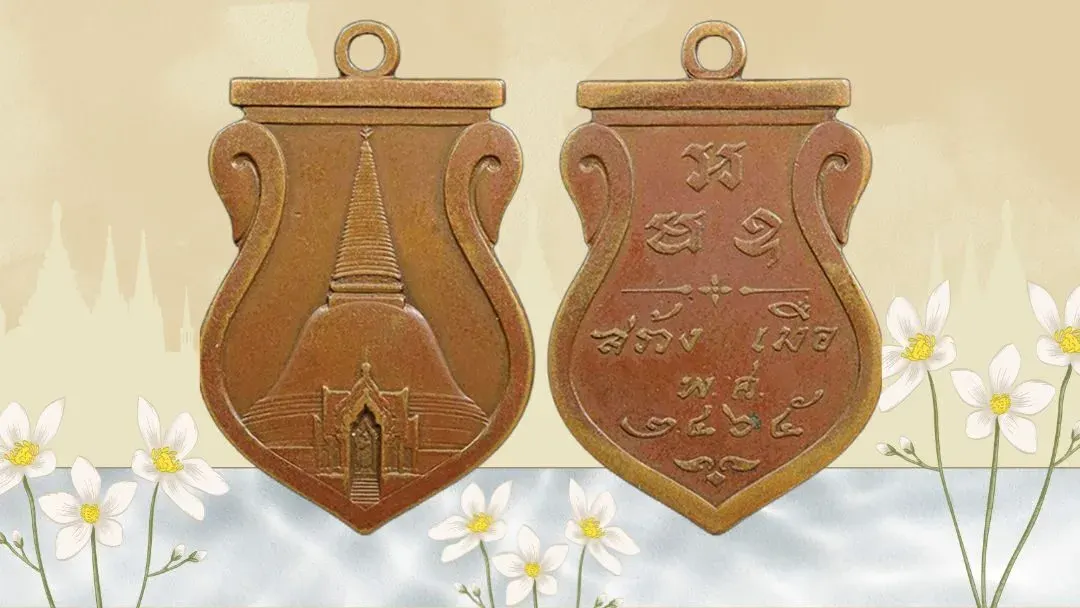
On December 15, 1922, he also had a Buddha image cast measuring 2 cubits and 4 inches, 18 small golden stupas as replicas of Phra Pathom Chedi, and 10,000 commemorative Phra Pathom Chedi medals struck for distribution. He passed away shortly thereafter on January 1, 1923. The medal features an inverted coin design with a connecting loop, showing Phra Pathom Chedi on the obverse and Khmer script on the reverse, with "Established B.E. 2465" inscribed below.
It is believed the first edition medals underwent a formal consecration ceremony by a renowned abbot of that era, though no definitive historical record confirms which sacred masters performed the rites. Nevertheless, the prestige of the creator and the miraculous legend of Phra Pathom Chedi represented on the medal alone were sufficient to make these medals highly revered.