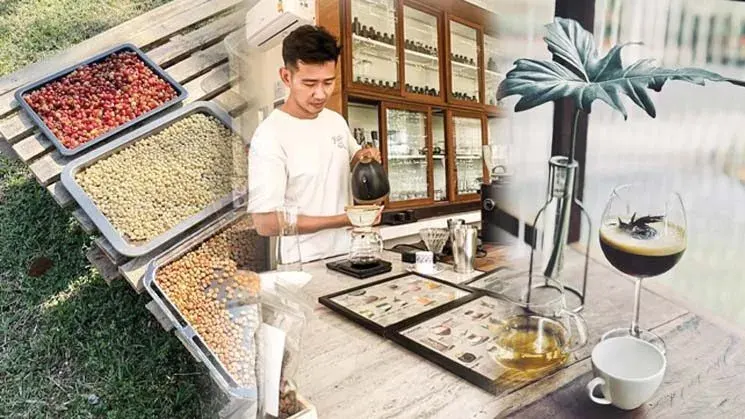
Former architect Pond Nathanol Mahachan left his career to grow specialty coffee in Khon Kaen province, applying engineering expertise to create a model farm that emphasizes quality and craftsmanship over volume to help local farmers compet
Thai coffee culture has evolved from the traditional coffee shop focused on energy and socializing to a modern lifestyle centered on specialty coffee, where people view coffee as an art and craft rather than merely a beverage. This shift emphasizes every stage from cultivation and roasting to complex flavor extraction science.
Pond Nathanol Mahachan, a former architect, has decided to return to his hometown in Khon Kaen province to develop coffee as a crop for the future on highland areas, positioning his farm as a must-visit destination for coffee enthusiasts.
As an architect and instructor in high-rise building technology, experienced with 3D modeling and AI technology, Pond applies engineering knowledge to agriculture and coffee shop operations. He carefully positions each coffee plant and designs shop layouts to optimize light, wind direction, and space efficiency.
He admits his initial thoughts wavered between money, time, and passion until he realized he needed to sacrifice some income to pursue his new goal. However, he acknowledges that capital remains essential, as casually tasting coffee a few times daily in the garden would not sustain a business. He felt compelled to develop a clear business model.
Coffee is complex in terms of consumption and experience. The challenge is how to present it to the market. Simply selling "drinking" adds little value, but selling "experience"—including storytelling, marketing service, and branding—leverages his strengths.
Local farmers have strong growing capabilities, but face challenges in closing sales. He is discussing with various organizations to find support and help strengthen farmers' operations, such as purchasing their produce to add value. He intends his farm to serve as a model.
Pond emphasizes that modern agriculture must be crafted with refinement and sophistication, as Thailand cannot compete internationally on volume alone. Chinese coffee is flowing in through investments in Laos, while northern Thai coffee faces disasters and climate change that reduce yields. "This is why I shifted my thinking toward craftsmanship and greater skill. I believe local farmers can survive sustainably by focusing on refinement. Traditional resource-based tourism may become tiresome, but genuine craft processes attract people longer. We don't emphasize quantity but quality felt in every step."
Most Thais think coffee grows only in the north or south, but today it is spreading widely in the northeast and attracting more farmers. However, it requires strong intention and understanding, as terrain and climate are less favorable than the north.
For anyone wanting to grow coffee in the northeast, the key factors are water management and pest control. Low-elevation areas often suffer from insects that bore into stems and damage crops. Leaves must be frequently pruned to keep stems open—details that differ from highland forest farming, which requires little maintenance.
At Mahachan's farm, coffee grows mixed within rubber plantations at 1-1.5 meter spacing. Two water management systems are used: drip irrigation to maintain soil moisture and sprinkler systems to maintain humidity.