Survey Finds 16 Dugongs Off Trang Coast
A survey off Trang's coast found 16 dugongs along with 60 hawksbill turtles and a finless porpoise, with healthy grazing patterns indicating robust seagrass ecosystems vital to their survival.
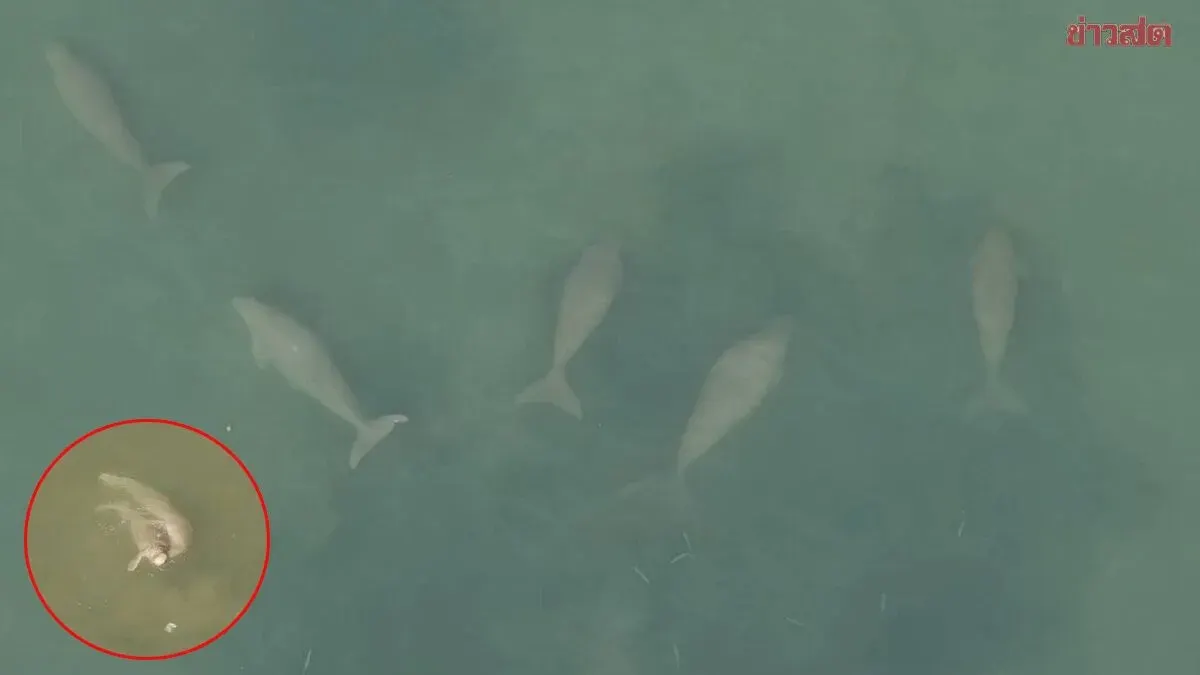
The Department of Marine and Coastal Resources announced survey results from waters around Libong and Muk islands in Trang province, discovering a total of 77 rare marine animals comprising 16 dugongs, 60 hawksbill turtles, and one Indo-Pacific finless porpoise. A mother-calf dugong pair was also spotted, reflecting the richness of the seagrass ecosystem in the area.
The survey was conducted between July 20–23, 2024, by the Lower Andaman Marine and Coastal Resources Research Center using multirotor unmanned aerial vehicles to track dugong distribution, assess the health of rare marine species, and survey seagrass grazing patterns.
Rare marine animals were found scattered across multiple areas around Libong Island, including Ban Prao Bay, Samet Bay, Saphan Chang Canal mouth, Khlong Hwa, and Cape Chuyai. Remote health assessments showed all animals displaying normal behavior—grazing on seagrass, swimming, traveling, and rolling—with no signs of fishing gear injuries, marine debris, or abnormal behavior.
Officers also discovered dugong seagrass grazing marks at multiple locations including Cape Tho Chai, Ban Prao Bay, Saphan Chang Canal mouth, Khlong Hwa, Cape Chuyai, and Cape Phra Muang, representing positive signals of coastal ecosystem integrity and successful marine conservation in Trang province.
However, despite these encouraging results, experts continue closely monitoring impacts from climate change. Rising sea temperatures, storm intensity, coastal erosion, and changing water quality all affect seagrass ecosystem health. Degradation or loss of seagrass would jeopardize dugong survival, reproduction, and long-term viability.
Dugongs also remain threatened by fishing gear, boat strikes, and marine debris—particularly plastic—which continue to pose significant dangers to Thailand's rare marine species.