Thailand, Indonesia Launch Joint Economic Partnership Forum
Thailand and Indonesia launched a strategic economic partnership forum in Jakarta, with PM Anutin proposing closer ties in manufacturing, logistics, halal economy, and green energy to boost bilateral trade toward $23 billion.
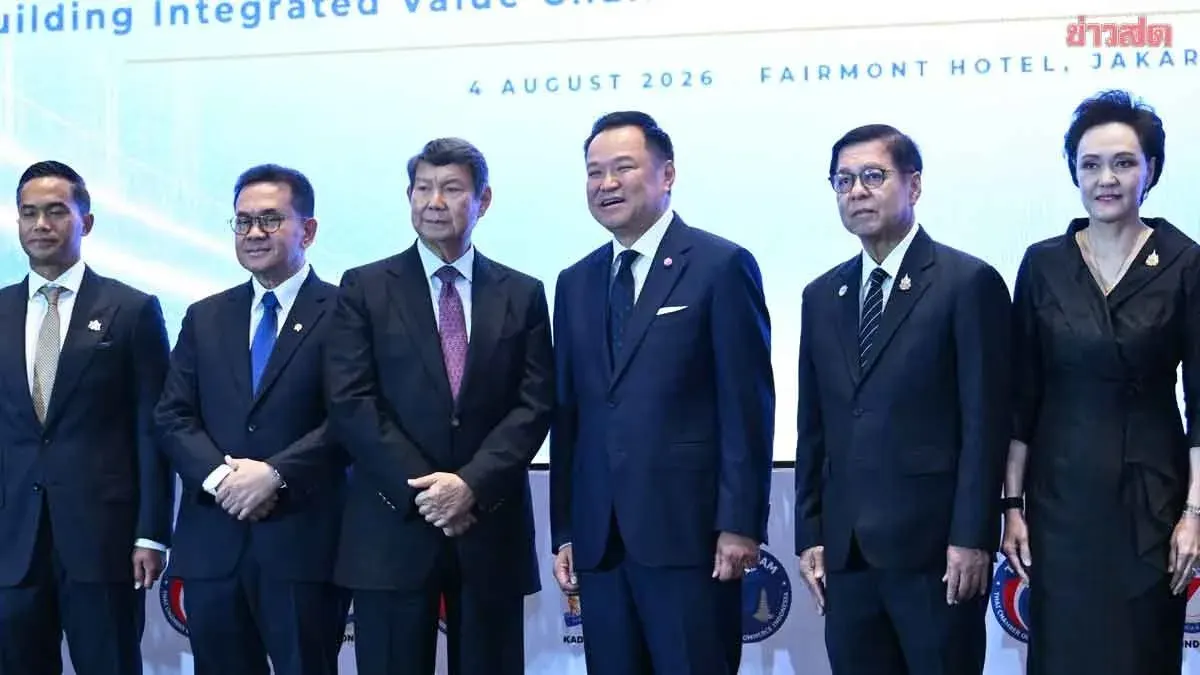
Prime Minister Anutin Charnvirakul delivered a keynote address at the Indonesia-Thailand Business Forum held this morning at Fairmont Jakarta, titled "Advancing the Indonesia–Thailand Strategic Partnership: Building Integrated Value Chains in Industry, Services, and Halal Economy." The forum was organized by the Thai Chamber of Commerce in Indonesia in partnership with Kadin Indonesia, with participation from Indonesian Commerce Minister Budi Santoso, presidential special envoy Hasim Djojohadikusumo, Thai Chamber of Commerce President Poj Aramwattananont, Bangkok Bank chairman Chatsiri Sophonpanich, and approximately 300 government, private sector, and media representatives.
Anutin proposed elevating Thailand-Indonesia relations from "trading partners" to "co-builders" by linking production, investment, technology, and innovation to create strong value chains and expand economic opportunities across ASEAN. He emphasized that Thailand should serve as a regional manufacturing hub while Indonesia functions as a major market and maritime economic gateway. Following discussions with President Prabowo Subianto, both sides agreed to create concrete opportunities for citizens, business operators, and investors.
With global economic volatility, Anutin stressed that deeper ASEAN economic integration is "not an option but a necessity," with Thailand and Indonesia as key drivers. He noted current bilateral trade reaches nearly $20 billion with a target of $23 billion, and combined populations exceed 350 million. The Prime Minister proposed four strategic cooperation pillars: (1) Food security and halal development of comprehensive halal value chains; (2) Logistics, transport, and digital services including new Bangkok-Jakarta and Phuket-Bali air routes and Thai Lion Air expansion; (3) Finance and digital economy, connecting PromptPay and QRIS payment systems; and (4) Energy and green economy for clean energy and future industries like EV, AI, and data centers.
Anutin concluded that success should be measured not by trade figures alone but by jointly built industries, connected supply chains, and a more competitive ASEAN.