Thailand to Host 2026 Advanced Air Mobility Symposium
Thailand will host the Second Advanced Air Mobility Symposium (AAM 2026) in December 2026, showcasing the country's rapidly growing drone industry which has surpassed 73,000 registered units. The event aims to advance Thailand's position in the global low-altitude economy, projected to reach $52.1 billion by 2034, while CAAT develops a master plan and regulatory framework for safe integration of new aviation technologies.
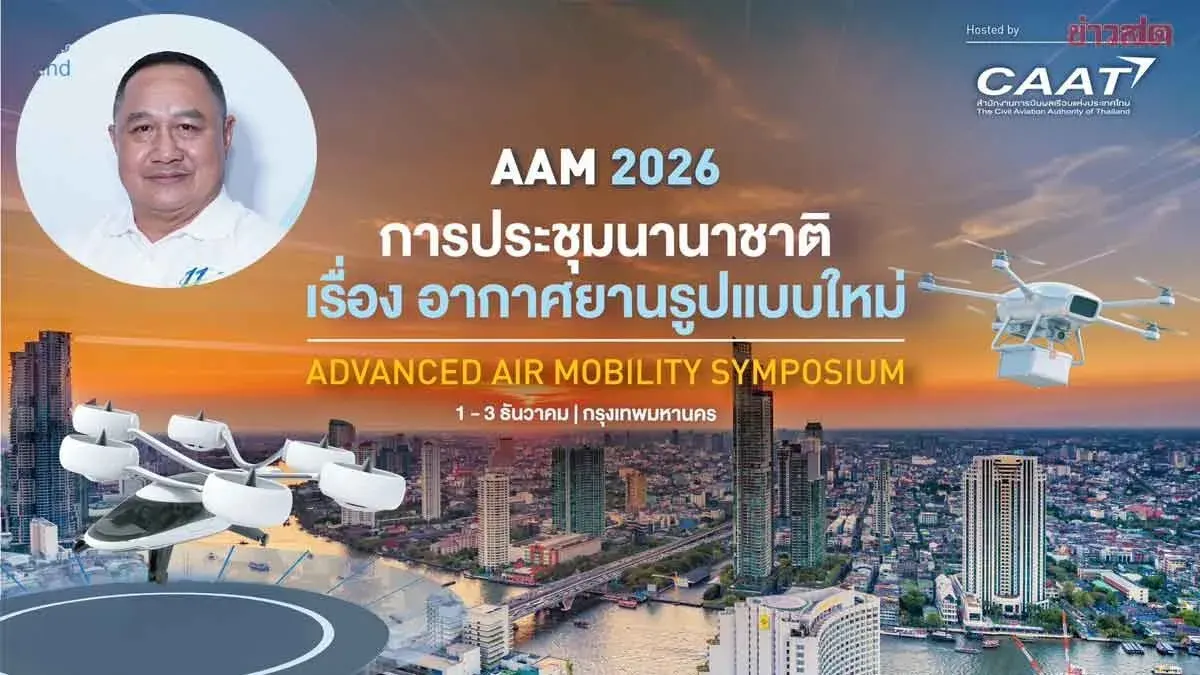
Thailand's drone industry continues to grow at an average of over 10% annually, with more than 73,000 units registered, primarily serving agriculture, medical transport, logistics, and area inspection. CAAT Director-General Air Vice Marshal Manat Chuanaprayun revealed that developing Advanced Air Mobility (AAM) technology presents a key opportunity to elevate Thailand's aviation sector across travel, transport, public services, and new industry creation. AAM extends beyond drone taxis or passenger aircraft to include medical supply delivery, connecting remote areas, supporting emergency missions, and improving service efficiency across sectors, requiring parallel development of safety standards, regulations, infrastructure, and airspace management systems. Thailand is preparing to host the Second Advanced Air Mobility Symposium 2026 (AAM 2026) from December 1-3, 2026, at IMPACT Forum Hall 4, Muang Thong Thani. CAAT serves as the main coordinating agency alongside the International Civil Aviation Organization under the theme "From Vision to Implementation: Enabling the AAM Ecosystem," providing a crucial platform for knowledge exchange and development strategies among regulators, manufacturers, technology developers, and experts from various countries. The AAM 2026 program includes seminars, exhibitions, and flight demonstrations covering key topics such as progress in unmanned aircraft systems (UAS) and electric vertical takeoff and landing aircraft (eVTOL), vertiport infrastructure development, airspace management, safety standards and oversight, and AAM applications for economic and social benefits. The event will also advance the "Bangkok Statement" reflecting international cooperation intent, with substance depending on symposium negotiations. For Thailand's readiness, CAAT is drafting the Thailand UAS and AAM Master Plan to systematically guide new aviation ecosystem development across regulations, technology, infrastructure, and personnel, alongside promoting technology testing through a regulatory sandbox with appropriate safety risk assessments before wider deployment, while fostering domestic industry opportunities from manufacturing and assembly to R&D, testing, maintenance, software, and data services. Deputy Director of the Pilotless Aircraft Standards Division, Krittapas Intuyot, noted that the low-altitude economy is gaining global prominence, with the 2025 commercial drone market valued at approximately $27.9 billion and projected to reach $52.1 billion by 2034. Thailand's market grows at an average 10.3% annually, reflecting economic opportunities from drone use in agriculture, logistics, medical services, infrastructure inspection, and new services. However, increasing drone numbers complicate airspace management, prompting CAAT to prioritize system development.