Trump arrives in Beijing for talks with China's Xi on Iran war, trade and US arms sales to Taiwan
Trump arrived in Beijing Wednesday for high-stakes talks with Xi Jinping on trade, Iran, and U.S. arms sales to Taiwan, with the formal summit beginning Thursday at the Temple of Heaven.
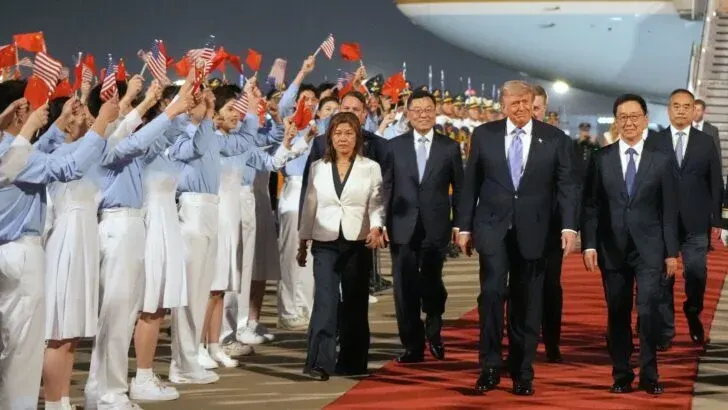
BEIJING (AP) — U.S. President Donald Trump arrived in Beijing on Wednesday for his highly anticipated talks with Chinese President Xi Jinping on the Iran war, trade and U.S. arms sales to Taiwan.
The core of the summit kicks off Thursday when the two leaders conduct bilateral talks, visit the Temple of Heaven—where ancient Chinese emperors once prayed for abundant harvests—and attend a formal state banquet. China rolled out the red carpet for Trump's arrival, literally and figuratively, as Air Force One touched down in the Chinese capital.
Trump was welcomed by Chinese Vice President Han Zheng, U.S. Ambassador to China David Perdue, China's Washington ambassador Xie Feng, and executive vice foreign minister Ma Zhaoxu. The welcoming ceremony featured a military honor guard, brass band, and roughly 300 Chinese youth dressed in white and robin's egg blue—matching Air Force One's colors—waving flags and chanting welcome greetings as the president made his way to his motorcade.
"We're the two superpowers," Trump told reporters before departing Washington. "We're the strongest nation on Earth militarily. China's considered second."
The visit comes at a sensitive moment for Trump's presidency, with his domestic approval ratings weighed down by the ongoing U.S.-Israel war with Iran and inflation tied to the conflict. Trump is eyeing a diplomatic win by securing Chinese commitments to purchase more American soybeans, beef and aircraft, with trade as his primary focus.
The administration hopes to establish a Board of Trade with China to resolve bilateral differences and prevent a repeat of last year's trade tensions triggered by Trump's tariff increases. China responded with restrictions on rare earth minerals, though the two countries agreed to a one-year ceasefire last October.
Yet the Iran conflict remains front and center on Trump's domestic agenda. The war has effectively closed the Strait of Hormuz, tranding oil and gas tankers and sending energy prices soaring—a spike that threatens global economic stability. Trump downplayed expectations that Iran would be a significant discussion point with Xi.
"We have plenty to discuss, but Iran isn't really one of them, to be honest," Trump told reporters Tuesday. "We have Iran very much under control."
Taiwan's status looms large on the agenda, with China expressing displeasure over U.S. arms sales to the self-governing island.