WHO Urges Thailand to Preserve Health Fund, Sin Taxes
The user wants a short summary (1-2 sentences, 120-220 chars, max 240) of the article about WHO urging Thailand to preserve health fund and sin taxes. Must be in English only. No filler. Lead with what happened, then most important detail.
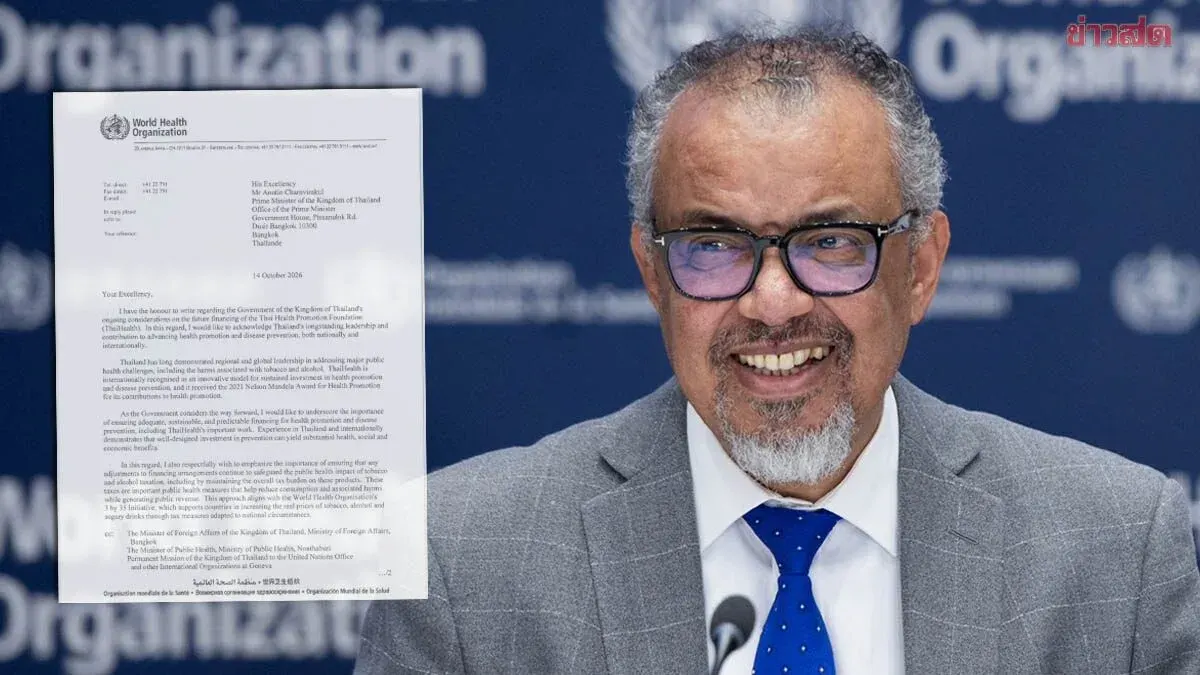
WHO Director-General Tedros Adhanom Ghebreyesus has sent an open letter to Prime Minister Anutin Charnvirakul, copied to the Foreign Minister, Public Health Minister, Thailand's Permanent Mission to the UN in Geneva, and other international organizations. Dated October 14, 2026, the letter outlines WHO's position on Thailand's public health policy direction, emphasizing the importance of sustaining the financial stability of the Thai Health Promotion Foundation (ThaiHealth) and maintaining the intensity of tax measures on tobacco and alcohol products to protect health and reduce the long-term burden of non-communicable diseases (NCDs).
Tedros highlighted Thailand's prominent and longstanding role as a regional and global leader in health promotion and disease prevention, particularly its success in tackling major public health challenges such as the harms from tobacco and alcohol consumption, which Thailand has addressed continuously and effectively.
"ThaiHealth is internationally recognized as an innovative model that has achieved remarkable success in sustainable investment for health promotion and disease prevention," Tedros wrote. "This distinction earned ThaiHealth the prestigious Nelson Mandela Award for Health Promotion in 2021."
Regarding future funding structures and sources, Tedros advised the Thai government that both domestic and international experience clearly proves that well-designed investments in disease prevention yield enormous returns across health, social, and overall economic dimensions. Therefore, it is essential to guarantee sufficient, sustainable, and predictable funding sources for this work.
"I must stress that any changes to funding arrangements should prioritize protecting the public health impact of tobacco and alcohol taxes by maintaining the overall tax burden," Tedros stated. "Tax measures are recognized as highly effective public health tools; research clearly shows they reduce consumption rates, mitigate associated harms, and generate government revenue simultaneously. This aligns with WHO's '3 by 35 Initiative,' a cooperation framework supporting member states to use tax measures to increase the real price of health-harmful products such as tobacco, alcohol, and sugar-sweetened beverages, according to national context and circumstances by 2035."