Thai Chamber Seeks US Tariff Cap 18-20% for ART Deal
We need to output a short summary, 1-2 sentences, 120-220 characters, never more than 240. Must be in English, factual, lead with what happened, then the single most important detail (who, where, or when). No filler. No quotes, no labels, n
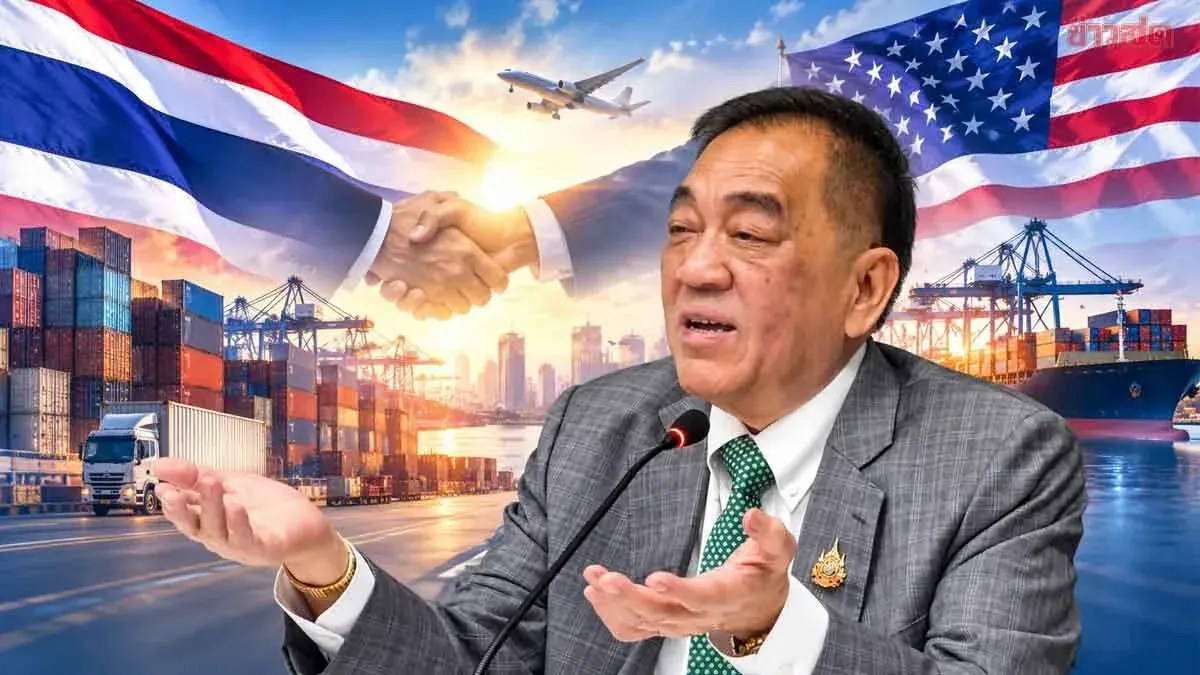
Mr. Poj Aramwatthananon, Chairman of the Thai Chamber of Commerce and the Board of Trade of Thailand, said that the Thai Chamber supports the government and the Ministry of Commerce in swiftly concluding the Thailand–United States Reciprocal Trade Agreement, or ART, to keep the overall tariff rate around 19% or no higher than that of key ASEAN competitors.
Since the United States announced reciprocal tariff measures on April 2, 2025, the government, the Ministry of Commerce, and the Thai Chamber have worked together continuously. Initially, Thailand faced a 36% tariff under the IEEPA before negotiations helped reduce the framework to 19%. Later, the US shifted to Section 122 at a 10% rate, and currently it sets tariffs on Thai goods under Section 301 concerning forced labor at 12.5%.
Although US trade measures have changed several times, Thai products have maintained their competitiveness. In 2025, Thailand exported goods to the United States worth 2.37142031 trillion baht, up 23% from the previous year. During the first eight months of 2026, the value reached 2.06963786 trillion baht, up 38% year-on-year, showing that the US remains an important market and Thai goods still have significant growth potential.
However, the current 12.5% rate under Section 301 is not a final conclusion, as it results only from the forced‑labor investigation; the probe into structural overcapacity in the manufacturing sector is still ongoing.
The Thai Chamber therefore backs speedy conclusion of the ART for three main reasons. First, preserving Thailand’s competitiveness. Setting a target overall tariff band of roughly 18–20%—no higher than that of major ASEAN rivals—is appropriate because it allows Thai products to compete on near‑equal terms with neighbours and reduces the risk that orders or production bases will shift to lower‑tariff countries.
Second, mitigating risk from Section 301. The Section 301 investigation covers two key issues: forced labor, which has already been ruled on with Thai goods facing a 12.5% rate despite Thailand having long resolved that problem, and structural overcapacity, which is still under review.
Third, creating certainty for long‑term trade and investment. ART would lessen both tariff and non‑tariff obstacles, enabling exporters, investors, and supply‑chain operators to plan business more clearly. It would also help push for exemption lists on products where Thailand has strength—especially agricultural goods, food, electronics, and rubber—to ensure sustained and sustainable growth of exports to the United States.
"The present 12.5% figure cannot be directly compared with the ART target of about 19% because the 12.5% applies only to the forced‑labor finding. The real goal is not merely to achieve today’s lowest tariff number but to establish a competitive, certain framework that limits future additional measures," Mr. Poj said.
The Thai Chamber urges all sectors to support the government’s and Ministry of Commerce’s approach in negotiating with the United States. Successfully concluding ART would reflect the ongoing public‑private cooperation since April 2025 and could serve as a model for future FTAs and trade agreements with other countries worldwide.