Thailand-Japan Dialogue Yields Three MOUs for 'Made with Thailand' Push
Deputy Prime Minister Pichai Chunhavajira led a high-level Thai delegation to Tokyo for the Thailand-Japan Investment and Business Dialogue 2026, resulting in three memoranda of understanding covering digital infrastructure, aerospace supply chains, and product traceability standards. The talks focused on upgrading bilateral cooperation from 'Made in Thailand' to 'Made with Thailand,' targeting next-generation vehicles, AI infrastructure, and modern power grids, with Japanese investment applications reaching 45.5 billion baht in the first nine months of 2026.
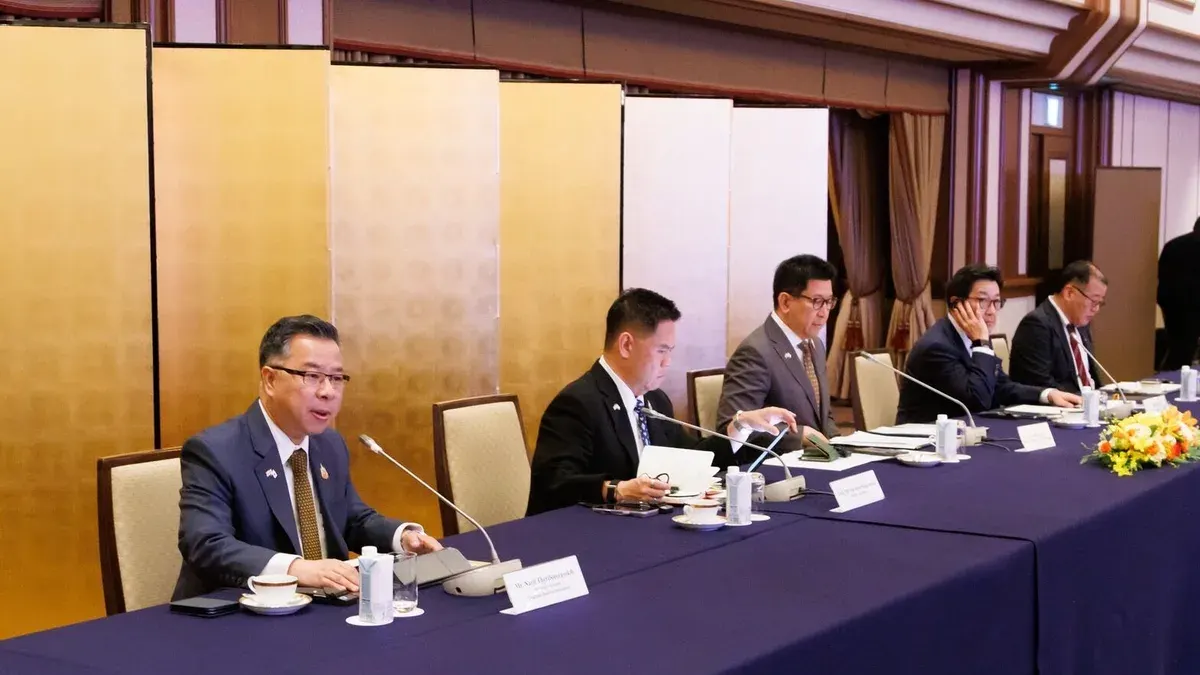
Deputy Prime Minister and Finance Minister Pichai Chunhavajira led the BOI and the Joint Standing Committee on Commerce, Industry and Banking (JSCCIB) in partnering with the Japan Business Federation (Keidanren) to advance three future supply chains — next-generation vehicles, AI, and modern power grids — under the 'Made with Thailand' banner. BOI Secretary-General Narit Therdsteerasukdi disclosed that on November 19, 2026, Pichai chaired the Thailand-Japan Investment and Business Dialogue 2026 in Tokyo, jointly organized by the BOI and Keidanren. The meeting included leaders from the three JSCCIB institutes and over 40 Thai executives, who engaged with 64 Japanese representatives from 38 companies and Keidanren across nine industrial groups.
Pichai stated that Thailand aims to elevate cooperation from 'Made in Thailand' to 'Made with Thailand,' enabling entrepreneurs from both nations to co-develop technology and create business opportunities by leveraging existing industrial bases toward new sectors — next-generation vehicles, semiconductors, and aerospace. Thailand offers potential in high-precision component manufacturing, supported by the Thailand FastPass mechanism to accelerate investment promotion approvals, alongside job creation, workforce development, and linking Thai entrepreneurs into supply chains.
The private sectors delved into three target supply chains: next-generation vehicles and parts to increase Thai manufacturers' role in supporting various electric vehicles (xEV) and new car models; AI infrastructure and advanced electronics, highlighting Thailand's potential in power systems, cooling systems, and optical transceiver equipment; and modern power grids to support new industries, data centers, and renewable energy integration.
Three cooperation agreements were signed at the event: 1. Amata B. Grimm Power and NTT Global Data Centers signed an MoU to develop digital infrastructure, AI ecosystems, and sustainable energy infrastructure in Thailand. 2. The Federation of Thai Industries (FTI), the Japan Aerospace Exploration Agency (JAXA), and the Japan External Trade Organization (JETRO) signed a letter of intent on supply chain development. 3. GS1 Thailand and GS1 Japan signed an MoU on product identification and traceability under international standards.
Keidanren representative Keita Ishii noted that over 6,000 Japanese companies currently invest in Thailand, creating approximately 1.4 million jobs. Keidanren supports clean energy cooperation under the AZEC framework, including renewable energy, grid interconnection, and EV battery recycling, as well as promoting green investment through the JCM mechanism, expanding free trade cooperation, and supporting Thailand's OECD membership ahead of the 140th anniversary of Thai-Japan diplomatic relations in 2027.
JSCCIB leaders urged the Thai Chamber of Commerce to accelerate business matching and connect Thai SMEs to Japanese supply chains. The FTI promoted technology cooperation and human resource development, while the Thai Bankers' Association supported SME access to funding and cross-border financial services. The mission also included a semiconductor and advanced electronics dialogue on November 18 to link business, technology, and workforce collaboration.
Narit added that in the first nine months of 2026, Japanese investors submitted 192 investment promotion applications worth a combined 45.478 billion baht. The BOI will follow up on the Tokyo discussions to drive these into actual investments.