Thailand, Japan Deepen Economic Cooperation in Tokyo Talks
Thailand's Deputy Prime Minister and Finance Minister Pichai Chunhavajira led a high-level delegation to Tokyo for talks with JETRO and METI to strengthen bilateral trade and investment ties. Japan endorsed Thailand's EV tax restructuring and emphasized the importance of clear tax guidelines for long-term Japanese investment planning. Both sides agreed to upgrade Thai auto parts makers and SMEs, expand cooperation into semiconductors, clean energy, biofuels, and emerging sectors like aerospace and quantum technology under the 'Made with Thailand' framework.
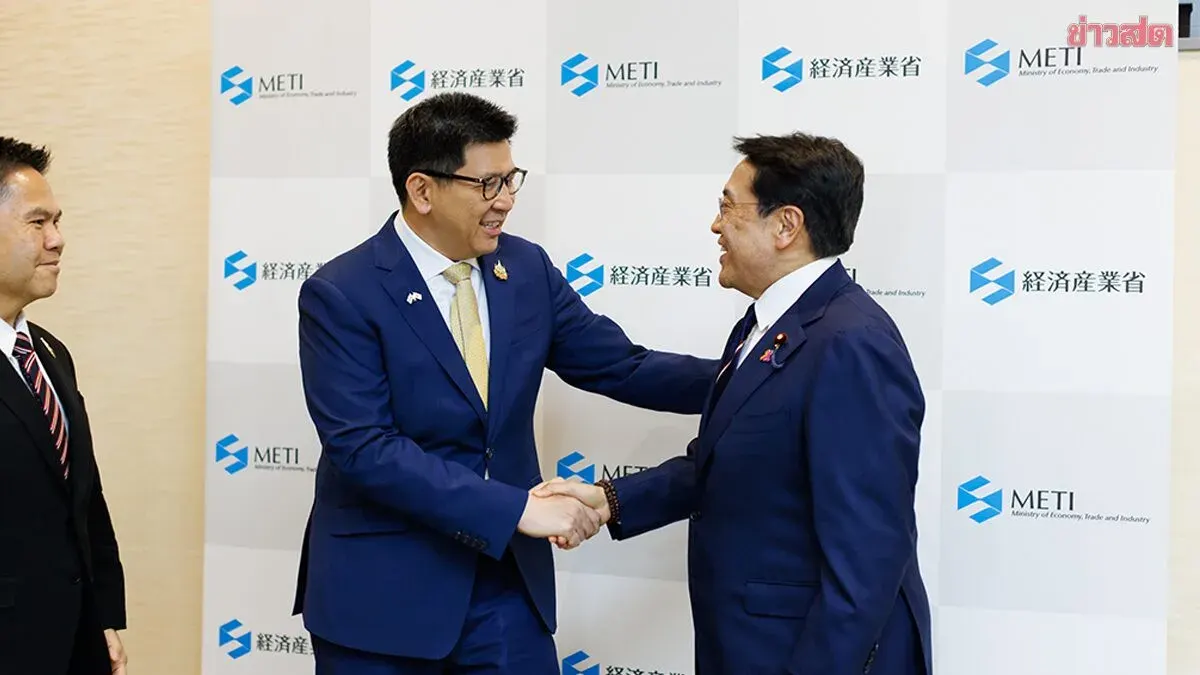
Deputy Prime Minister and Finance Minister Pichai Chunhavajira led an economic delegation in talks with JETRO and METI in Tokyo to strengthen trade and investment cooperation, elevate the automotive, semiconductor, clean energy, and advanced technology industries, and push Thai parts manufacturers and SMEs into Japanese supply chains to build a new production base alongside technology transfer and enhanced competitiveness.
On November 18, 2026, in Tokyo, Japan, Deputy Prime Minister and Finance Minister Pichai Chunhavajira, along with Industry Minister Akanat Promphan, Finance Permanent Secretary Lawan Saengsanit, and BOI Secretary-General Narit Therdsteerasukdi, met with Mr. Ishiguro Norihiko, Chairman and CEO of the Japan External Trade Organization (JETRO), before meeting with Mr. Akazawa Ryosei, Japan's Minister of Economy, Trade and Industry (METI), to elevate cooperation on economic, trade, and investment policies between the two countries.
In talks with JETRO, the Japanese side confirmed Thailand remains an important investment base and is ready to link global Japanese investor networks with new opportunities in Thailand, particularly in the future automotive industry, semiconductors, clean energy, and advanced technology. They also accepted Thailand's approach to restructuring excise taxes on imported fully-built electric vehicles and proposed creating clarity on tax guidelines and import regulations so Japanese companies can plan long-term production and investment in Thailand with confidence.
In discussions with METI, both sides emphasized maintaining the strength of the automotive industry base and supply chains between Thailand and Japan. The Japanese side accepted Thailand's tax approach and proposed considering measures to support entrepreneurs who produce and use parts domestically.
Deputy Prime Minister Pichai stressed the importance of upgrading Thai parts manufacturers and SMEs to grow alongside Japanese investment. Both sides also discussed cooperation on biofuels, circular economy, and expanding the automotive industry base into aerospace and quantum technology, as well as using bilateral negotiation mechanisms to drive tangible cooperation results in line with the 'Made with Thailand' concept that aims to maintain the existing industrial base while creating jobs, transferring technology, and opening opportunities for Thai entrepreneurs to participate in future supply chains.