Thailand Considers 35% EV Tariff to Boost Domestic Production
Thailand's Trade Policy and Strategy Office recommends raising EV import tariffs to 35 percent to attract domestic EV and hybrid production investment. While Thailand leads ASEAN in auto manufacturing, its exports remain 87 percent ICE vehicles, far behind the global shift where new energy vehicles now represent 42 percent of exports. Current EV incentives have caused oversupply and price wars, threatening established domestic manufacturers and parts suppliers who pay higher excise taxes.
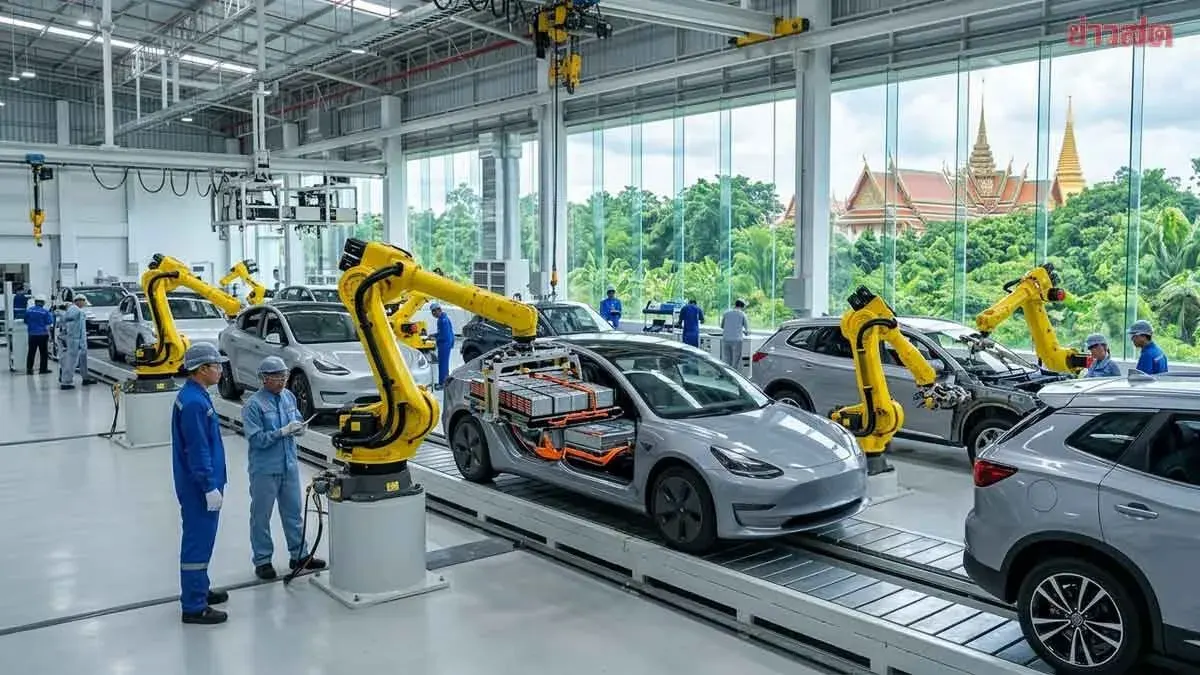
The Trade Policy and Strategy Office (TPSO) says raising the import tariff on electric vehicles to 35 percent would help attract EV and hybrid production investment to Thailand. Director-General Nanthapong Jiralekphong revealed that Thailand's automotive industry faces a critical turning point as the world shifts toward clean energy. Although the Thai EV market has grown dramatically, that growth depends mainly on importing finished technology and parts from abroad rather than building domestic value added and linking with local supply chains, which could affect the country's employment structure and automotive production base. The government has therefore pursued proactive policies to preserve domestic production and labor.
In 2025, Thailand ranked as ASEAN's top automotive production and export hub and 11th globally, with strengths in midstream and downstream supply chains including parts manufacturing, vehicle assembly, and exports. However, over the past five years, Thailand's passenger vehicle export structure still relied on internal combustion engine (ICE) vehicles for as much as 87 percent, with diesel vehicles alone accounting for 47 percent of total passenger vehicle export value, showing that Thailand's new energy vehicle exports remain small compared to ICE vehicles.
Meanwhile, the global automotive market is shifting from reliance on ICE vehicles to new energy vehicles — hybrids (HEV), plug-in hybrids (PHEV), and battery electric vehicles (BEV). According to Global Demand Dashboard international trade statistics on the ThinkTrade.com website, the global share of new energy passenger vehicle exports rose from 20.1 percent in 2020 to 42.2 percent in 2025. Thailand's share, by contrast, increased only from 8.1 percent to 12.5 percent — a key signal reflecting the need for Thailand to accelerate production restructuring to align with new market directions to maintain long-term competitiveness.
To push Thailand as an EV production base and attract foreign investment, the government introduced the EV 3.0 and EV 3.5 measures, offering subsidies and tax incentives to manufacturers to encourage consumers to adopt EVs, before extending conditions for operators to establish domestic production bases. This drew foreign automakers to set up assembly and battery plants in Thailand. These measures, combined with the ASEAN-China Free Trade Area (ACFTA) agreement, increased Thai imports of finished EVs from China, consistent with China's rise from the 17th largest vehicle exporter in 2020 to the second largest in 2025. Since the measures began in 2022 through 2025, the value of EVs imported from China nearly quadrupled.
However, accelerating EV imports to expand market share, combined with production capacity from new factories coming online, created oversupply and fierce price competition. This directly affected domestic ICE and hybrid manufacturers who have invested in supply chains and employment in Thailand for decades and still bear standard ICE excise tax rates of 25–35 percent, creating competitive inequality. The impact has cascaded to parts manufacturers, some of whom have reduced working hours and shut down production lines.
To preserve domestic investment and production bases, the government has implemented measures to...