Maha Sarakham Health Officials Defend Liver Fluke Screening Results
Maha Sarakham health authorities screened 4,000 people for liver fluke infection using a new urine antigen test kit approved by Thailand's national health insurance office, defending the method against concerns about false positives.
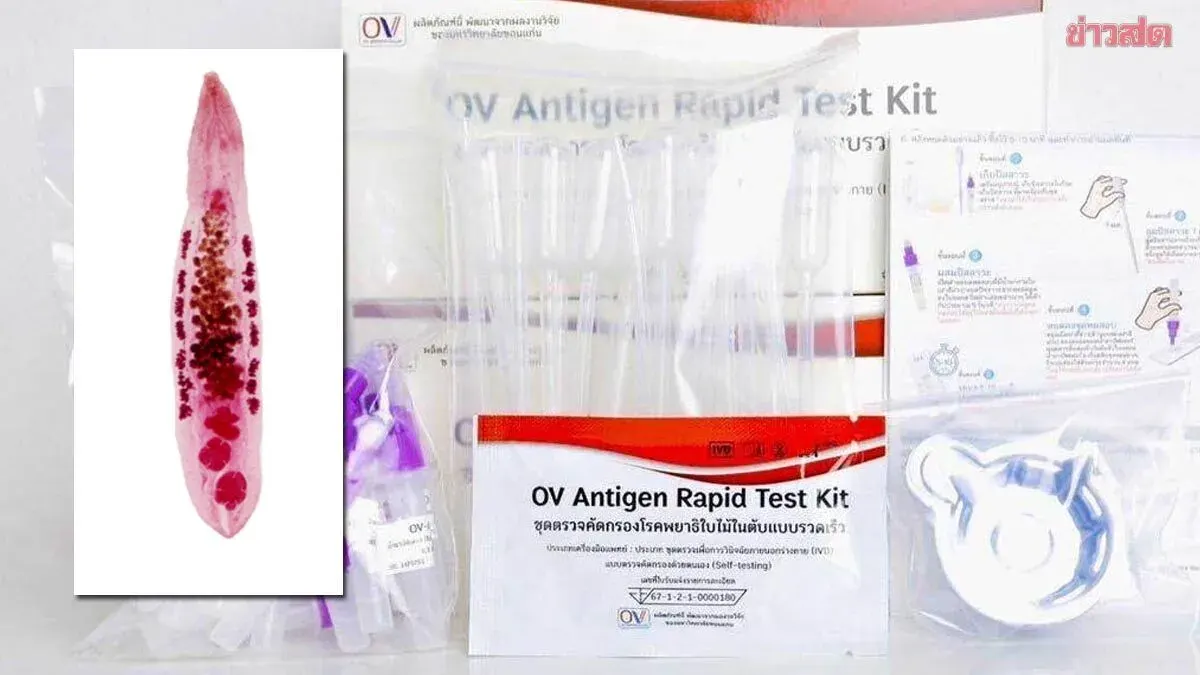
On July 7, Dr. Hascha Neuoytong, the provincial public health officer for Maha Sarakham, addressed criticism surrounding the liver fluke screening program that found a large number of positive cases, raising concerns from multiple parties that the testing kit had low specificity and might produce many false positives.
Dr. Hascha clarified that the screening was a Maha Sarakham provincial health office project, with the office managing the program and screening at-risk populations. The testing used an innovation unit registered with the National Health Security Office (NHSO), which provided the testing service and funded it—not a kit the provincial office procured independently.
The testing kit, called the Urine Antigen Test Kit (Urine ATK), detects antigens from urine in a manner similar to COVID-19 ATK kits but identifies fragments of the liver fluke parasite rather than parasite eggs. "In the past, Thailand used stool examinations viewed under microscopes to find parasite eggs, which worked well because Thai people carried significant parasite loads, producing many eggs in stool," Dr. Hascha explained. "However, today Thai people use deworming medication more frequently, so parasite loads have decreased, leading to fewer eggs in stool and more false negative results from traditional screening."
Dr. Hascha noted that researchers from Khon Kaen University developed the new antigen detection technique to find parasite antigens in urine—pieces of the parasite such as waste it releases into the bloodstream or naturally shed skin fragments detectable in urine.
"Out of approximately 10,000 at-risk people screened, we found about 4,000 positive cases," Dr. Hascha stated. "Antigen testing detects infections better than stool egg detection because the absence of eggs doesn't mean no infection—parasites may not be releasing eggs yet or release so few they're undetectable. Antigen testing directly detects parasite fragments."
When asked if the screening covered everyone using this method, Dr. Hascha confirmed it did, screening many people simultaneously. The screening has tested over 10,000 people, finding approximately 4,000 positive cases as previously reported.
Dr. Hascha acknowledged the high detection rate was concerning, as previous control efforts were believed to have improved the situation based on lower stool test findings. "However, with this new testing method, we must reconsider whether the prevalence truly decreased or simply appeared lower with the old method. Further studies are needed to confirm the accuracy of antigen test results," he said. The Department of Disease Control is preparing to visit Maha Sarakham to investigate further.