Thailand NESDB Launches 14th Plan to Lift Growth Above 3%
We need to produce a short summary 1-2 sentences, 120-220 characters, max 240. Must be English only. Provide factual summary. Lead with what happened, then single most important detail (who, where, when). So first sentence: NESDB launched i
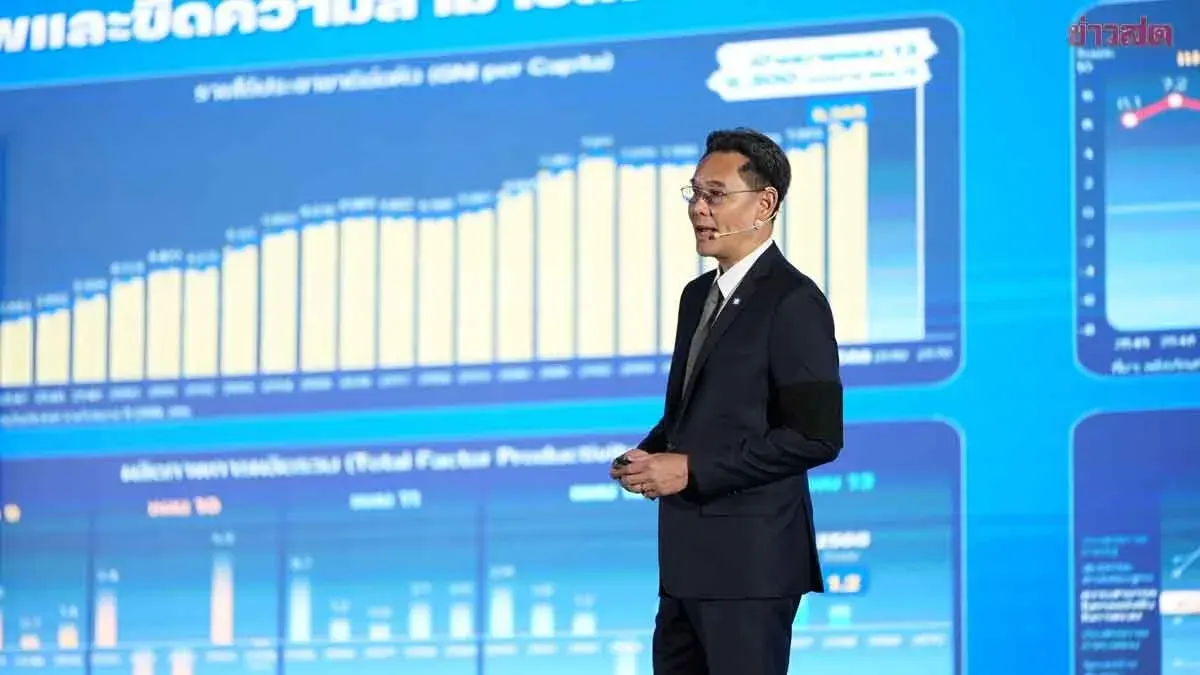
The NESDB said productivity grew only 1.2% in 2025, while Thailand’s competitiveness ranking stands at 26th, short of the goal to break into the top 20 by 2029. The agency wants the economy to expand at 3% or higher. On the social front, the Human Achievement Index (HAI) is 0.64, below the target of 0.72, and the income gap between the richest 10% and the poorest 40% is 5.04 times. Environmentally, Thailand must cut greenhouse‑gas emissions and cope with climate risks; it ranks 17th globally for exposure to extreme weather, while public‑sector effectiveness is 32nd, shy of the 15th‑place target.
Danucha noted that Thailand also faces reshoring of production, shifting global economic rules, climate change, and a rapidly ageing society that is shrinking the labour force, while AI reshapes work. If workers do not upskill, future job prospects could suffer.
For the 14th plan, the NESDB consulted government, business, citizens, youth and international organisations, and held forums in 18 provincial clusters. Key proposals include improving SME access to finance, creating quality jobs, developing local products, disaster‑warning systems and anti‑corruption measures.
The implementation framework rests on four pillars: raising productivity, spreading opportunity inclusively, enhancing adaptability, and building immunity. Under the TRUST strategy, 13 priority reform areas are pursued:
T – Transform the economy: restructure agriculture, processing industry and tourism, and create new engines such as future vehicles, high‑tech industry, health‑care and creative economy.
R – Reform the public sector: streamline redundant procedures, boost efficiency and transparency, and revise outdated laws.
U – Upgrade human capital: upgrade workforce skills, align education and vocational training with market needs, and address declining birth rates and an ageing society.
S – Sustain natural resources and the environment: manage water and disasters, pursue low‑carbon economy, energy transition and smart power grids.
T – Technology and innovation: aims to transfer technology from low‑investment projects …