PSU Students Win National Sustainability Contest with Community Innovation
The user wants a short summary (1-2 sentences, 120-220 characters, max 240) for a news deck. The article is about PSU students winning a national sustainability contest with a community innovation project in Phatthalung. Key points: PSU tea
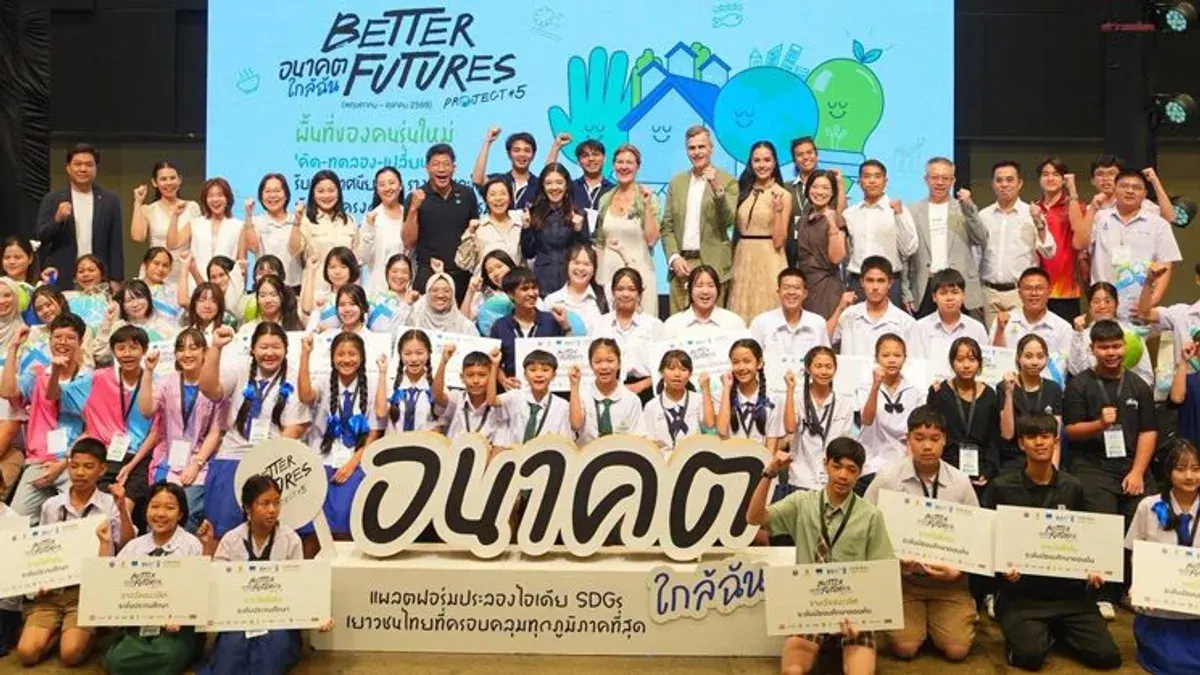
Prince of Songkla University congratulates the team "Because Teachers Believe in People" for winning first place nationally at the Better Futures Project 2026 finals, held under the theme "Future Near Me" at CentralWorld in Bangkok. The victory highlights the potential of southern Thailand representatives who applied scientific knowledge to develop socially relevant innovations for the future. The team consists of seven students — Nakorn Warathanti, Patcharapol Faiju, Jakkarin Borirak, Chawalya Jaipleen, Niyada Jitmani, Leawraa Phokaeo, and Thanyawan Suksri — supported by five faculty advisors: Assistant Professor Dr. Karakot Wijitsanguan Chetwaran, Associate Professor Dr. Pimolsri Mittraphap-athorn, Associate Professor Dr. Chularat Chumnuan, Assistant Professor Dr. Ammarat Rattana, and Dr. Morakot Kaewphet.
The collaboration originated from a group of seven students who had previously worked together at a Songkhla Nakharin camp for disaster victims. They recognized that scientific and mathematical processes should not end in the classroom or with short-term projects. With support from the Better Futures Project by the United Nations Development Programme (UNDP) and network partners, the team chose to engage directly with the Ban Ta Chang community enterprise in Phatthalung province to address the challenge of "Beautiful Seas, Sustainable Tourism, and Communities Living Together." They understood that environmental and wastewater issues in the Songkhla and Phatthalung lake basins are interconnected through a single water system.
During fieldwork, the team collaborated with Khun Mali Phangwong, president of the Ban Ta Chang community enterprise, and identified key limitations in the group's tie-dye fabric products: color fading, poor colorfastness, undistinctive patterns, and inability to market the goods. Moreover, the use of synthetic mordants (fixing agents) harmed the marine environment, particularly damaging and bleaching coral reefs if contaminated water reached the sea. Although most team members had mathematics backgrounds, they researched and experimented to find natural substitutes, discovering that locally sourced "wild banana sap" effectively fixes dyes without harming ecosystems.
Beyond natural dye chemistry, the team applied a geometric mathematics program (GSP) to design community-identity patterns and develop them into screen-printing blocks. They incorporated the image of a three-trunked elephant raising its leg against the backdrop of Khao Ok Thalu mountain, a key symbol of Phatthalung province. They also utilized leftover sago flour from local production to create natural screen-printing ink, transforming ordinary tie-dye fabric into distinctive, value-added handicrafts ready for development into creative tourism workshops to attract visitors.
This success reflects the core of "Three Changes" the team achieved: changing mindsets by turning local resources like wild banana sap and sago flour into innovations; changing methods by reducing chemical use and adopting eco-friendly natural processes; and changing roles from classroom students to youth driving community development, empowering locals to become proud producers and presenters of their own work. It clearly demonstrates that Sustainable Development Goals (SDGs) can be tangibly achieved when powered by science and belief in human potential.