BLCP Releases 3.9 Million Aquatic Animals to Restore Rayong Marine Resources
BLCP Power Plant in Rayong marked its 24th annual aquatic animal release, partnering with industrial, government, and fishing groups to restock 3.9 million juveniles including shrimp, crabs, and fish. The long-running ESG initiative aims to restore marine ecosystems, support sustainable livelihoods for local fishermen, and strengthen community-industry relations along the Rayong coast.
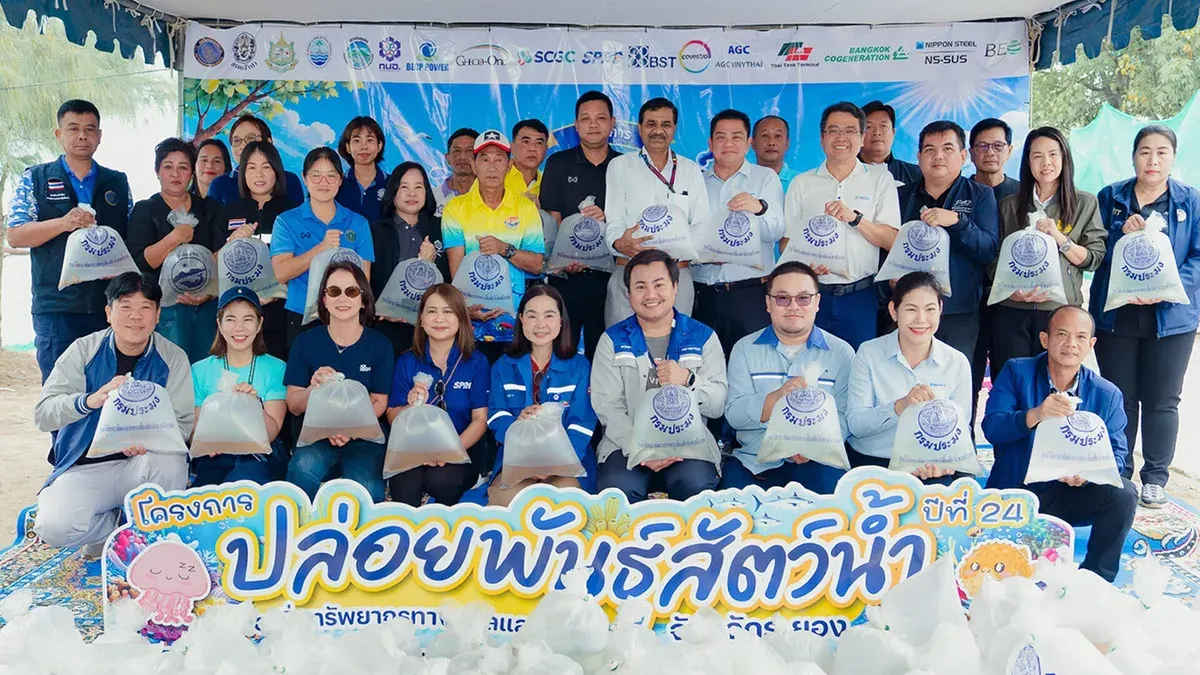
BLCP Power Plant reinforces its sustainability and ESG mission by joining forces with 11 partners from the Map Ta Phut industrial network, government agencies, and all seven small-scale fishing community enterprises to release 3.9 million aquatic animals. The initiative restores richness to the Ban Chang and Rayong coastlines, serving as a mechanism to revive marine ecosystems while generating stable income for local fishermen for 24 consecutive years.
BLCP Power Limited, as a project initiator and main organizer, hosted the "Aquatic Animal Release Project to Increase Marine and Coastal Resources in Rayong Province, Year 2026" for the 24th time at the Plao U-Thaphao Samakkhee Small-Scale Fishing Group (Plao Beach), Ban Chang District, Rayong Province. Adisorn Wangmun, Vice President of Finance and Corporate Administration at BLCP Power Limited, welcomed attendees alongside Plao Subdistrict Mayor Pongchai Lueanlon, who presided over the ceremony, along with government representatives, industrial partners, and fishing group members.
Adisorn Wangmun explained that BLCP operates under a mission covering environment, society, and governance, focusing on sustainable growth, income distribution, and improving local quality of life alongside proactive conservation projects such as mangrove planting and aquatic animal releases carried out continuously for 24 years. Fishing is a traditional occupation in Rayong due to abundant aquatic resources, supporting both small-scale and commercial fisheries. The release project aims to increase aquatic populations and maintain ecological balance. Continuously restocking juvenile aquatic animals back into the sea acts like "natural capital investment," leading to stable careers and income for local fishermen while fostering awareness of marine and coastal conservation. Crucially, it builds good relationships among government, communities, and industrial operators in Rayong.
The release activity is held regularly eight times a year, serving as a key gear in restoring marine ecosystems, enhancing biodiversity, and reviving coastal nursery grounds. This results in continuous catches for small-scale fishermen, reduced fuel costs, and sustainable income for the grassroots economy. This release totaled 3,900,000 animals, comprising 2,900,000 shrimp larvae, 990,000 crab larvae, 8,900 blood cockles, 650 white snapper, and 450 broodstock horseshoe crabs. The juvenile animals were purchased from fishing groups that BLCP Power Plant has supported with breeding knowledge transfer, providing the fishing groups with income of 2