Thailand Sends First Homegrown Moon Equipment to Chang'e-7
Thailand's first homegrown lunar instrument, CE-7 MATCH, will launch aboard China's Chang'e-7 mission on August 24 to measure cosmic radiation and study Sun-Earth-Moon relationships from orbit.
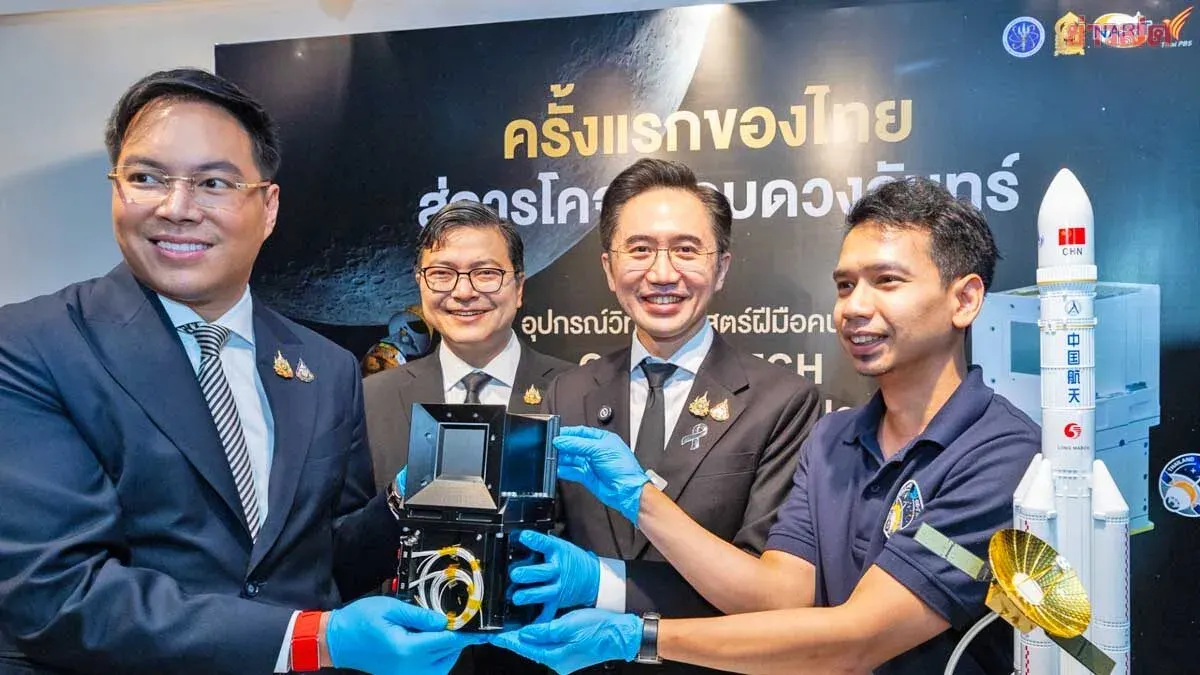
Thailand is preparing to send the CE-7 MATCH scientific instrument, designed and developed by Thai engineers, to participate in a lunar exploration mission for the first time under the Chang'e-7 program. This marks another significant milestone for Thai science and space research, underscoring Thailand's capability in space technology development, engineering, and frontier research recognized internationally.
The National Astronomical Research Institute of Thailand (NARIT) under the Ministry of Higher Education, Science, Research and Innovation held a press conference announcing "Thailand's First Mission to Lunar Exploration" at the ministry headquarters. The institute announced the readiness of the Thai-made CE-7 MATCH scientific instrument to conduct lunar exploration as one of seven international scientific instruments for the Chang'e-7 mission, with partnerships including the Ministry of Education, Thai PBS, and Sea (Thailand).
A live broadcast of the Long March-5 Y14 rocket launch carrying the Chang'e-7 spacecraft into space is scheduled for August 24 at approximately 7:00 a.m. Thai time, accompanied by science, engineering, and space technology learning activities for the public nationwide.
Deputy Prime Minister and Minister of Higher Education, Science, Research and Innovation Prof. Dr. Yotchanan Wongswadiwat stated that the success of the CE-7 MATCH mission results from continuous investment in science, research, and innovation.
The CE-7 MATCH (Chang'e-7 Moon Aiming Thai-Chinese Hodoscope) is a scientific instrument jointly developed by NARIT and Mahidol University under Thai-Chinese cooperation within the International Lunar Research Station (ILRS) project. It was developed based on scientific objectives aligned with the Chang'e-7 mission goals before being selected as one of seven international scientific instruments to orbit the Moon.
The instrument's mission includes measuring cosmic radiation or high-energy particles in space and studying relationships between the Sun, Earth, and Moon to understand radiation origins and processes that may affect humans in the future, particularly establishing knowledge foundations for long-term space exploration and lunar settlement.
Deputy Prime Minister Prof. Dr. Yotchanan Wongswadiwat stated that the CE-7 MATCH mission's success results from continuous investment in science, research, and innovation, including personnel development, knowledge creation, and cooperation among research institutions, universities, and international partners, which has raised the country's advanced technology capabilities through building upon existing knowledge to create Thailand's own knowledge and technology, enhancing competitiveness and creating new economic opportunities.
Prof. Dr. Yotchanan stated that the government aims to transform Thailand from a "technology user" to a "technology creator" by using Thai knowledge as the foundation for innovation that generates economic value, coupled with human capital development, support for frontier research, and promotion of the space industry.