Kasetsart University Receives NASA Payload for Liquid Crystal Space Research
The user wants a short summary of the article about Kasetsart University receiving a NASA payload for liquid crystal space research. The summary must be 1-2 sentences, 120-220 characters, max 240. English only. No filler. Lead with what hap
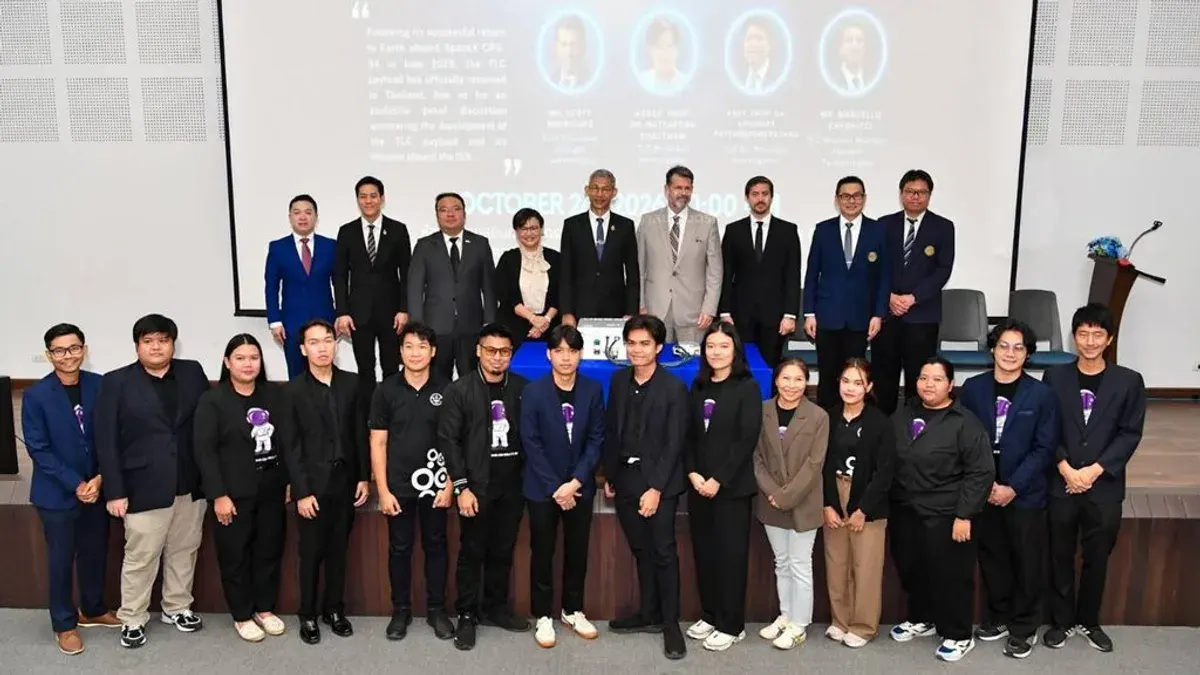
On October 26, 2026, Kasetsart University's Faculty of Science hosted 'Exposed to Space: TLC Payload Return and Our next ISS External Mission.' Voyager Technologies, the TLC project's space advisor, received the payload from NASA and tasked Scott Rodriguez, Vice President, and Marcello Caporicci, TLC Mission Manager, with returning it to the university research team. President Associate Professor Dr. Kongsak Theingtham accepted the payload at the Sumin Suthumkul Conference Room in the Physical Science Building during the faculty's 45th anniversary.
The Thailand Liquid Crystals in Space (TLC) project, led by Associate Professor Dr. Natthaporn Chattham from the Physics Department, studies thin liquid crystal films under microgravity on the International Space Station. Launched in 2021 under a memorandum of understanding between Kasetsart University and NASA, the experiment aims to develop advanced Liquid Crystal Display (LCD) technology. LCD screens are ubiquitous in Thai smartphones across all demographics, with the global LCD industry valued at approximately $150 billion annually and projected to reach $1.4 trillion by 2029. Conducting experiments in space eliminates Earth's gravity, significantly reducing defects in liquid crystals and improving their response to electric fields.
The TLC project received primary funding for payload construction and testing from the Human Capital Development Fund and the Higher Education Institution, Research and Innovation Development Fund under the National Science and Technology Development Agency (NSTDA), plus additional support from Kasetsart University and the Geo-Informatics and Space Technology Development Agency (GISTDA). Launch and in-space operations by NASA astronauts were funded by the U.S. ISS National Laboratory and NASA, valued at over 500 million baht.
President Dr. Kongsak praised the TLC project's success as a source of pride, reflecting the university's capacity to support complex, cutting-edge scientific research — particularly in space, which demands multidisciplinary expertise, comprehensive preparation, and sustained effort. He emphasized Kasetsart's commitment to both applied and fundamental research, noting that basic research forms the foundation for long-term technological innovation. The TLC achievement demonstrates that the university's existing knowledge and expertise can be extended to highly challenging research when pursued rigorously.