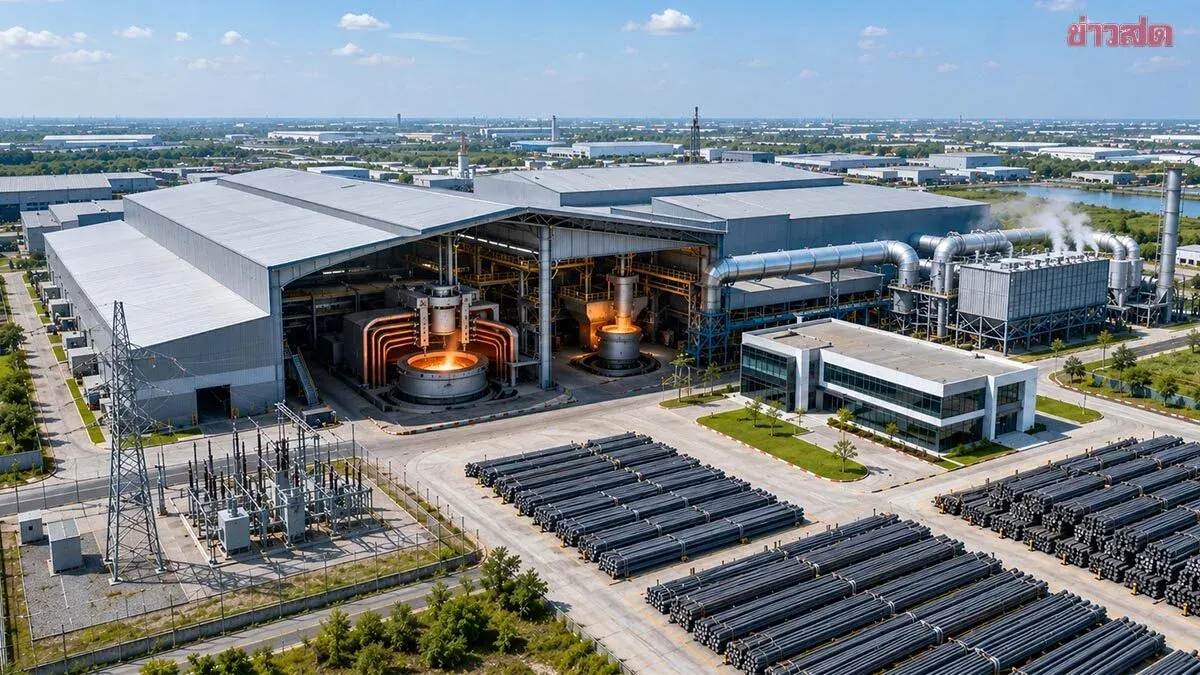
Modern IF furnace steel technology with secondary refining produces cleaner, safer materials for Thai construction while reducing air pollution by up to six times and lowering production costs compared to alternative methods.
Dr. Sakkachai Thanabodee, chairman of the Induction Furnace (IF) Metal Casting Operators Association, says that amid public and consumer concerns about construction material safety standards, steel production technology—particularly IF furnace steel—has come under broad scrutiny for its perceived past limitations. However, modern metallurgical engineering has advanced significantly. Clean steel production using IF furnaces combined with secondary refining processes overcomes former impurity removal constraints and strengthens building structure safety, reduces air pollution by up to six times, and serves as a critical key to sustainable Thai construction industry development.
1. Automatic Steel Stirring Innovation for Uniform Steel Quality
A common misconception is that IF furnaces cannot produce clean steel. In reality, IF melting relies on electromagnetic induction to generate eddy currents, which create automatic electromagnetic stirring of the molten steel. The steel circulates from the edges to the center and continuously moves upward, ensuring uniform chemical composition and temperature distribution throughout the furnace (homogeneity). The magnetic field stirring also helps lift lighter inclusions and impurities to the surface, allowing producers to efficiently add slag-forming agents and remove them from the furnace.
2. Quality Enhancement Through Secondary Refining—Overcoming Chemical Limitations
Modern high-standard IF steel mills now employ secondary steel refining technology. When molten steel from the IF furnace is transferred to a refining furnace (such as LF or AOD), argon gas is blown and chemical composition is carefully adjusted. Using secondary refining furnaces with basic refractory materials can reduce sulfur (S) content to minimal levels of 0.002%, which improves ductility and toughness, preventing brittleness and enabling excellent performance in earthquake-resistant applications.
3. Eliminating Brittle Steel from Nitrogen Contamination
A significant metallurgical advantage of IF furnaces compared to electric arc furnaces (EAF) is nitrogen contamination. EAF requires high-temperature electric arcs that ionize atmospheric nitrogen molecules, absorbing up to 80–100 ppm into the molten steel, causing hardness and brittleness. In contrast, IF furnaces lack such high-temperature arcs, resulting in minimal nitrogen pickup and completely reducing the risk of brittle steel.
4. Environmentally and Economically Friendly
In terms of sustainability, IF furnace technology produces far lower air pollution, with only 1–2 kilograms of dust per ton compared to EAF furnaces that emit 6–12 kilograms per ton (a sixfold difference). Operating noise is also lower at 82–86 decibels, and importantly, operating costs are 20–25% cheaper, helping prevent monopolistic pricing of structural steel in the country.