Education Council and Equitable Education Fund Sign 3-Year MOU to Reduce Inequality
Thailand's Office of the Education Council and Equitable Education Fund have signed a three-year MOU to integrate knowledge bases and data systems aimed at reducing educational inequality. The partnership will focus on equitable resource allocation, teacher development, and data-driven policy innovation to improve education quality nationwide. The agreement runs from 2026 to 2029 and targets underprivileged children and youth for sustainable access to quality education.
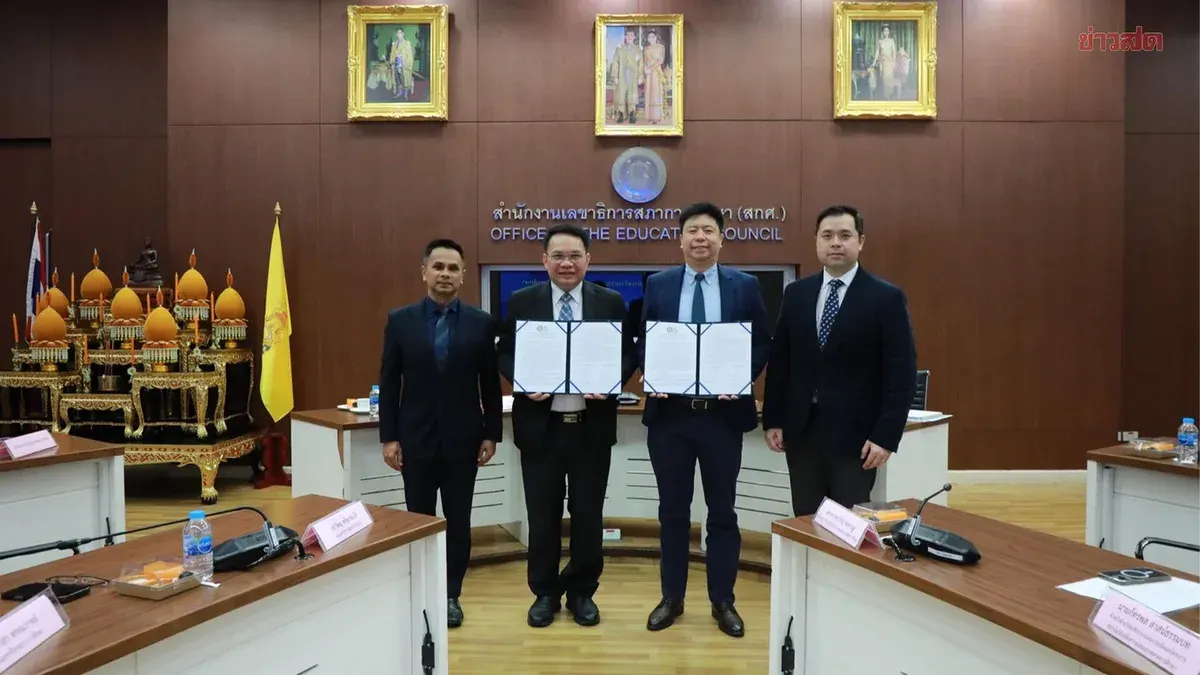
The Office of the Education Council (OEC) and the Equitable Education Fund (EEF) have signed a memorandum of understanding to integrate knowledge and databases in promoting educational equity and quality, with a three-year operational framework. The agreement aims to combine strategic expertise and deep data resources to sustainably drive national human resource development.
The signing ceremony took place at the Kamphaeng Phet Auditorium of the Office of the Education Council, with Dr. Pichet Phophakdee, Secretary-General of the Education Council, and Dr. Kraiyos Patrawart, Managing Director of the Equitable Education Fund, as primary signatories, witnessed by Dr. Wisanu Thapsombat, Deputy Secretary-General of the Education Council, and Assoc. Prof. Dr. Sawarat Phalaharn, Director of the Research Institute for Equitable Education.
The cooperation spans three years (from November 13, 2026 to November 13, 2029) and focuses on merging the capacities of both agencies to reduce educational inequality and elevate learning quality through three main frameworks:
• Integration of resources and knowledge: Jointly driving policy and educational resource allocation for equity, responsive to specific local contexts and needs, alongside scaling up knowledge and prototype innovations into practice. • Personnel and learning environment development: Enhancing teacher and education personnel capacity to support flexible learning, creating learning ecosystems linking families, communities, and the private sector, and strengthening local resource management efficiency. • Data systems and policy innovation development: Driving standardized, secure data infrastructure and technology to accurately analyze and monitor inequality situations, leading to concrete policy recommendations.
Under this agreement, the OEC, as the national strategic body and education knowledge hub, will provide expert support, personnel, research, and academic resources to jointly drive national policy proposals. Meanwhile, the EEF will support academic works, learning management innovations, and deep database systems to target and assist underprivileged or opportunity-deprived children and youth in accessing quality education thoroughly and sustainably.