Flood Devastates Durian Farms Across Nine Chanthaburi Districts
Severe flooding in Chanthaburi province has submerged durian orchards across nine districts, damaging over 20,000 rai of farmland and affecting more than 4,000 farmers. The disaster threatens next season’s premium durian export to China, with recovery expected to take years for affected trees.
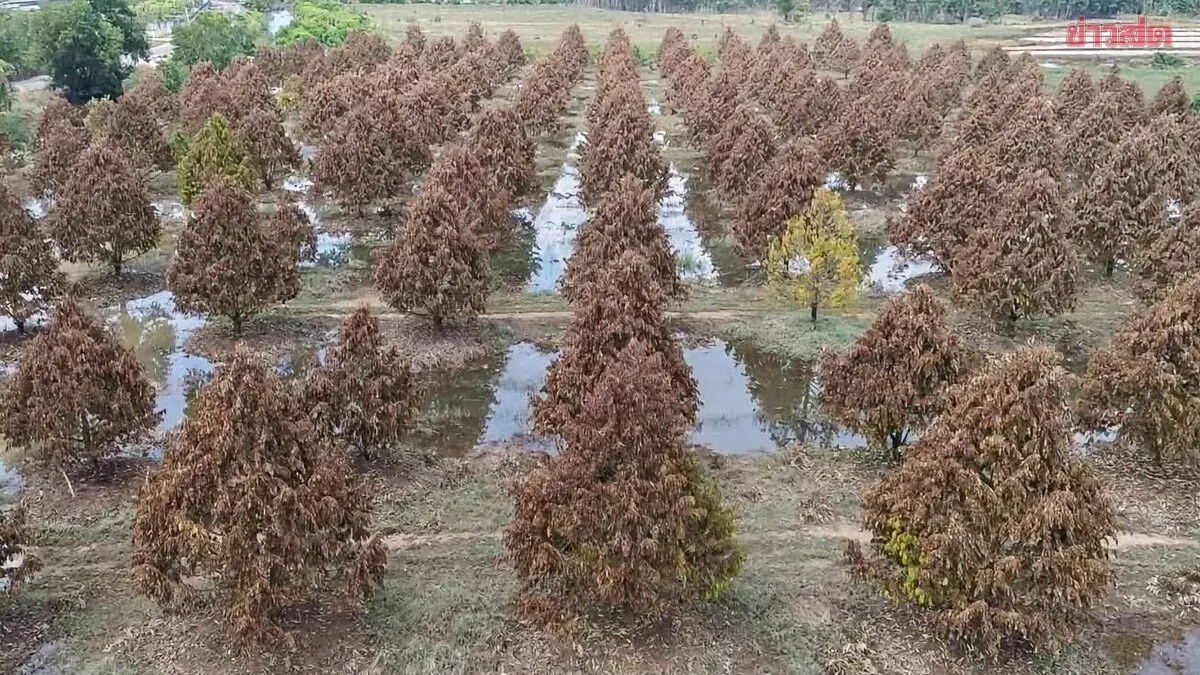
Severe flooding in Chanthaburi province has inundated durian orchards across nine districts, damaging over 20,000 rai of farmland and affecting more than 4,000 farmers. The Kaeng Hang Maeo district suffered the worst impact, with floodwaters lingering for six to eight days and reaching depths of four to five meters in the Sam Phi Nong area, causing root rot and sudden tree death. Similar damage was reported in Khun Song (Wang Jaeng village), Kaeng Hang Maeo, and Pha Wa subdistricts, where rubber and durian orchards were hit by flash floods.
In Tha Mai district, fruit orchards in Khao Kaew subdistrict were submerged nearly two meters for over five days, and durian trees about five years old—soon to be harvested next year—were severely damaged. Additional impacts were noted in Khomong, Thung Bencha, and Si Mum subdistricts. Districts such as Na Ya Am, Khao Khitchakut, Makham, Mueang Chanthaburi, Khlung, Pong Nam Ron, and Soi Dao also experienced overflow from tributaries that flooded fruit farms and damaged agricultural machinery.
Agricultural experts explain that durian trees submerged two to five meters for several days suffer root oxygen deficiency, leaves wilt and turn brown, and the trees may die. Surviving trees require one to two years to prune, restore root systems, and recover before producing again, while completely dead trees need five to six years of replanting before yielding fruit. This threat is expected to reduce the province’s premium durian output for export to China in the coming season.
Regarding relief, the Chanthaburi Province Agriculture Office outlined criteria under the Emergency Disaster Assistance Act of 2026 (2569 BE): total loss of durian trees receives 6,800 baht per rai, growth disruption receives 3,400 baht per rai, and silt or debris covering topsoil qualifies for 16,000 baht per rai for dredging and removal. Farmers must have pre‑disaster registration and submit form Kor Sor 01 to local leaders and village‑level subcommittees for verification before posting objections at the village hall or Tambon Administrative Office for at least three days to propose approval to the Provincial Disaster Relief Committee for direct disbursement via the Bank for Agriculture and Agricultural Cooperatives.
Authorities are also coordinating with the Land Development Station to distribute dolomite lime to adjust acidic, water‑logged soil, and with financial institutions to consider debt suspensions to support Chanthaburi fruit farmers.