Luang Pho Khuean Amulets Consecrated at Uthai Thani Temple
A commemorative amulet series honoring Luang Pho Khuean, a revered monk famed for his prophetic incantations, was consecrated at Wat Nong Kadi in Uthai Thani province in 1972. The eight-item collection — including statues, coins, and yantra cloths — was created to fund public welfare and education projects. Luang Pho Khuean, who died in 1954, studied occult arts under prominent masters and served as abbot of several temples before his final residence at Wat Nong Kadi.
Luang Pho Khuean Sangwaratham, the revered abbot of Wat Nong Kadi in Tap Than district, Uthai Thani province, was widely known for his potent incantations — whatever he spoke came true — earning him the title "Deity of the Sakae Khrang River Basin."
According to his biography, Luang Pho Khuean was of Chinese descent, born a Thai citizen in Buddhist Era 2432 (1889 CE) in Ban Khlong Chado, Tung Yai subdistrict, Mueang district, Uthai Thani. He was ordained in BE 2453 (1910 CE) at Wat Nong Tao under Phra Khru Uthai Thammawinith (Luang Pho Sin) as preceptor, receiving the monastic name Sangwaratham.
He spent three rains retreats studying occult sciences with Luang Pho Sin at Wat Nong Tao until mastering incantation and invulnerability arts. At that time, Wat Nong Tao housed many monks and novices, making it unsuitable for mental cultivation. Luang Pho Sin often said, "If you want those arts to work, you must find a quiet place to train the mind." After discussing dhamma with Luang Pho Sin, Luang Pho Khuean asked leave to seek further training. Luang Pho Sin directed him to a master of kasina meditation in the Lopburi area. Accompanied by three other monks, he found the teacher — identified by elders as Luang Pho Kob of Wat Khao Salika, a master of formidable occult knowledge in that era.
Upon arrival, Luang Pho Khuean paid respects and asked to become a disciple to learn sacred chants. Luang Pho Kob said, "If you are not ordained, I will teach you; if you are ordained, I will not." Luang Pho Khuean vowed firmly that in this lifetime he would not seek ordination again, while his companions declined and did not receive the teachings.
He practiced meditation until his mind reached one-pointedness, learned fire kasina, and studied Khmer script for inscribing yantra designs under Luang Pho Kob for six full years. After taking leave, he wandered north on foot for many years, his destinations unknown, before returning to Wat Nong Tao. He stayed only a few days before relatives from Wat Nong Ya Nang invited him to observe the rains retreat there.
While residing there, he built an ordination hall, but before it was completed, disputes arose with the temple committee. He declared, "If I am not here, no one can stay here." Later, finding a resident monk proved difficult, so Luang Pho Khuean returned to Wat Nong Tao.
Eventually, when Wat Nong Kae lacked a monk for the rains retreat, Luang Pho Khuean stayed there for one retreat, then moved to Wat Tap Than Wararam for three more. Later, when Wat Nong Kadi had no abbot, relatives invited him to govern the temple, where he remained until his passing in BE 2497 (1954 CE).
During his lifetime, he created several sacred objects himself, including alms bowls and photographs.
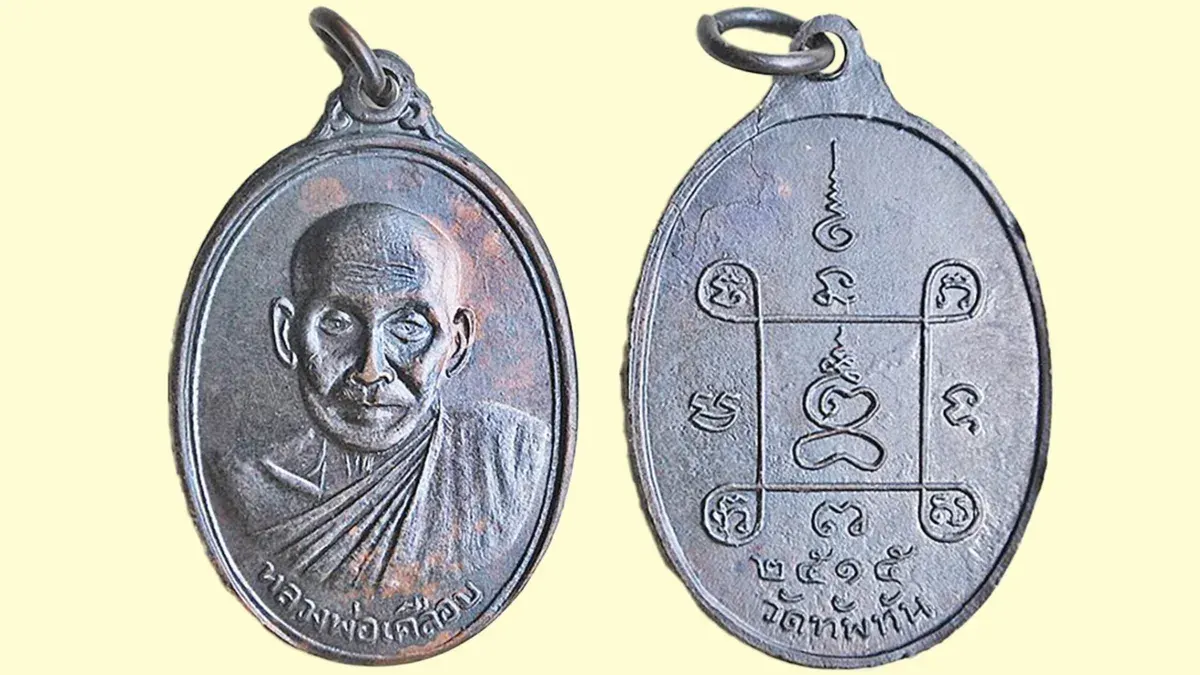
The most popular amulets are the BE 2515 (1972 CE) series, created by Phra Khru Ular Thammakhosit (Sanga Chittasangvaro), former Tap Than district ecclesiastical chief and abbot of Wat Tap Than Wararam, to raise funds for public welfare and youth education support.
The series comprises eight items: a five-inch Luang Pho Khuean statue, a gold-like bronze cast image, a locket coin with Luang Pho Khuean's photo containing alms-bowl powder and yantra cloth on the reverse, a half-body oval amulet in alpaca and bronze with the master's personal yantra on the back, Akkhara yantra flag, Nang Kwak yantra flag, Akkhara yantra cloth, and Nang Kwak yantra cloth.
The Luang Pho Khuean coins and amulets were consecrated in a ceremony inviting the master's spirit, officiated by Brahmins at Wat Nong Kadi, Tap Than district, on April 11, BE 2515 (1972 CE), from 07:00 to 09:00, coinciding with the 13th waxing night of the fifth lunar month. After the ceremony concluded, the items were distributed.