Revered Monk Luang Por Kuay's Amulets Highly Sought by Collectors
Amulets from revered Thai monks like Luang Por Kuay, Luang Por Tuan, and Luang Por Maha Bodhi are now rare and highly sought by collectors, with original 1961 and 1982 editions commanding high prices despite originally costing just 20 baht.
A reflection on Buddhist practice: "We must examine our bodies, consider our words carefully, for this is wisdom itself"—a teaching attributed to Luang Por Cha Subhaddo of Nong Pa Pong Temple, Ubon Ratchathani.
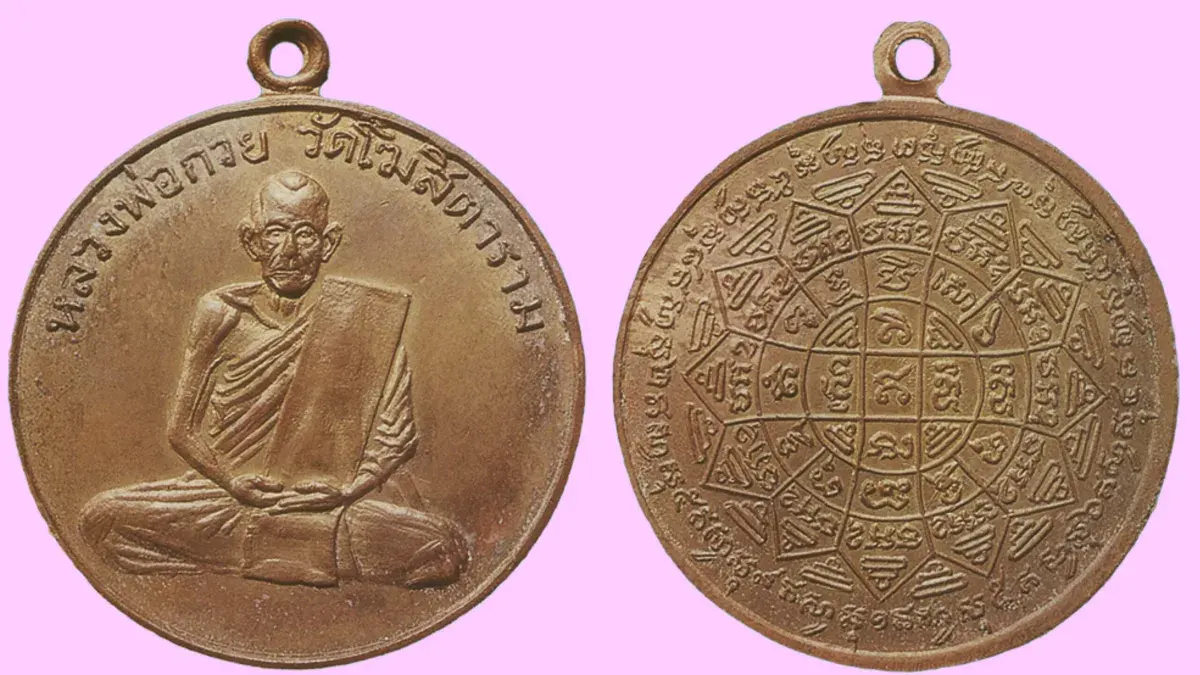
Luang Por Kuay Chutinitthro of Khositrarama Temple (Ban Kaeng Temple) in Sakhon Buri, Chainat, was a renowned monk whose reputation spread throughout central Thailand. His first-edition amulet, created in 1961, was cast from gold-plated bronze with approximately 5,000 pieces produced in a single pressing. The front depicts a full-length seated image of Luang Por, with the inscription "Luang Por Kuay, Khositrarama Temple" at the top. The reverse contains sacred yantra including the Buddha Crown Yantra, bound with Tripitaka incantations and the Trinity Mantra, surrounded by protective yantra. These amulets exist both with and without chakra marks, with marked versions being significantly rarer. At that time, the offering was just 20 baht per amulet, yet they are now extremely scarce.
Luang Por Tuan Intapanyo, former abbot of Kluay Temple in Kamang District, Phra Nakhon Si Ayutthaya, was another famous monk of the old royal capital. His most popular amulet is the 1982 edition, which is oval in shape, made from unplated copper, and produced in only 2,000 pieces. The front shows Luang Por Tuan's image with a raised border, featuring Khmer script on the left reading "Commemoration of the Ubosot Consecration Ceremony" and on the right "Kluay Temple, Ayutthaya," with the bottom inscribed "Luang Por Tuan Intapanyo." The reverse is smooth without raised borders and displays a central yantra with Thai numerals marking the year 1982. This amulet is now rare, as Luang Por Tuan meditated intensively for three months while distributing them to devotees participating in the ubosot consecration.
In 1988, Luang Por Maha Bodhi Yanasangvaro, former abbot of Khlong Mon Temple (Suwannakohtamaram) in Makham Tao District, Wat Sing, Chainat, and a successor in the lineage of Luang Pu Suk Kaserao, commissioned an ancient-style cast amulet in brass—both small and large editions—as a commemorative piece. Shaped as a bowl with a horizontal loop and made from brass, produced in limited quantity, the front features a raised border with a central image of Luang Por Maha Bodhi seated with both hands resting on his knees, while the reverse is smooth and borderless. Luang Por Maha Bodhi consecrated these intensively for three months, adding his handwritten seal reading "Buddha Rolls the World" guided by the Pali phrase "Itipi So." This edition was produced in small numbers and is rare, highly prized by amulet collectors.
Phra Mettavihari (Pad Thammatho), former abbot of Tham Kuhasuwan Temple in Phasi Charoen District, Bangkok, was a renowned monk who created amulets bearing his likeness in only two editions throughout his life. The first edition, created in 1959, was a half-length figure amulet made from copper, initially plated with silver. When supplies ran out, further copies were pressed and gold-plated instead, totaling 5,000 amulets, all consecrated intensively over three months. The amulet features the Sema form with integral loops, showing a half-length image of Phra Mettavihari on the front with raised Thai script reading "Phra Mettavihari Thera" below, surrounded by a decorative peacock border. The reverse is smooth with a five-Buddha yantra in the center and raised Thai script reading "Abbot of Tham Kuhasuwan Temple, Thonburi." The second edition, created by his disciples in 1963, is rectangular in full-length form, made from alpaca metal, and produced in 1,000 pieces.