Luang Pu Yod's Life and Legacy at Wat Kaew Charoen
The article profiles Luang Pu Yot Chinwongso (Phra Khru Sunthorn Thamakit), the former abbot of Wat Kaew Charoen in Amphawa, Samut Songkhram. It details his life from a merchant's son in Ratchaburi to a revered monk who rose through ecclesiastical ranks, revitalized an ancient Ayutthaya-era temple, and made it famous for traditional bone-setting treatment. His legacy includes advancing monastic education and serving as a key religious leader in the Mae Klong basin for decades.
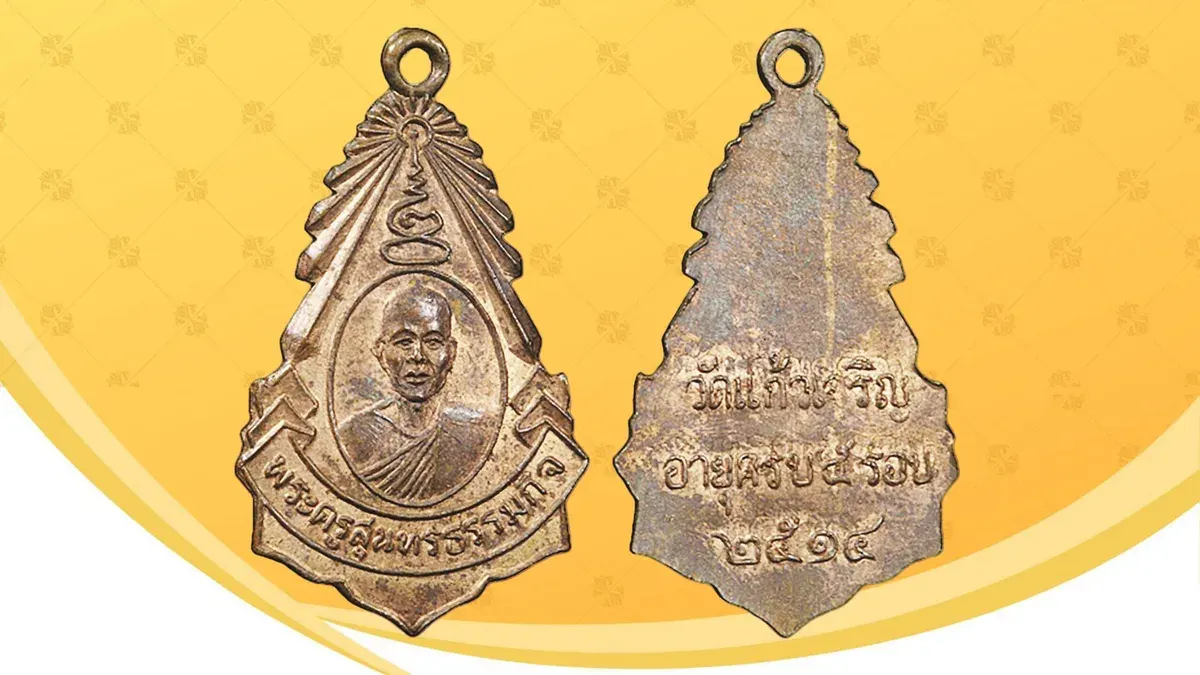
Luang Pu Yot Chinwongso, also known as Phra Khru Sunthorn Thamakit, former abbot of Wat Kaew Charoen in Amphawa, Samut Songkhram, was a revered monk of the Mae Klong River basin. His lay name was Sunthorn Chutimas. He was born on Tuesday, May 16, 1911 (BE 2454) at Bang Noi Market (opposite the Chao Pho Rong Khaan Shrine) in Ta Luang Subdistrict, Damnoen Saduak District, Ratchaburi Province. His family were merchants. In his youth he studied with his father until he could read and write, and later helped his mother with trading to support the family.
At age 18 he entered the novitiate under Phra Khru Plian Suwannachoto, abbot of Wat Kaew Charoen, on July 16, 1929 (BE 2472). At age 20 he received full ordination on May 8, 1931 (BE 2474) with Phra Ratchamongkhon Wuthachan (Jai) of Wat Sed as preceptor, Luang Pho Plian Suwannachoto as kammavaca acharya, and Phra Khru Udom Sutakit (Phon) of Wat Pramot as annusavana acharya. He received the monastic name Chinwongso, meaning 'descendant of the Buddha.'
He pursued Pali studies diligently on his own, passing the third-level Parian exam in 1935 (BE 2478) and subsequently the three levels of Nak Tham examinations. He attended his preceptor Phra Khru Plian closely during his illness until the latter's death on August 16, 1941 (BE 2484).
The next day, Phra Ratchamongkhon Wuthachan, the district ecclesiastical chief, appointed him acting abbot of Wat Kaew Charoen and acting chief of the Muang Mai subdistrict. Wat Kaew Charoen is an ancient temple of the Raman community built in the Ayutthaya period and long abandoned. Legend says villagers from Ta Yai in Ayutthaya fled the Burmese sack of 1767 (BE 2310), found the overgrown site with a ruined ordination hall, many laterite Buddha images, a glass Buddha image, and a bronze Buddha without robes. Two ruined Raman chedis remained. The villagers moved about 5 sen (approx. 2 km) away and founded a new village named Ta Yai.
In 1897 (BE 2440) Phra Athikan Tai restored the temple. The glass Buddha became the principal image, and locals called it Wat Kaew (Glass Temple). It was officially established as Wat Kaew Charoen in 1932 (BE 2375) and received the royal boundary marker (Wisungkham Sima) on March 4, 1986 (BE 2529).
In 1944 (BE 2487) he was fully appointed abbot and chief of the Muang Mai–Wat Pradu subdistrict. After assuming the post he developed the temple extensively, including operating a clinic for various ailments. Most famously, the temple became renowned for traditional bone-setting; in those days almost anyone with a broken arm or leg came to Wat Kaew Charoen for treatment.
He received successive royal ecclesiastical ranks: Phra Khru Sanya Batr Tri (third class) with the name Sunthorn Thamakit in 1948 (BE 2491), served as preceptor from 1956 (BE 2499), elevated to Phra Khru Sanya Batr Tho (second class) in 1964 (BE 2507), and to Phra Khru Sanya Batr Ek (first class) in 1974 (BE 2517), retaining the name Sunthorn Thamakit.
His educational contributions included serving as dean of Nak Tham studies for all three levels and as a member of the Amphawa District Dhammaduta Committee. In propagation work he acted as preceptor for novitiate and full ordinations, governed the monastic community at Wat Kaew Charoen, and trained novices and monks in disciplinary conduct and daily routine.