Minister Orders Bryde's Whale Monitoring After Dead Whale Found
Thailand's Natural Resources Minister has ordered close monitoring of Bryde's whales in the upper Gulf of Thailand after a dead sub-adult male was found near the Samut Sakhon-Phetchaburi border. Necropsy showed the whale was in excellent condition but had abrasions and foreign objects in its intestines; cause of death remains undetermined. Authorities urge boaters to slow down and keep distance to prevent strikes on the endangered whales.
On November 7, 2026, Natural Resources and Environment Minister Suthep Chumklin emphasized the importance of conserving and protecting rare marine animals. He directed the Department of Marine and Coastal Resources (DMCR) to closely monitor and track the situation of Bryde's whales in the upper Gulf of Thailand. He also called for cooperation from the public and boat operators to increase vigilance while navigating to prevent accidents that could affect Bryde's whales.
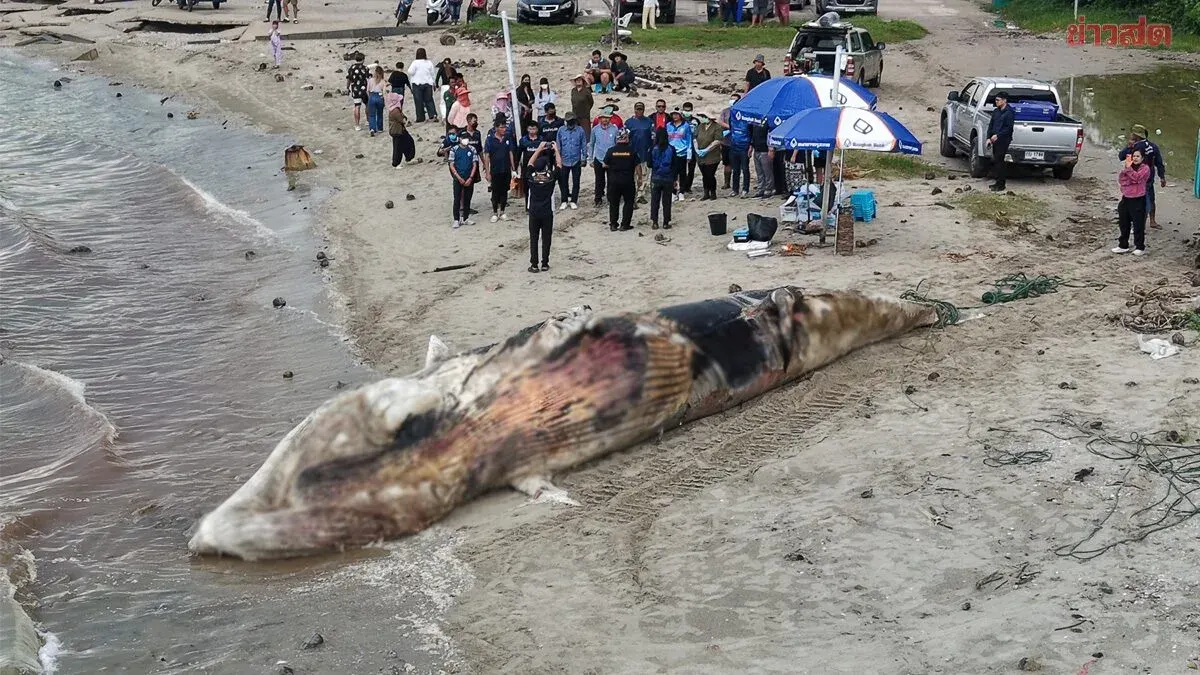
Between November 6-7, 2026, officials from the Upper Gulf of Thailand Marine and Coastal Resources Research Center, together with Marine and Coastal Resources Office 3 (MCRO 3) Phetchaburi Province, Laem Phak Bia Subdistrict Administrative Organization, the Upper Gulf of Thailand Conservation Network, and volunteers, conducted a necropsy on a Bryde's whale carcass. This followed a report from Jamrun Phongphitak on November 5, 2026, about a dead whale found in the middle of the sea at the border between Samut Sakhon and Phetchaburi provinces.
Examination confirmed it was a male Bryde's whale (Balaenoptera edeni) in the sub-adult stage, measuring 11.20 meters in length. The carcass was decomposed with skin sloughing off. The veterinary necropsy revealed the whale had an excellent body condition with a blubber thickness of 6.5 centimeters. Abrasions approximately 2.5 meters long were found on the left side of the body, along with minor bruising on the mid-dorsal muscle. The cardiovascular system and respiratory system showed no abnormalities. A large amount of food was found in the stomach, and foreign objects were discovered in the intestines, including a piece of processed wood about 8 centimeters in size and seeds. The liver, kidneys, and pancreas were decomposed.
The necropsy could not definitively determine the cause of death, as no pathological lesions indicating a specific cause were found. It is suspected the whale may have died suddenly, given its excellent pre-death body condition. Officials collected tissue and organ samples for further laboratory analysis.
The DMCR requests cooperation from the public, fishers, and boat operators in the area to reduce speed, maintain a safe distance, and avoid approaching or disturbing Bryde's whales when encountered. This aims to prevent boat strikes and reduce impacts on the rare marine animals. The DMCR will continue to monitor and track the situation of Bryde's whales in the upper Gulf of Thailand continuously. All sectors can participate in monitoring and report sightings of rare marine animals that are stranded or in distress, to jointly care for and conserve Bryde's whales and Thailand's marine resources sustainably.