MP Prasit Proposes Four-Stage Budget Plan, Criticizes Budget Bureau
List MP Prasit Watsarasin urged Parliament to restructure the FY2028 budget around four life stages — early childhood, basic education, higher education, and working age — and accused the Budget Bureau of blocking the 600-baht child allowance. He called for fairer school funding formulas, Student Loan Fund reform, and coordinated workforce upskilling, demanding the government shift money from low-priority items and make agencies plan jointly.
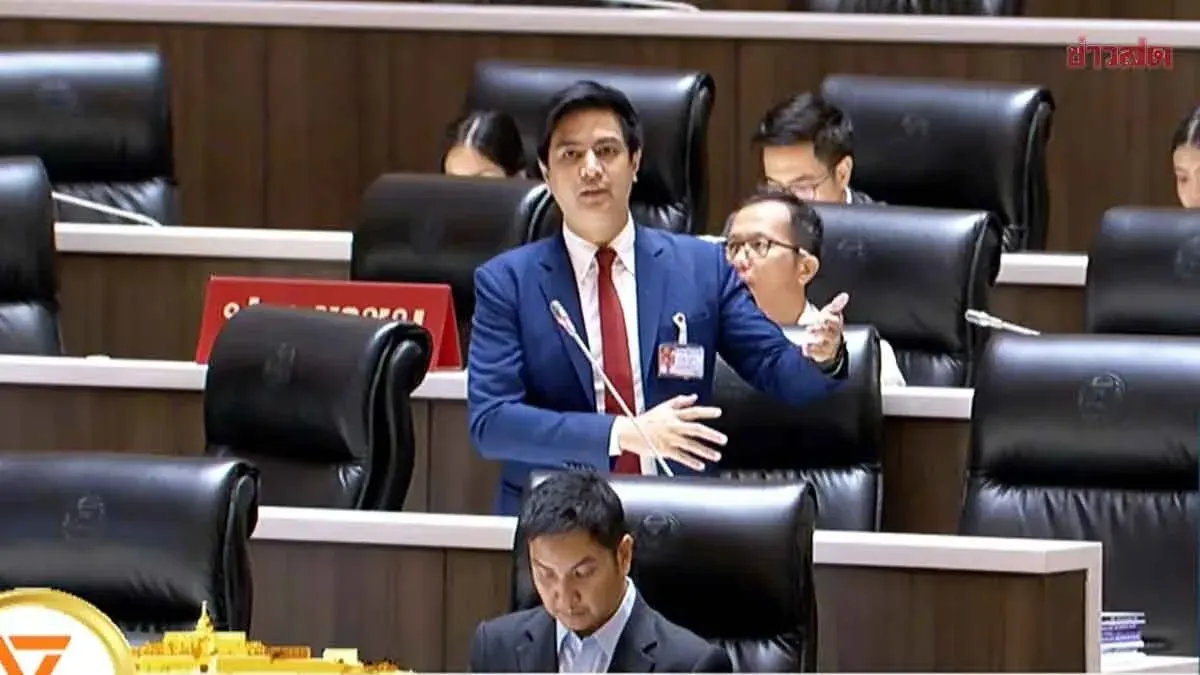
MP Prasit Watsarasin proposes allocating the budget across four age groups and criticizes the Budget Bureau for blocking the 600-baht child allowance, questioning who the real prime minister is. On November 20, 2026, at Parliament, a special House session considered a motion asking Parliament to study and provide opinions before drafting the FY2028 annual budget for the Cabinet. At 3:20 PM, list MP Prasit Watsarasin of the Prachachon Party debated, proposing a budget allocation method for citizens in four life stages. First, early childhood: he noted that annual budgets have not allocated funds to expand the universal 600-baht child welfare allowance, as politicians repeatedly claim the Budget Bureau refuses. "As the minister cut in at the start of the motion, saying the real PM is the Budget Bureau director, I don't know if the minister thinks the PM is Anutin Charnvirakul or Kanjanok Kanjanomai, the Budget Bureau director. At least this House now has a chance to debate before drafting the budget; this is the first time, which will let us successfully push for small universal payments," Prasit said.
Second, basic education: the budget problem isn't just funding but allocation efficiency, such as the school subsidy formula based mainly on student numbers, disadvantaging small schools. Recently, the Education Minister acknowledged in a post that a new formula will be used in the FY2028 budget to calculate subsidies more fairly for each institution. Prasit added two suggestions: the government should maximize the subsidy framework by shifting less-essential Education Ministry funds, and revise the teacher quota calculation formula per institution.
Third, higher education: the Student Loan Fund (Kor Yor Sor) still has access inequality. He urged the government to pursue two parallel tracks: replenish the fund so youth don't lose educational opportunities, and reform it for sustainability by making repayment income-contingent, which requires inter-agency data linkage to verify borrowers' incomes.
Fourth, working age: budgeting for workforce upskilling is good but currently fragmented across agencies. He hopes this year the government won't let agencies each create their own projects, but will bring relevant agencies together to plan from the start: how much to invest in upskilling, how to design budget support to meet market needs.
Prasit emphasized his proposals don't demand increasing budgets for every agency involved in human capital development, but urge the government to boldly review allocation methods: shift funds from lower to higher priorities, devise new formulas despite controversy, and force overlapping agencies to jointly plan projects from the outset rather than acting separately. "If this succeeds, we hope..."