AI Decodes Muay Thai Masters' Mastery, Builds Fair Royalty System
The MUAY THAI INTELLIGENCE project, led by Dr. Naphat Phuttharatanamani, uses AI and motion tracking to digitally preserve the mastery of Thai boxing legends while establishing an intellectual property system to ensure fighters and their families receive fair compensation when their likeness, style, or knowledge is commercialized. Showcased at AI Expo 2026, the initiative attracted government officials and industry partners interested in applications for gaming, robotics, and AI content. The project addresses long-standing issues like that of Sak Phetchayindee, whose identity was used for decades without royalties.
Dr. Jo champions using technology and AI to decode the deep expertise of Thai boxing legends across eras, while creating an intellectual property management system to ensure the value generated flows back to fighters and their families fairly.
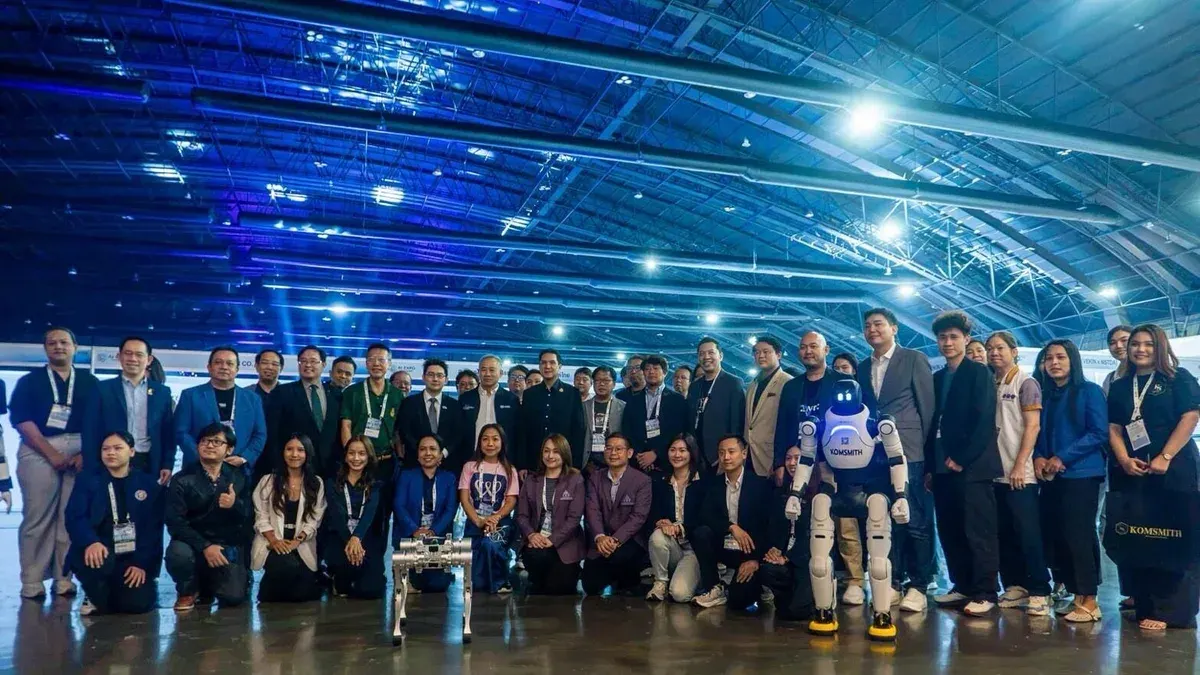
The MUAY THAI INTELLIGENCE booth at AI Expo 2026 drew interest from media, researchers, tech entrepreneurs, game companies, and content producers studying the use of data, motion tracking, and AI to decode the wisdom and expertise within Thai boxers.
Recently, Danuporn Punna, Deputy Minister of Higher Education, Science, Research and Innovation, and Dr. Jenkrit Kanatharanan, Director of the Competitiveness Enhancement Fund Management Unit, visited the booth to hear the concept and see a demonstration. Throughout the event, interested parties discussed collaboration in gaming, humanoid robotics, digital media, and AI content.
Dr. Naphat Phuttharatanamani, or Dr. Jo, developer of the MUAY THAI INTELLIGENCE concept, said the goal is not to use AI to make Muay Thai smarter because that intelligence has existed in Muay Thai for a long time.
Champions are not great just because they punch hard or kick well; they read opponents, anticipate, choose timing, decide, and adapt in split seconds. These are Mastery — understanding born from repeated training and experience until it becomes instinct.
What the project wants to capture is not just techniques but ways of thinking, reading the fight, decision-making, and the unique identity of each champion.
The next goal is to create a Digital Legacy of Thai boxing legends of every era: fight histories, photos and videos, interviews, knowledge, signature motions, plus 3D and motion data so that Mastery once confined to individuals can be studied, learned, and passed to future generations.
MUAY THAI INTELLIGENCE gives as much importance to rights of the wisdom owners as to technology.
One interview reflecting this problem clearly is with Sak Phetchayindee, who recounted how his name, image, and identity-linked style have been used to create value in popular culture for decades, yet he never received compensation.
This case raises a critical question for the new era: if a fighter's name, identity, story, fighting style, or Mastery is used to create games, digital characters, AI content, films, or even robots, who should receive the value generated?
Dr. Jo said: I don't want to see legends spend a lifetime building a name, identity, and wisdom, only to have no system that returns value to them or their families when those assets create value in the new world.
The MUAY THAI INTELLIGENCE concept is therefore not just about building a database but developing an IP and rights management system for legends alongside it.
Muay Thai may be Thailand's shared heritage, but the name, identity, story, and value each fighter creates over a lifetime must be managed fairly.
Because in the future, a legend's digital character may be in a game, their motion used to develop robots, their thinking turned into curricula, and their knowledge used to train AI.
If value arises from these, fighters and heirs should benefit from what they created.
This makes MUAY THAI INTELLIGENCE view AI not as an endpoint but as a connecting tool: HERITAGE MASTERY KNOWLEDGE DATA IP NEW VALUE.