New Giant Rodent Fossil Named After Princess Sirindhorn
Thai and international researchers have discovered a new giant rodent fossil species, Yakamys sirindhornae, dating back 33-35 million years in Krabi's Bang Mark lignite mine. Weighing around 30 kg, it is the largest known Paleogene rodent and proves gigantism evolved 15-20 million years earlier than previously thought. The species was named in honor of Princess Maha Chakri Sirindhorn with royal permission, marking the fifth fossil to receive such distinction.
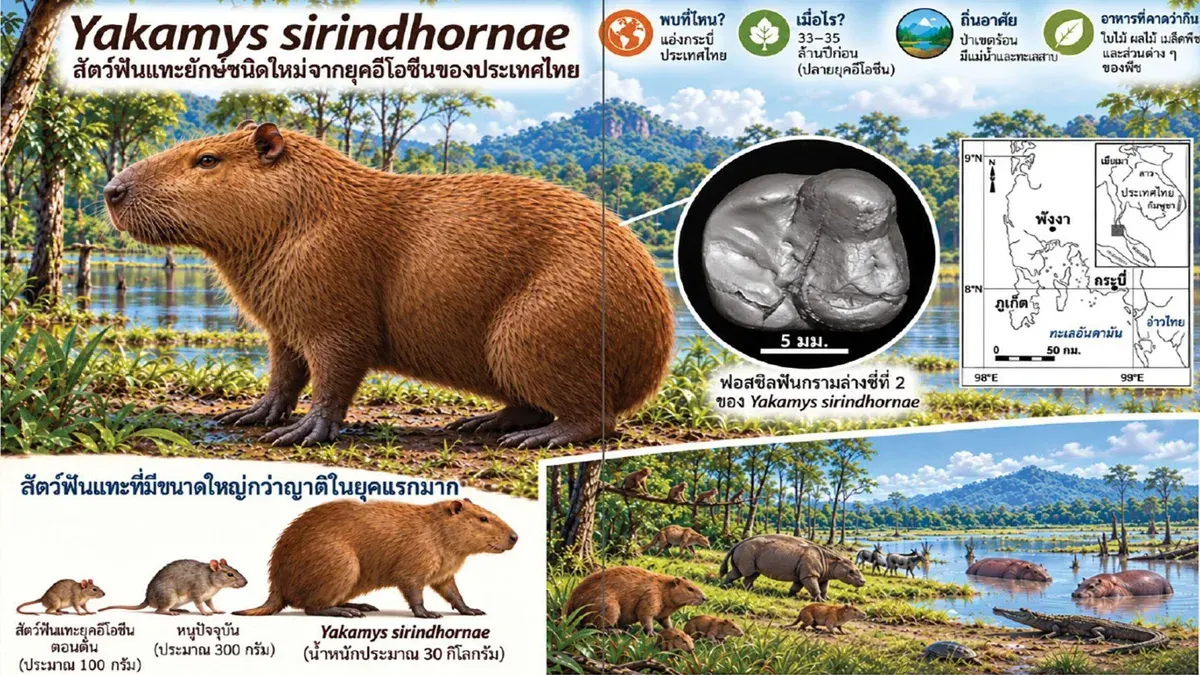
The "Sirindhorn Giant Mouse" fossil, royally named and dating back 35 million years, was announced by Natural Resources and Environment Minister Supachai Chomklan as a Thai research success creating world-class knowledge.
On November 4, 2026, Minister Supachai Chomklan revealed that the Department of Mineral Resources, together with Thai and international researchers, studied fossils of a new genus and species of rodent, Yakamys sirindhornae, aged approximately 33-35 million years, from the Bang Mark lignite mine in Krabi. The research results are slated for publication in the international academic journal Scientific Reports on November 4, 2026. This is a major discovery that changes understanding of the evolution of giant rodents globally.
Minister Supachai stated that an even more important aspect of this discovery is receiving royal permission to use the name "Sirindhorn" as the species name sirindhornae, to honor Princess Maha Chakri Sirindhorn, who has continuously supported Thailand's science, geology, and paleontology. This marks the fifth fossil to receive a royally bestowed name.
This research is a collaboration between the Department of Mineral Resources and researchers from France and Canada, led by Dr. Yaowalak Chaimanee, a mammal paleontology expert from France's National Center for Scientific Research (CNRS). They studied molar and incisor fossils found in the sediment layers of the Bang Mark lignite mine in Krabi. Using advanced scientific techniques, they determined it to be an ancient rodent from the Late Eocene, weighing approximately 30 kg, making it the largest rodent ever found in the Paleogene. It serves as crucial evidence that rodents evolved large body sizes at least 15-20 million years earlier than previously understood. The fossil specimens are preserved at the Department of Mineral Resources.
"This discovery reflects the potential of the Department of Mineral Resources and Thai researchers to create paleontological knowledge alongside international research networks. It also underscores Thailand's importance, particularly Krabi's fossil sites, as a natural heritage site with world-class scientific value," Minister Supachai said.