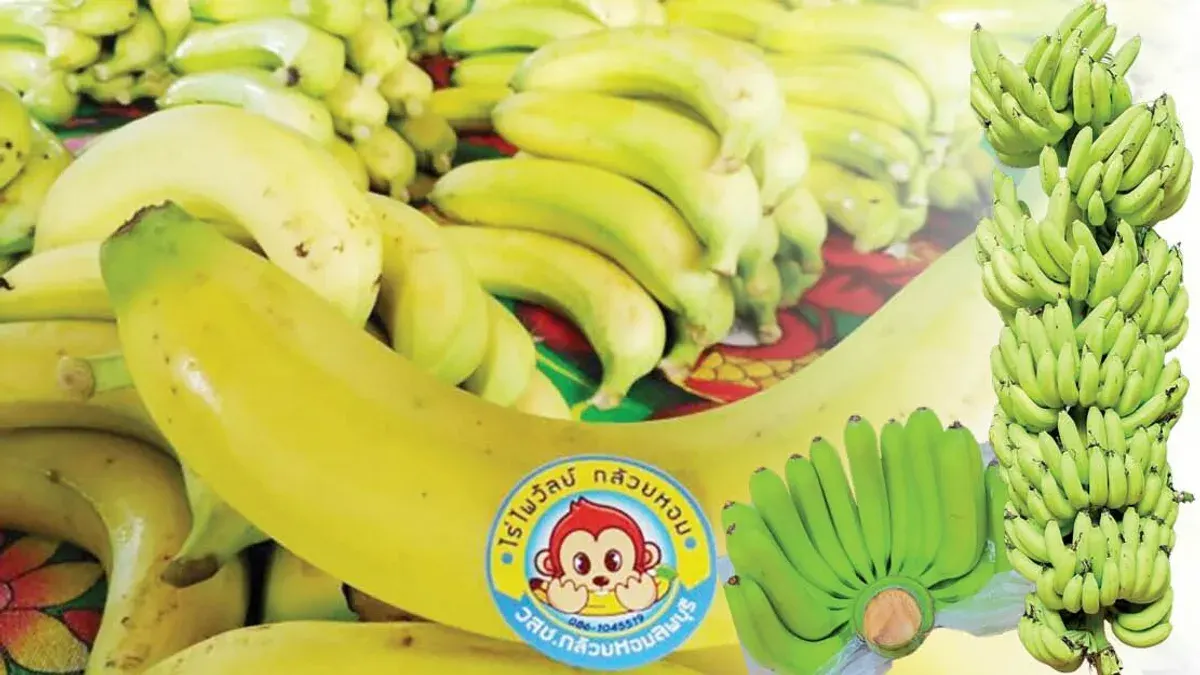
A Lopburi farmer has found financial success growing Israeli Cavendish bananas, earning up to 360,000 baht annually per rai using sustainable methods and tissue-cultured plantlets that reduce disease and pest problems.
Uncle Paiwal Jaem, a farmer from Chon Muang subdistrict in Ban Mi district, Lopburi province, is passing on his knowledge of growing "Cavendish bananas"—a venture that began as a hope to create a legacy for the next generation.
Paiwal learned agriculture from his father, a distinguished farmer, so farming became a profession he took personal pride in. After his father's death, he continued farming, starting with corn, sugarcane, and cassava, rotating to livestock during dry years. Beyond farming, he also worked as a well-digger. Over the past decade, as he felt himself aging and worried he might not live to harvest his crops, he began searching for work better suited to him—something less physically exhausting, with established market demand, and something he could pass on to his children. He became interested in banana cultivation, seeing it as a large, high-demand market.
Paiwal initially tried water bananas but was disappointed with the yields. He experimented with other varieties until discovering the Cavendish banana, a cultivar from Israel, a country renowned for agricultural technology. "Cavendish bananas are a quality variety—low in sugar, high in energy, with strong international markets, especially in Japan, so sales aren't limited to the domestic market. Importantly, you plant once and harvest for many years—you do little but gain much," he explained.
Rather than propagating from shoots, he uses tissue-cultured plantlets from quality stock to avoid plant diseases and insect problems that can affect fruit development. Before planting, he places organic fertilizer at the bottom of each hole, then plants 3 plantlets per hole, spacing them about 3 meters apart. When new shoots emerge, he removes the old ones, keeping only 3—a technique that increases yield per rai. He nourishes the soil every 6 months using no chemical inputs throughout cultivation. For irrigation, he uses a drip system powered by solar cells to reduce production costs, adjusting for climate and humidity.
"After about 5–6 months, the banana begins to flower, and another 75 days before it's ready to harvest," he noted. "One bunch has about 45 hands, each with 16–30 individual bananas. Per bunch, the price is around 300 baht. One rai yields 630 bunches, so income is roughly 180,000 baht per rai. Harvesting twice a year totals about 360,000 baht per rai—on 3 rai, that's 1 million baht. Initial investment is about 90,000 baht per rai. Although it seems like a large sum, you plant once and harvest many times. All of this comes from 10 years of trial and error, developed to the point of success." While banana growers typically use stakes to support stems against the weight of heavy bunches, Paiwal's approach differs. "At our farm, we don't use stakes because it's wasteful. We plant everything together, they grow together, and the spacing keeps sizes from differing too much."