Ratchaburi Monk Luang Pho Khan Amulet Coin Legacy
This article profiles Luang Pho Khan Buddhanano (1866-1938), a revered meditation master from Ratchaburi who served as abbot of Wat Sara Tago and Wat Ban Sing. It details his monastic education, tudong pilgrimages, temple-building projects across Thailand and Burma, and his famous sacred amulets — particularly the three-faced Brahma and the first-series portrait coins issued at Wat Sara Tago in 1962.
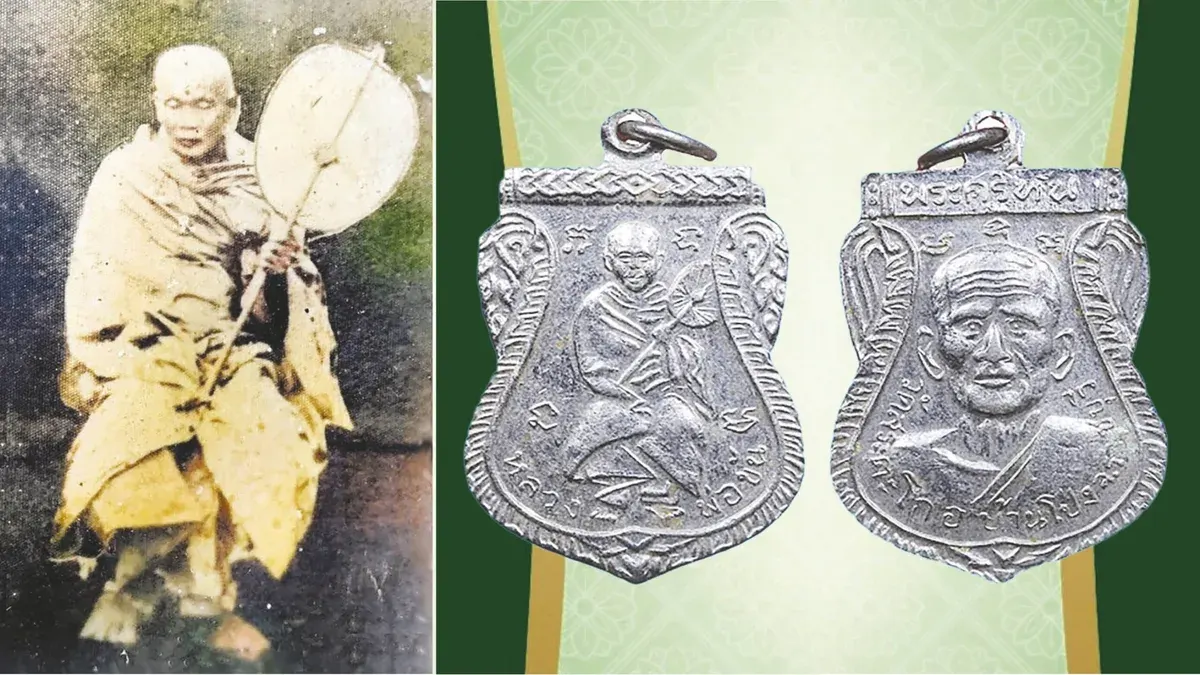
Luang Pho Khan Buddhanano, former abbot of Wat Sara Tago in Nong Pla Mo, Ban Pong District, Ratchaburi Province, and former abbot of Wat Ban Sing in Ban Sing, Photharam District, Ratchaburi Province, was a famous meditation master of Ratchaburi.
His lay name was Khan. He was a native of Ratchaburi, born in 1866 in Ban Sing, Photharam District. His father was Nai Jan (later Luang Pho Jan Chanthachot, who ordained and became abbot of Wat Ban Sing). His mother was Nang Na. He had ten full siblings and was the fourth child.
In 1887, at the age of 21, he ordained at the ordination hall of Wat Ban Sing, Photharam District, with Luang Pho Jan as his preceptor, receiving the name Buddhanano. During the rains retreats, he studied with his father, and each year undertook tudong journeys to learn from various meditation masters and practice Vipassana Kammathana.
Around 1907, he traveled to Ban Sara Tago in Ban Pong District, finding it a shady, peaceful place suitable for practice. Villagers developed faith in his conduct, invited him to stay for the rains retreat, and built a temple in 1910, naming it Wat Sara Tago after the village.
Phra Kru Han, then a junior monk of 2-3 rains, helped build the temple and teach villagers. The temple received its royal boundary markers (Wisungkham Sima) on February 21, 1927. After completion, villagers invited him to be the first abbot. He continued developing the temple until it flourished, then resumed tudong wanderings.
Later, when Luang Pho Jan passed away with no successor at Wat Ban Sing, Ban Sing villagers sought out Luang Pho Khan, who was then wandering in the Yangon region and Thai-Burmese border areas. They eventually found him and persuaded him to return as abbot.
Upon becoming abbot of Wat Ban Sing, he developed it extensively, including constructing a large, beautiful Thai-style ancient sermon hall showcasing the diligence of that era's Ban Sing villagers. He sourced timber from Ratchaburi's great forests, transporting it by oxcart to build the hall that stands today.
He also restored the old vihara, built a group of twelve chedis to house ancestors' relics, constructed three groups of kutis, ten individual kutis, and a road (monks' infirmary), though the latter has since been demolished, leaving only memories.
Beyond Wat Sara Tago and Wat Ban Sing, he established monasteries in many other locations, including Wat Khun Thai Thararam in Thamaka, Kanchanaburi; Wat Yang Hak in Ban Pong, Ratchaburi; and one or two temples in Yangon, Burma.
In 1938, after the rains retreat, he set out on his annual tudong to pay homage to relics in Yangon. Upon reaching the Thakilen area in Sai Yok District, Kanchanaburi, he fell ill with jungle fever. The condition worsened and he passed away in 1938 at age 72, with 51 rains.
During his life, he created many sacred amulets and talismans. The most famous is the Three-Faced Brahma. Equally popular are the first-series portrait coins issued at Wat Sara Tago in 1962, after his death, for distribution to...