Thailand-China Human Rights Seminar Highlights People's Happiness as Core
Thailand and China held a landmark human rights seminar at Srinakharinwirot University involving seven leading institutions from both countries. The event emphasized President Xi Jinping's view that people's happiness is the supreme human right, and focused on poverty alleviation, social welfare, and regionally grounded rights development. A translated volume on Xi's human rights philosophy was exchanged, strengthening academic and think-tank ties between the two nations.
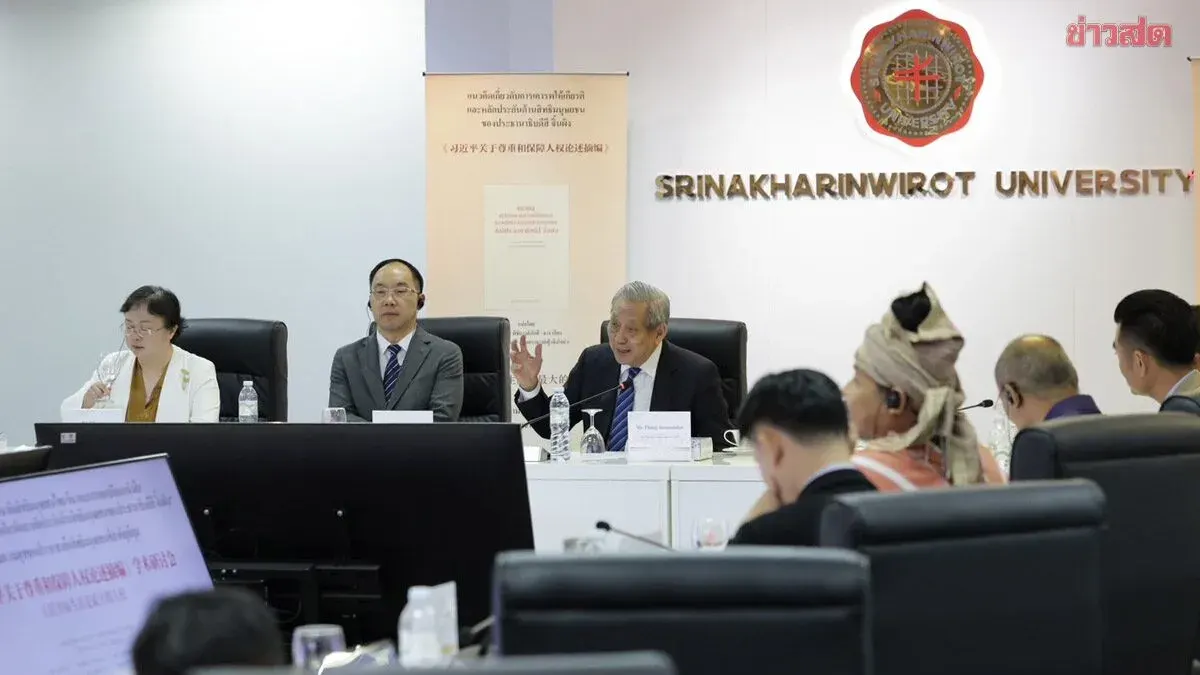
Thailand and China have united seven premier institutions to convene a historic academic seminar on human rights concepts at Srinakharinwirot University (SWU). The gathering included a book exchange ceremony for "Thoughts on Respecting and Safeguarding Human Rights by President Xi Jinping," under the central theme "A Happy Life for the People Is the Greatest Human Right."
The unprecedented academic forum assembled professors and researchers from Thailand's top universities — Kasetsart, Thammasat, SWU, and Surat Thani Rajabhat — alongside strategists, civil society representatives, and high-level Chinese delegates. Participants brainstormed lessons for advancing human rights in ways aligned with Asia's social, historical, and cultural foundations, with a focus on eliminating poverty, ensuring economic security, and delivering basic welfare tangibly to the people.
The book exchange also marks a major step in linking think-tank networks and higher-education institutions between the two nations, opening doors for Thai scholars to study China's policy thinking from primary sources and fostering sustainable regional understanding and cooperation.
Pinij Charusombat, President of the Thai-Chinese Cultural Council and Relations Promotion, delivered a keynote stressing that human rights must begin with respect for human dignity; without mutual understanding, oppression and rights violations follow. He traced historical wounds from the Chinese resistance against invasion, the Indochina wars, the Vietnam War, Middle East conflicts, to the Russia-Ukraine war — all stripping life, hope, and happiness from the innocent.
Pinij also outlined China's development trajectory through successive leaders from Mao Zedong to Xi Jinping, moving from nation-building through reform and opening up to an era of innovation, technology, and total poverty eradication. "China's development path centers on the people, coupled with the virtue, integrity, sacrifice, and responsibility of its governors. However, applying China's experience to Thailand requires careful, all-round consideration of successes, limitations, and historical lessons from each era," he said.
Professor Xia Wei-hua, Director of the International Organization Research Center at the Human Rights Institute of Southwest University of Political Science and Law, highlighted two keywords: "development" and "cooperation." He praised the Thai way of life and Bangkok's cultural diversity and work-life balance. Xia stated that human rights protection must be tied to people's real lives, including the right to subsistence and development, and that China's modernization offers a new model for developing countries.