Thailand Faces Super-Aged Society Within 5 Years
Thailand will become a super-aged society within five years as births plunge and deaths surge, threatening labor supply and economic productivity, the Industry Minister warned while calling for the cement sector to lead the nation's transit
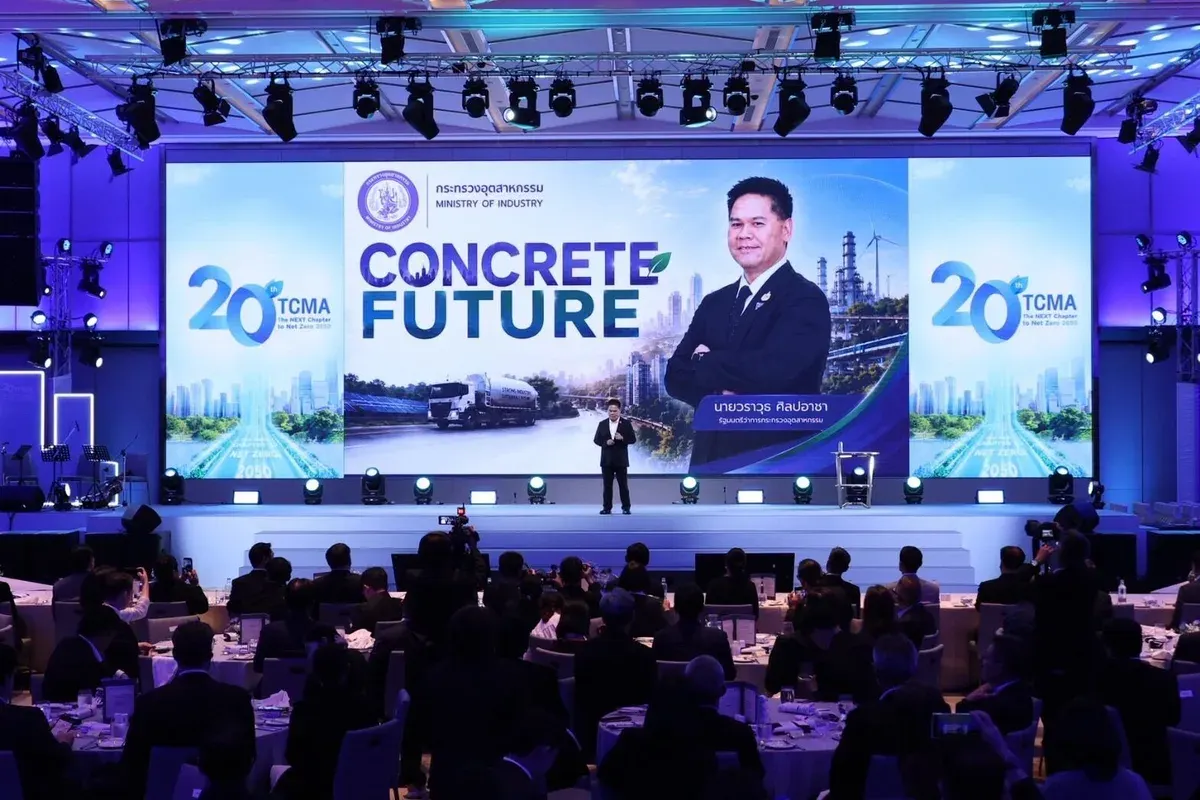
Industry Minister Varawut Silpaarch delivered a keynote address titled "ONE MIND, Shared Future: Toward Net Zero 2050" at the Thai Cement Manufacturers Association's (TCMA) 20th anniversary celebration, held at the Grand Centre Point Prestige Hotel in Bangkok. He emphasized that the cement industry stands at a critical juncture for Thailand, serving not only as a foundational industry supporting infrastructure and economic development, but also playing a crucial role in reducing Thailand's greenhouse gas emissions.
The Ministry of Industry is accelerating the industrial sector's transition to a green economy under the Net Zero 2050 target. Future competitiveness will no longer be measured solely by production costs, but by the ability to reduce carbon emissions, manage resources efficiently, and operate according to ESG principles—increasingly becoming a prerequisite for global trade.
As a high-emission industrial sector classified as Industrial Process and Product Use (IPPU), the cement industry must lead the transition to a low-carbon economy. The Ministry is pushing support measures across the entire value chain, including Smart and Green Mining projects, reducing clinker content, developing new low-carbon cement variants like LC3 (Limestone Calcined Clay Cement), and piloting carbon capture technology to align Thai industry with global standards.
The industrial sector is facing a "Poly Crisis"—a complex crisis across four dimensions directly impacting costs and competitiveness: geopolitical and geoeconomic instability affecting energy and raw material prices; climate and environmental challenges increasing pressure on manufacturing; non-tariff trade barriers such as the European Union's Carbon Border Adjustment Mechanism (CBAM); and structural demographic changes reducing the country's quality workforce.
"The most concerning issue is Thailand's entry into a super-aged society within the next five years," Varawut warned. "In 2024, Thailand recorded only around 400,000 births while experiencing over 500,000 deaths, resulting in a total fertility rate of just 0.8—among the world's lowest. This could significantly impact labor supply and long-term economic productivity."
Over the next 20 years, the Thai cement industry will undergo major transformations across three dimensions: transitioning from traditional cement to low-carbon and zero-carbon cement; developing a comprehensive circular economy where cement plants become processing hubs for municipal waste and industrial byproducts as alternative energy and raw materials; and upgrading to smart factories utilizing AI, robotics, and automation to increase production efficiency and address labor shortages.
Varawut emphasized that ESG is no longer merely corporate social responsibility—it is now a "License to Operate" for future business. "Companies that fail to adapt to environmental and carbon standards risk losing their competitive edge in global markets," he concluded.