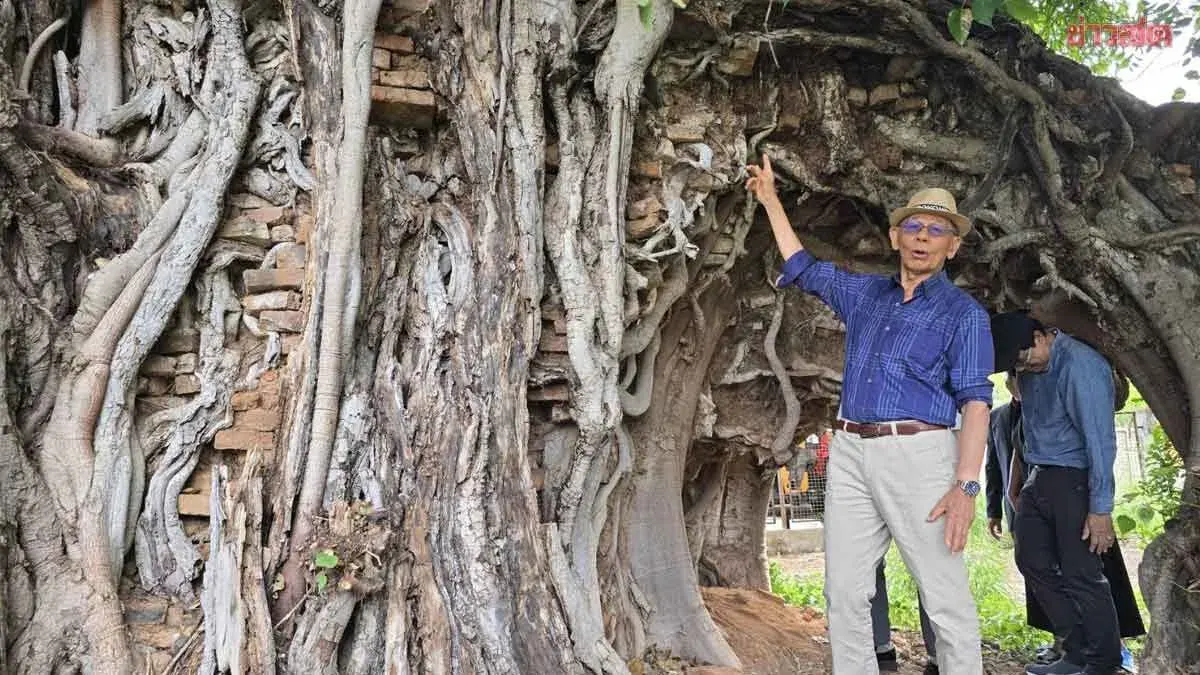
Archaeologists in Nakhon Ratchasima have discovered an ancient city wall previously missed in surveys, found remarkably preserved around a large bodhi tree near Panlaan Tan Panja road. The brick structure, being analyzed to establish its ti
Archaeologists have discovered a previously unknown ancient city wall at Nakhon Ratchasima after excavations unearthed significant evidence. The site, embraced by a large bodhi tree, is being prepared for development as a historical landmark. On August 6, 2025, excavation progress was reported on the eastern side of the ancient Nakhon Ratchasima city wall near Panlaan Tan Panja road in Nakhon Ratchasima municipality, continuing to generate excitement. The discovery follows archaeologists unearthing an ancient city wall not found during a 2567 survey, which at that time yielded only ancient human skeletons and numerous ornaments—both ceramic vessels and gold ornaments—dating back approximately 2,500–1,500 years to the pre-historic era, confirming that the current site of Nakhon Ratchasima was once home to a large settlement. The 2567 excavation did not reach the city wall's foundation, prompting a new excavation pit opened approximately 200 meters away.
Excavation began on July 20, 2025, with a pit measuring approximately 2 x 10 meters, eventually revealing the ancient brick city wall. Brick samples were sent to the United States and Kasetsart University for age verification. Researchers from Silpakorn University aim to connect archaeological history with the construction materials used for the wall to establish a historical timeline of Nakhon Ratchasima Province.
Most recently, the ancient brick city wall was found surrounded by a large bodhi tree, revealing an evocative image of a "wall through time" that continues to tell the story of Khorat through centuries. Wannapong Palakavong Na Ayutthaya, a senior archaeologist at the Silpakorn Office 10 in Nakhon Ratchasima, revealed that this excavation project is a collaboration between Silpakorn Office 10 and Nakhon Ratchasima Municipality as an important study of the Nakhon Ratchasima city wall for the first time in over 20 years.
The excavation is a critical step before landscape improvement of the moat area according to academic standards, which require archaeological evidence verification before project implementation. Since the area is part of the old Nakhon Ratchasima city, the discovery of the eastern city wall—not found in the 2567 survey—represents a significant achievement in studying the city's history, following continuous study of the city wall since 1999 before a gap of over 20 years.
Beyond the city wall, evidence of human settlement from the pre-historic Samrit period through the iron age and historical period was found, including animal bone fragments, pottery vessels, charcoal, shell ash, and shells, reflecting the lifestyle and livelihood of people approximately 1,500–2,500 years ago. Although some areas were damaged by past land use, destroying portions of ancient soil layers, the city wall discovery remains critical evidence for studying Nakhon Ratchasima's history.
Archaeologists are currently collecting organic samples from beneath the brick foundation, including bricks showing rice husk marks, for scientific age analysis to clarify the construction period of the city wall, gates, and fortifications for the first time. Expanding the excavation pit has revealed the city wall extending from north to south, consistent with historical records. Dr. Wannarath Chanyunakoln, mayor of Nakhon Ratchasima Municipality, stated that this project is a collaboration among multiple agencies to prepare for development of the moat area.