Toxic Contamination Found in 10 Aquatic Species in Kok River
Three Thai government agencies are collaborating after toxic contamination was found in 10 aquatic species in the Kok River across Chiang Mai and Chiang Rai. Officials warn against consuming bottom-dwelling animals from affected areas and have launched a flag-based warning system for local aquaculture farmers.
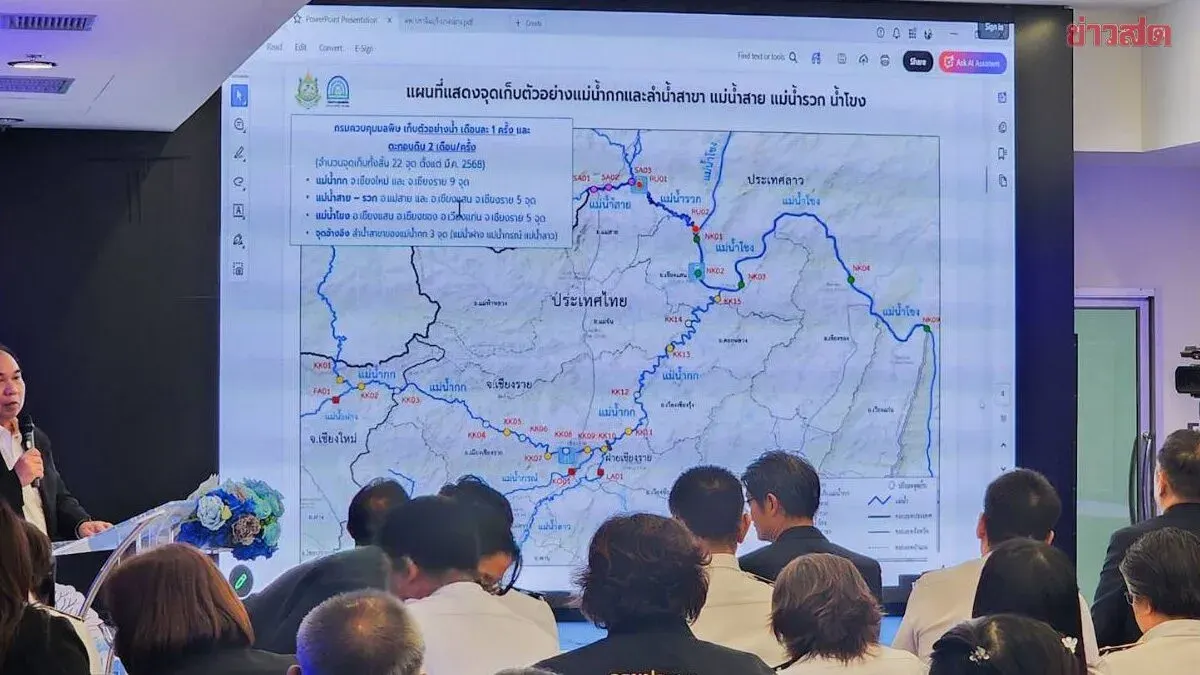
Authorities have discovered 10 species of aquatic animals contaminated with toxic substances in the Kok River spanning Chiang Mai and Chiang Rai provinces, warning the public not to consume them as three agencies collaborate to investigate, fearing impacts on the aquatic food chain.
On November 23, 2026, at the Department of Marine and Coastal Resources (DMCR) at the Government Complex Chaeng Watthana in Bangkok, Phetrat Laithong, Deputy Permanent Secretary of the Ministry of Natural Resources and Environment, acting Director-General of DMCR, along with Surinth Warakijthamrong, Director-General of the Pollution Control Department (PCD), and Pinsak Suraswadi, Director-General of the Department of Fisheries, attended a meeting to discuss integrated solutions for water quality and contaminant issues in aquatic animals. The meeting aimed to exchange factual data and inspection results to determine remediation measures and mitigate impacts on the public.
Pinsak stated the joint meeting aimed to exchange information, clarify the problem situation, and share each agency's measurement results covering environmental aspects, water quality, and aquatic animals in the river. The goal is to establish safety for those farming aquatic animals in the river and assess impacts on the marine environment, leading to a monitoring, inspection, and early warning system for coastal aquaculture farmers.
Regarding public concerns about consuming aquatic animals, particularly in northern areas along the Kok River where toxic substances exceed standards, inspections found significant contamination in sediment. This puts bottom-dwelling animals or those feeding near the sediment at risk, such as shellfish or bottom-feeding fish.
From random testing of 300 aquatic animals, 10 species showed contaminant levels exceeding standards, including: freshwater prawns, cherry clams, bitter clams, freshwater cockles, freshwater venus clams, gobies, climbing perch, yellow catfish, northern black catfish, and high-fin catfish.
The Department of Fisheries Director-General noted that living organisms naturally have mechanisms to convert some toxins into organic substances and excrete them in the short term, but concerns remain about long-term accumulation of contaminants. He recommended avoiding consumption of aquatic animals from contaminated areas. Species inhabiting mid-water and surface layers can be consumed, but internal organs should be avoided as they accumulate various substances.
For remediation, plans include inspecting fish in cages, especially in the Mekong River, and from additional fish farms to classify safe farms and risk areas. Safe and risk zones will be designated using a green, yellow, and red flag system based on detected values to warn local residents. If farms are affected by highly contaminated river water, assistance will be provided to modify farming methods or promote suitable alternative aquaculture practices.
Additionally, the impact of contaminants on aquatic life cycles must be studied, including reproduction and whether effects transfer to offspring, as no clear data confirms chain effects.
Regarding the 'Pla Ka' (catfish) issue in the Mekong basin and tributaries, where fish skin abnormalities were found, Pinsak confirmed this is unrelated to water pollution but caused by leaf parasites causing inflammation and skin lesions. However, consumption of this species should still be avoided as they are bottom-dwellers and carry parasites.